NMN is the most famous longevity supplement in the world. It is also the one with the widest gap between what it does in a blood test and what it does in a person. That gap just got wider. A new trial from the University of Tokyo, published September 25, 2026 in npj Aging, is the longest and highest dose test of NMN yet: 1,250 mg a day for 24 weeks in 62 adults aged 65 and older. Blood NAD+ went up and stayed up. Hearing, the trial's primary outcome, did not improve. Physical performance did not improve either.
This is the 4th longevity molecule reviewed today, and the pattern has held all day: Klotho, Spermidine and Ergothioneine all raised a marker without moving a human outcome. NMN now joins them, with the strongest test yet, and the strongest null result yet.
The short version
- NMN reliably raises blood NAD+ and related metabolites in every human trial that measured it, at doses from 250 to 1,250 mg a day.
- The new 2026 trial, 62 adults aged 65 and older, 1,250 mg a day for 24 weeks, found no significant improvement in hearing, its primary endpoint, or in physical performance.
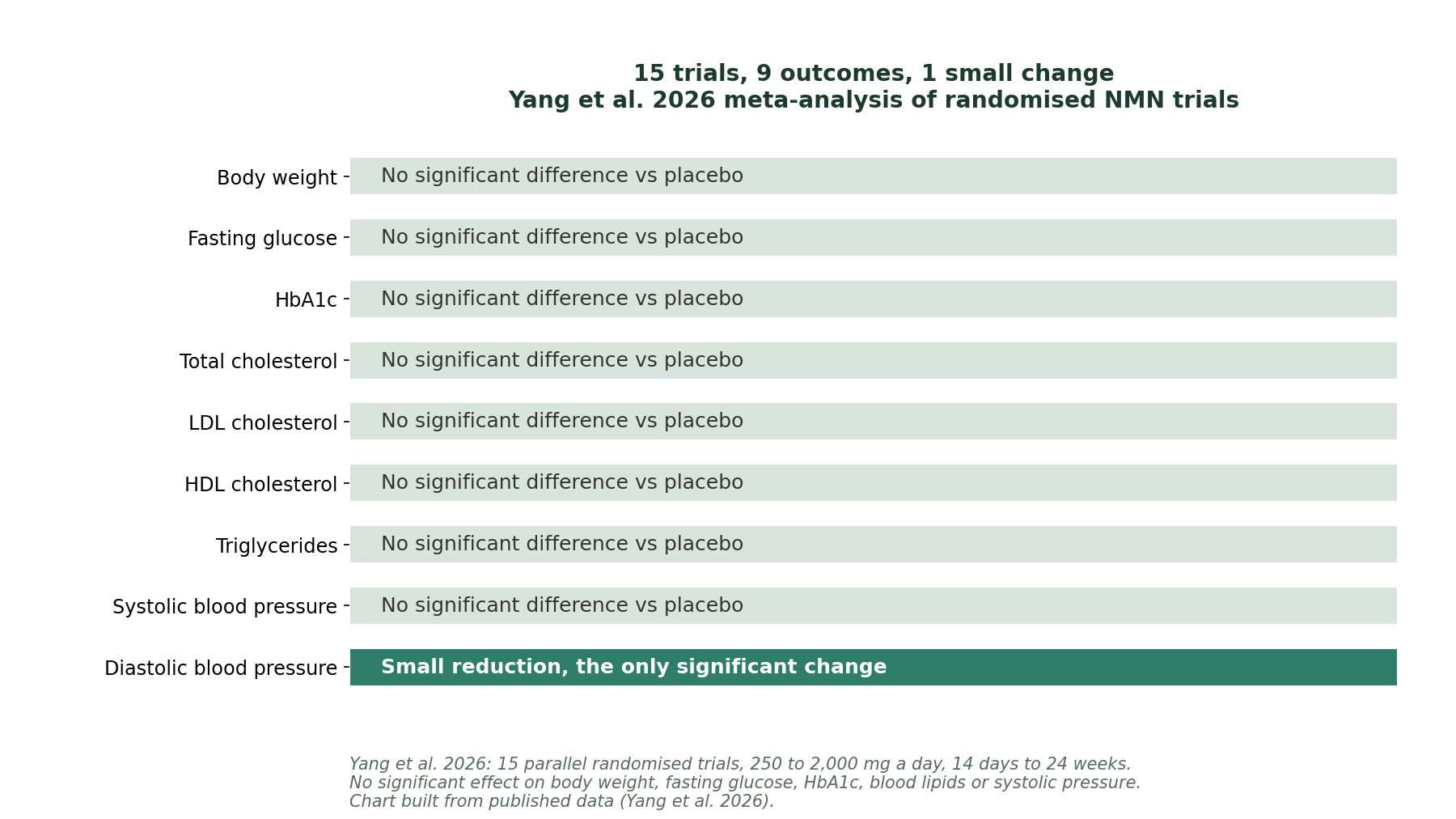
- A 2026 meta-analysis of 15 randomised NMN trials found no significant effect on body weight, fasting glucose, HbA1c, blood lipids or systolic blood pressure. Diastolic pressure fell slightly, the only significant change.
- A 2026 systematic review of 113 studies, 33 in humans, concluded clinical efficacy for anti-aging or wellness is not established.
- The positive signals that do exist are small and fragile: a walk test here, a sleep score there, an insulin sensitivity finding with a published critique attached.
- NMN was well tolerated in the trials, at doses up to 1,250 mg a day for 24 weeks. Long term safety over years is unstudied.
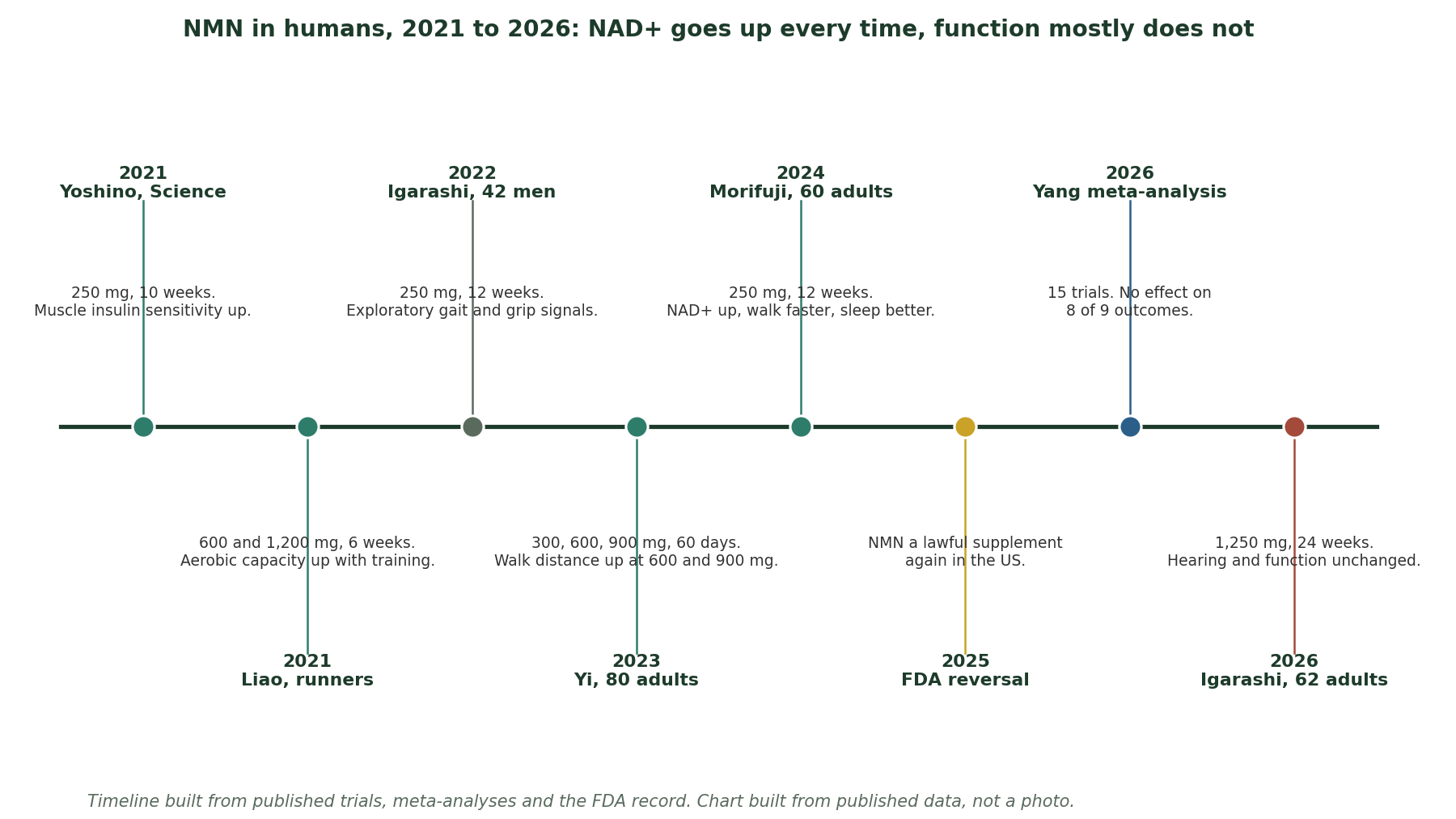
- In the US, NMN is a lawful dietary supplement again after the FDA reversed its 2022 position in September 2025.
What NMN is, and why NAD+ matters
NMN stands for nicotinamide mononucleotide. It is a building block the body uses to make NAD+, short for nicotinamide adenine dinucleotide, a coenzyme involved in energy production, DNA repair and the activity of sirtuins, a family of proteins linked to aging in animal studies. NAD+ levels fall substantially with age, and in mice, restoring NAD+ improves several measures of health. That is the whole case for NMN in one paragraph: a molecule that falls with age, a supplement that raises it, and a hope that the rise matters.
The first half of that chain is now solid. Oral NMN raises blood NAD+ in humans, consistently, in every trial that measured it. The second half is where the evidence runs out. Raising a blood marker is not the same as improving a person's health, and after 23 published human trials, no trial has shown that NMN slows aging, sharpens thinking, strengthens muscle or extends life in people.
One detail worth knowing: whether NMN enters cells intact is debated. A transporter called Slc12a8 was proposed in mice, but it has never been demonstrated in humans, and gut bacteria break NMN down before the body rebuilds NAD+ from the pieces. That does not stop the blood NAD+ rise, which is measured and real. It does mean the simple story is not settled science.
The new trial: 1,250 mg, 24 weeks, 62 adults
The trial that matters most was published September 25, 2026. Igarashi and colleagues at the University of Tokyo ran a randomised, double-blind, placebo-controlled trial in 62 adults aged 65 and older. The NMN group took 1,250 mg a day, as 5 tablets of 250 mg, for 24 weeks. The placebo group took 5 identical tablets. The primary endpoint was auditory function, hearing. The researchers also measured physical performance, body composition, blood lipids, dietary behaviour and quality of life, and they tracked blood NAD+ and related metabolites throughout.
On the biochemistry, the result was clear. Metabolomic analysis of whole blood confirmed that high dose NMN significantly increased NAD+ and related metabolites, and the increase was sustained across the 24 weeks. The supplement did what it was supposed to do to the pathway.
On the outcomes that matter to a person, the result was equally clear, and it was null. No significant improvement was observed in the primary endpoint of auditory function or in physical performance measures. Some nominal changes showed up in body composition, lipid-related measures and dietary behaviour, but they did not remain significant after correction for multiple testing, so the authors treat them as exploratory. In plain language, the blood chemistry moved and the main health outcomes did not.
Two caveats matter, and they cut in opposite directions. First, the trial was funded by MIRAILAB BIOSCIENCE Inc., which also supplied the NMN, and 3 of the authors are company employees, including the chief executive. The paper states the company was not involved in study design, data collection, statistical analysis, interpretation, manuscript preparation or the decision to publish. A company-funded null result is more credible than a company-funded positive one, since the sponsor had every reason to want a win, and still reported a null. Second, the trial was small, 62 people, and 24 weeks is short for an aging intervention. A small trial can miss a small benefit. But a null result at the highest dose, over the longest duration, in the best designed trial so far, is not a detail. It is the headline.
What the earlier human trials found
NMN has been tested in people since 2021, and the record is a mix of small positives and nulls, with the positives usually carrying an asterisk.
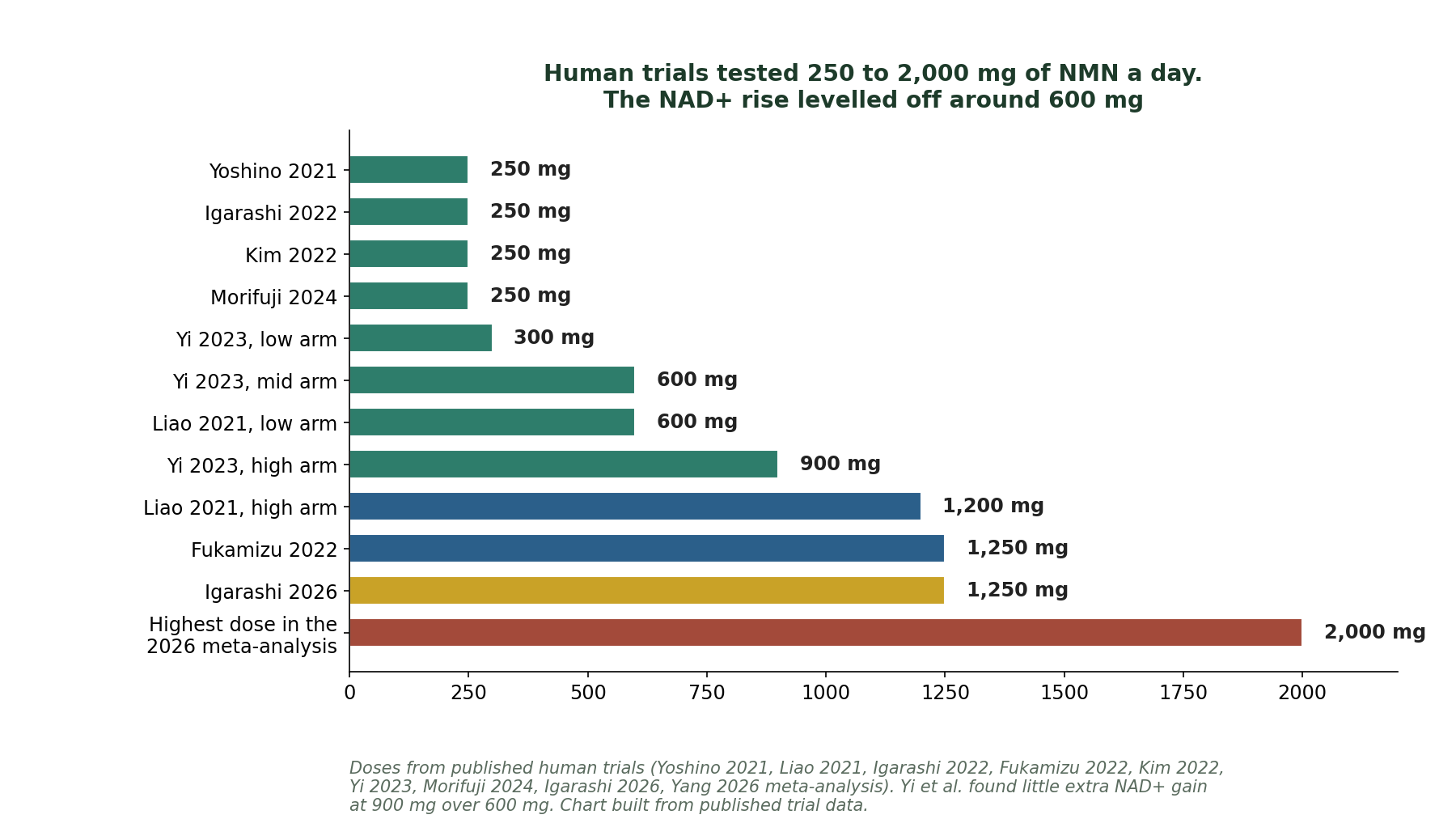
The most cited positive came first. Yoshino and colleagues, Science, 2021, gave 250 mg a day for 10 weeks to postmenopausal women with prediabetes and overweight, and found muscle insulin sensitivity improved. It is a real result in a good journal, but a published comment flagged a baseline imbalance in liver fat between the groups, which complicates the reading.
Yi and colleagues, GeroScience, 2023, ran the cleanest dose finding trial: 80 healthy adults aged 40 to 65, randomised to 300, 600 or 900 mg a day or placebo for 60 days. Blood NAD+ rose dose dependently, and 6-minute walking distance improved at 600 and 900 mg, with little extra NAD+ gain at 900 mg over 600 mg. The walk result used a per-protocol analysis and the trial was industry funded, so it is hypothesis generating rather than confirmatory. A follow-up analysis found bigger NAD+ rises went with longer walks and better self-rated health scores.
Morifuji and colleagues, 2024, gave 250 mg a day for 12 weeks to 60 older adults. Blood NAD+ rose, 4-metre walking time was shorter and sleep quality scores were better than placebo. The primary stepping test did not differ.
Kim and colleagues, 2022, gave 250 mg a day for 12 weeks to 108 older Japanese adults. The sit-to-stand interaction reached p equals 0.04, but all 4 timing and treatment groups improved, which weakens the claim. Liao and colleagues, 2021, gave 600 and 1,200 mg a day for 6 weeks to 48 recreational runners, and aerobic capacity rose more than placebo while they trained. Runners in training are a long way from the general older population, and the trial was short.
Igarashi and colleagues, 2022, a different trial from the same lead author, gave 250 mg a day for 6 or 12 weeks to 42 healthy older men. A supplier error meant only 10 people per arm had usable 12-week data. Exploratory models reported gait and left grip signals without correction for multiple testing, and the unadjusted gait change comparison was not significant. Muscle mass did not improve.
Fukamizu and colleagues, 2022, ran a 4-week safety study: 31 healthy adults aged 20 to 65 took 1,250 mg a day. It was well tolerated, with no serious adverse effects.
Read together, the pattern is consistent. Small trials, short durations, a few dozen people each. NAD+ goes up every time. Functional benefits show up sometimes, in secondary outcomes, in small samples, and often do not survive a stricter analysis. The 2026 trial is the first to test a high dose for 6 months in older adults with a prespecified primary outcome, and it found nothing on that outcome.
What the meta-analyses say
When individual trials disagree, meta-analyses pool them. Three now exist, and they agree with each other.
A 2024 systematic review and meta-analysis of 12 randomised trials with 513 participants found NMN reliably raised blood NAD+, but produced no significant improvement in fasting glucose, triglycerides, total cholesterol, LDL or HDL. The authors graded most of the underlying trials as having some concerns or high risk of bias, and concluded the benefits of NMN have likely been exaggerated.
A 2025 meta-analysis of 10 randomised trials in adults over 60, covering NMN and its cousin NR, found no improvement in skeletal muscle index, handgrip strength, gait speed or chair stand tests.
A 2026 meta-analysis by Yang and colleagues pooled 15 parallel randomised NMN trials, doses from 250 to 2,000 mg a day, durations from 14 days to 24 weeks. It found no significant effect on body weight, fasting glucose, HbA1c, blood lipids or systolic blood pressure. Diastolic pressure fell slightly, the only significant change across 9 outcomes.
The broadest review, Gallagher and Emmanuel, Ageing Research Reviews, 2026, covered 113 studies, 33 in humans and 80 in rodents, from 2010 to November 2025. Oral NR and NMN consistently raised NAD+ metabolites and were generally well tolerated over weeks to months. Functional, metabolic, vascular and healthspan outcomes were heterogeneous and often null, and clinical efficacy for anti-aging or wellness was not established.
The other 2026 data point: NMN formulations
One more 2026 study is worth a line, because it shows the pattern repeating. Abe and colleagues, Nutrients, 2026, ran an open-label, 4-arm exploratory study in 42 healthy adults aged 45 to 65 for 42 days, testing NMN alone and 2 multi-ingredient formulations against placebo. The study found no statistically significant improvements in cardiopulmonary or cognitive function, its primary objectives. Biological age by DNA methylation clocks decreased, but the authors said it did not amount to biological age reversal. The study was funded by the company that makes the formulations. Open-label and exploratory, it proves little on its own. It fits the pattern.
The FDA reversal: NMN is a supplement again
NMN's legal status has swung back and forth, and the latest swing matters for buyers. In 2022, the US FDA said NMN was excluded from the definition of a dietary supplement, because it was being investigated as a drug. On September 29, 2025, the FDA reconsidered that position, and a December 2, 2025 letter set aside the 2022 exclusion letters. NMN is a lawful dietary supplement ingredient in the US again.
That is a legal ruling, not a scientific one. It says nothing about whether NMN works. It does mean the product you buy is no longer in a legal grey zone in the US. Rules differ in other countries, so check your own country's position before ordering from abroad.
NMN vs NR vs liposomal NAD+
Three ways to raise NAD+ get compared constantly, so here is the honest version. NMN and NR are both precursors, smaller building blocks the body converts into NAD+ inside the cell. A 14-day head-to-head trial in 65 healthy adults in 2026 found NMN and NR comparably raised circulatory NAD+, while nicotinamide, plain vitamin B3, did not. No trial has shown one precursor beats the other on a health outcome, so the choice between them is a matter of price and preference, not evidence.
Liposomal NAD+ is the direct approach: actual NAD+ wrapped in liposomes. It has one small human study, 14 people, no placebo, company funded, using 1,000 mg a day, while the product on the market has 300 mg per packet. I reviewed that product and the dose problem in detail in the Cymbiotika Liposomal NAD+ review. The precursors have the real trials. Liposomal NAD+ has a hypothesis.
Disclosure: I'm affiliated with IM8, but I only recommend things I can actually stand behind so here's my honest breakdown.
Where NMN actually shows up: IM8 Daily Ultimate Longevity
If you want NMN in a finished product rather than a standalone capsule, IM8 Daily Ultimate Longevity is the one I am affiliated with. Each sachet has 600 mg of NMN, plus 250 mg of trans-resveratrol, 3 mg of spermidine, 100 mg of fisetin, 10 mg of PQQ, 3 g of glycine, 2 g of taurine, 100 mg of dihydroberberine and 6 mg of astaxanthin. That 600 mg is about half the 1,250 mg used in the Tokyo trial, and it matches the dose where the NAD+ rise levelled off in the Yi dose finding trial, so it is a reasonable dose, not a token one.
Two honest caveats. First, no controlled trial has tested this specific powder, so everything above about what NMN does or does not do in people applies here too. The registered trial IM8 cites covers a different product, Daily Ultimate Essentials. Second, the same ingredients show up across today's reviews: spermidine and fisetin each got their own article today, and both had the same story, interesting mechanism, no proven human benefit yet. Buying them together in one sachet does not change that.
The price is $119 a month on the 30-day plan, $104 a month on the 90-day plan, or $149 for a one-time order, with a 90-day money-back guarantee on the quarterly plan and a 30-day guarantee on the monthly plan. It is NSF Certified for Sport. You can get it with my link and code THRIVE10 here: https://www.im8health.com/THRIVE10
Safety and doses
Short term safety is the most solid part of the NMN file. Across the trials, NMN at 250 to 1,250 mg a day for 4 to 24 weeks produced no serious adverse events and no consistent abnormalities on laboratory testing. The 2026 trial at 1,250 mg a day for 24 weeks reported the same: generally well tolerated, with the authors noting careful safety monitoring is still warranted.
What is missing is long term data. No trial has followed people for years. There is no human evidence that NMN raises or lowers cancer risk, and a 2026 cell and mouse study found NMN reduced sensitivity to several chemotherapy drugs. That is preclinical work, not a supplement warning, but anyone in cancer treatment should talk to their oncologist before taking NMN.
There is no established effective dose, because no dose has proven a health benefit. The trials used 250 to 1,250 mg a day, and the NAD+ rise levelled off around 600 mg in the one dose finding trial. If you take medication, are pregnant or breastfeeding, or manage a medical condition, talk to a clinician first.
The bottom line
NMN does one thing reliably: it raises blood NAD+. It has now been tested at 1,250 mg a day for 24 weeks in older adults, in a randomised, double-blind, placebo-controlled trial, and the things people actually buy it for, hearing, physical performance, function, did not move. Three meta-analyses and a 113-study systematic review say the same thing in different words: the biomarker rises, the benefits mostly do not follow.
That does not make NMN a scam. It makes it an unproven bet. If you take it, you are buying a change in a blood marker, not a proven health outcome, and you are paying for it every month. The things with proven effects on how you age, strength training, sleep, walking, are cheaper and better evidenced. Today's other reviews tell the same story in different molecules: the Klotho review, the Spermidine review and the Ergothioneine review all found the same gap between a good mechanism and a missing human benefit. For longevity tools with verified offers, including the ones I actually use for sleep, training and recovery, see our discount codes page.
Safety and limitations
- This article reports on published studies and does not recommend any supplement, dose, or treatment.
- The 2026 Igarashi trial was funded by the company that supplied the NMN, and 3 authors are company employees. A company-funded null result is more credible than a company-funded positive one, but independent replication is still needed.
- The 2026 trial had 62 participants and ran 24 weeks. A small trial can miss a small benefit, and 24 weeks is short for an aging intervention.
- Most earlier trials were small, short, and several were industry funded or used per-protocol analyses. A 2024 meta-analysis graded most of them as having some concerns or high risk of bias.
- NMN is not a treatment for hearing loss, muscle weakness, or any disease. Anyone with hearing concerns or a medical condition should speak to a clinician.
- Safety data cover up to 24 weeks at studied doses. Long term effects over years are unknown.
- If you are pregnant, breastfeeding, taking medication, in cancer treatment, or managing a medical condition, talk to a clinician before trying a new supplement.
FAQ
Does NMN raise NAD+ levels?
Yes, reliably. Every human trial that measured it found oral NMN raised blood NAD+ and related metabolites, at doses from 250 to 1,250 mg a day. The 2026 trial at 1,250 mg a day for 24 weeks confirmed the rise is sustained over 6 months.
Does NMN slow aging or extend life?
No human trial has shown that. No trial has shown NMN improves a clinical measure of aging, and no trial has measured lifespan. A 2026 systematic review of 113 studies concluded clinical efficacy for anti-aging or wellness is not established.
What dose did the trials use?
Trials used 250 to 1,250 mg a day, and the 2026 meta-analysis covered doses up to 2,000 mg a day. The NAD+ rise levelled off around 600 mg in the one dose finding trial, with little extra gain at 900 mg. There is no established effective dose, because no dose has proven a health benefit.
Is NMN safe?
Short term, yes, as far as the trials show. Doses up to 1,250 mg a day for 24 weeks produced no serious adverse events. Long term safety over years is unstudied, and there is no safety data in pregnancy or childhood.
NMN or NR, which is better?
Both raise blood NAD+ to a similar degree in the one head-to-head trial, and no trial shows either one beats the other on a health outcome. Choose on price and preference, not on a claim that one is proven better. Does IM8 Daily Ultimate Longevity contain NMN? Yes. Each sachet has 600 mg of NMN, plus 250 mg of trans-resveratrol, 3 mg of spermidine and 100 mg of fisetin. That is about half the 1,250 mg a day used in the 2026 Tokyo trial, and it matches the dose where the NAD+ rise levelled off in the dose finding trial. No trial has tested this specific product. You can get it with code THRIVE10 here: https://www.im8health.com/THRIVE10
Is NMN legal as a supplement?
In the US, yes, since the FDA reversed its 2022 position in September 2025. Rules differ in other countries, so check your own country's position.
This article is for general information only and is not medical advice. It reports on published studies and does not recommend any supplement, dose, or treatment.
Looking for tools that support healthy aging and recovery? Browse the current offers on our discount codes page. This article is for general information only and is not medical advice. It reports on a published study and does not recommend any supplement, dose, or treatment.