The short answer
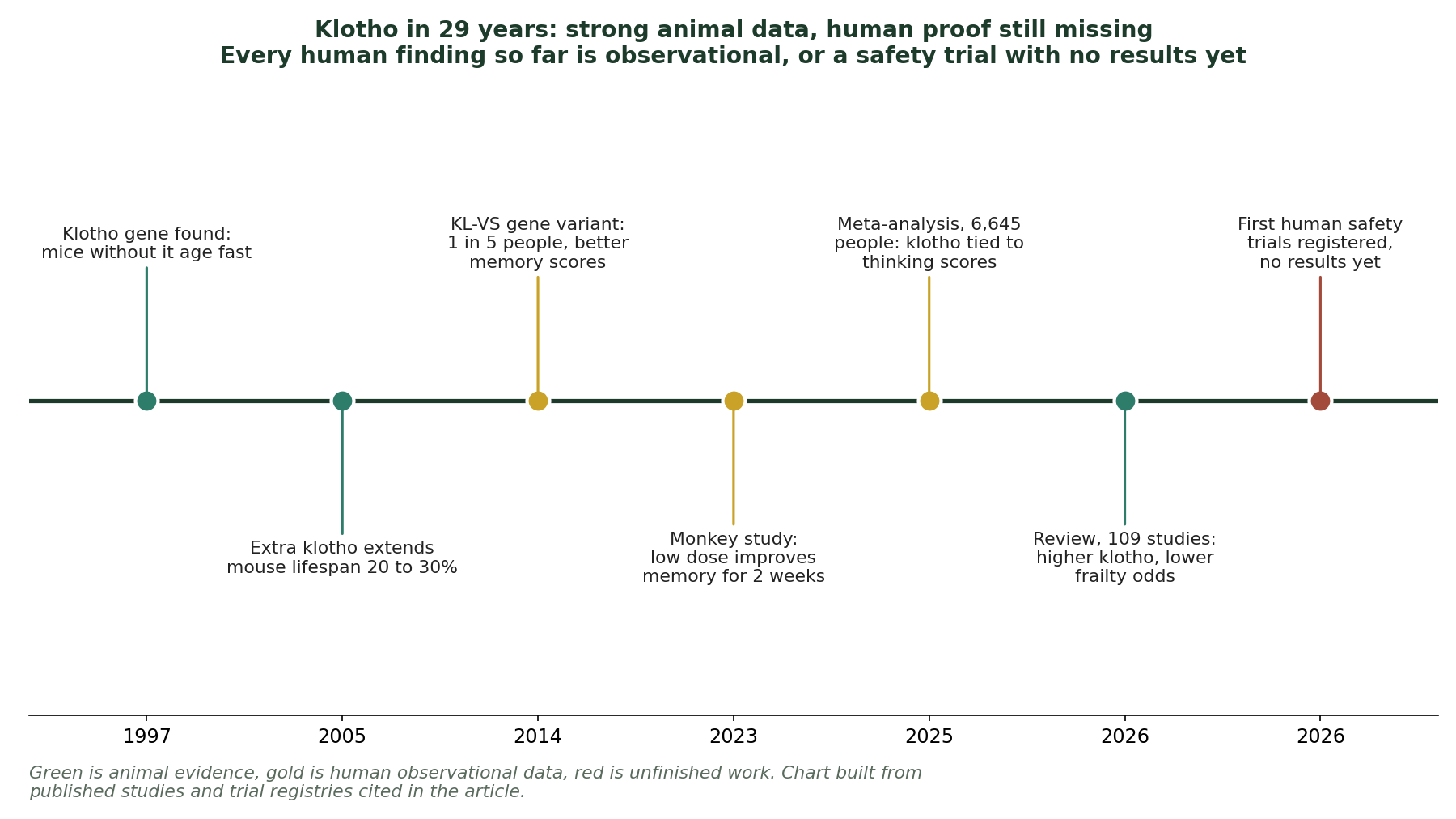
Klotho is a protein your kidneys make, and it has one of the strangest resumes in aging science. Mice without it age fast and die young. Mice engineered to make extra live 20 to 30 percent longer. In 2023, a single low dose of klotho improved memory in old monkeys for about 2 weeks, while a higher dose did nothing at all. Human data is thinner: higher klotho levels are linked to better thinking scores and lower odds of frailty, but those are snapshots, not proof. The first human safety trials are registered and have no results yet. You cannot buy klotho, and anyone selling it online is not selling the tested protein. The one lever with real evidence is exercise, which raises blood klotho in most trials, especially resistance training. That is the honest picture: a fascinating protein, a striking animal result, and no human proof yet.
What is klotho?
Klotho is a protein, not a vitamin and not a supplement. It was discovered in 1997 by Makoto Kuro-o and his team, and named after Clotho, the Greek Fate who spins the thread of life. The name turned out to be fitting.
Most klotho is made in the kidneys. One form stays attached to kidney cells, where it helps control phosphate, calcium and vitamin D. Another form, called soluble klotho, breaks off and circulates in the blood, acting a bit like a hormone. It is also found in the brain and in cerebrospinal fluid.
Two facts make researchers pay attention. First, soluble klotho declines with age, especially after 40. Second, low klotho is linked to a long list of age-related problems: frailty, weaker grip strength, slower walking speed, worse cognitive scores, faster kidney decline, and higher risk of death from any cause. The link shows up again and again in large population studies. What it does not show is direction. Low klotho could be a cause of aging, a consequence of it, or a marker of something else entirely, like kidney function. That distinction matters, and it runs through everything that follows.
The mouse story: where the nickname came from
The klotho story starts with an accident. In 1997, Kuro-o's team created mice with a broken klotho gene, and the animals aged at shocking speed. Within weeks they developed hardening of the arteries, osteoporosis, emphysema, skin thinning and cognitive decline, and they died young, at about 8 to 9 weeks old. It looked like aging on fast forward.
The reverse experiment was just as dramatic. In 2005, Hiroshi Kurosu and colleagues engineered mice to make extra klotho, and those animals lived about 20 to 30 percent longer than normal mice, with better insulin sensitivity and less oxidative damage. The same team later showed that extra klotho also improved learning and memory in mice, and the effect showed up in young mice too, not just old ones.
That last detail is important. If klotho helped young animals as well as old ones, its memory effect might be separate from aging itself. A klotho drug could, in theory, help memory without slowing aging at all. Or it could do neither in people. Mice are where the story starts, not where it ends.
The human genetics clue: KL-VS
The first human evidence came from genetics. About 1 in 5 people carry one copy of a variant of the klotho gene called KL-VS. In a 2014 study led by Dena Dubal at the University of California, San Francisco, researchers tested more than 700 adults aged 52 to 85 and found that people carrying one copy of KL-VS had higher circulating klotho and scored better on tests of memory and thinking than people without it.
That is a correlation with a genetic twist, which makes it stronger than a simple snapshot. Genes are assigned at birth, so the result is harder to explain away as a lifestyle effect. But it is still one study, and it does not prove that raising klotho in an adult would sharpen their memory. It proves that people born with a variant linked to more klotho tend to think a little better. The difference between those two statements is the whole gap this article is about.
The 2023 monkey study: the result that changed the conversation
The study that put klotho on the longevity map was published in Nature Aging in July 2023. Castner and colleagues at Yale and UCSF, with senior author Dena Dubal, tested klotho in 18 aged rhesus macaques, 13 females and 5 males, aged 15 to 28 years, roughly equivalent to 65 human years. Monkeys matter here because their brains and aging are far closer to ours than a mouse's.
Each monkey received a single injection of the rhesus form of klotho under the skin, at a low dose of 10 micrograms per kilogram of body weight, chosen to raise blood klotho to levels seen around birth. Then the researchers tested spatial memory: the monkeys had to remember where food had been hidden after a delay, in batches of 20 trials.
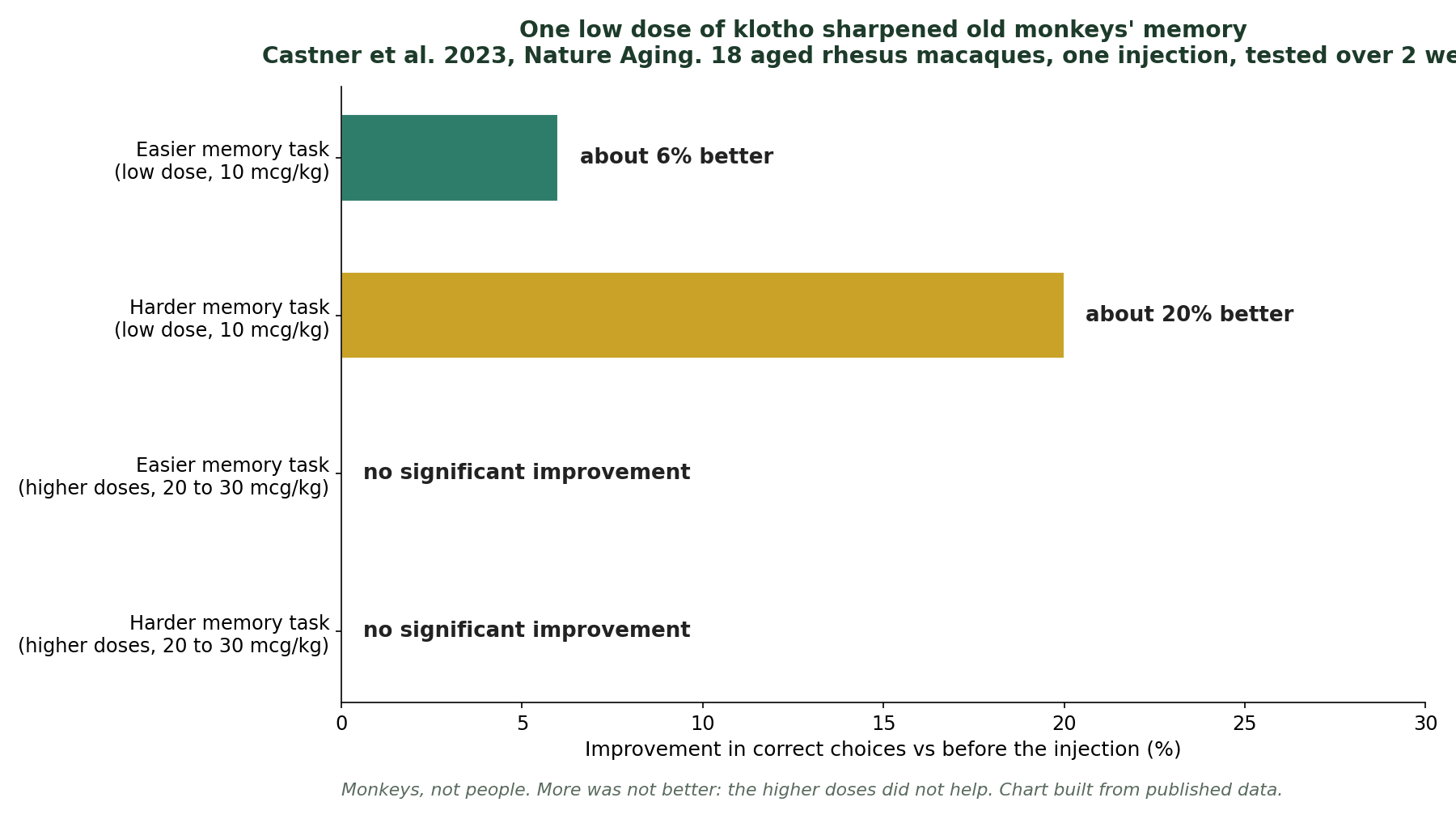
The result was striking. On the easier version of the task, the monkeys made correct choices about 6 percent more often than before the injection. On the harder version, they improved by about 20 percent. The improvement appeared within 4 hours and lasted for about 2 weeks, with some tests still showing benefit 14 to 23 days later.
One more detail makes the study remarkable. Klotho does not cross the blood-brain barrier, the tight filter that keeps most large molecules out of the brain. So the injected protein never entered the monkeys' brains. Whatever happened, it worked through a signal from the body to the brain, a downstream cascade scientists have not yet mapped. The authors' own conclusion was careful: systemic low-dose klotho treatment "may prove therapeutic in aging humans." May prove. Not does.
The study had real limits. It was not a randomized trial, and the monkeys were not randomly assigned to treatment groups. Eighteen animals is a small cohort, and the low-dose condition was tested in 9 animals, with 2 tested twice. Only a single dose was given, so nobody knows what repeated treatment would do, or whether it is safe. The work was funded by the US National Institutes of Health, philanthropic sources and Unity Biotechnology, a company with an interest in aging therapies. A 2026 reanalysis of the same data broadly reproduced the findings while flagging statistical shortcomings, which is a reason to want an independent replication, not a reason to dismiss the result.
The dose twist: more was not better
Here is the detail that should stop anyone from assuming a klotho supplement would work if it existed. In the monkey study, the researchers also tested higher doses, 20 and 30 micrograms per kilogram, and neither one produced a significant improvement in memory. Only the low dose helped.
That is an inverted U shape, and it shows up in the mouse work too. Too little klotho is bad, a little extra helps, and more does not help more. Nobody knows the right human dose, and that is a big part of why the first human trials exist. Dose-finding is not a formality here. It is the central unanswered question, and it is also a warning about the unregulated "klotho peptides" sold online, where the dose is a guess and the contents are unverified.
What the human data shows so far
Beyond genetics, the human evidence is mostly snapshots. A 2025 meta-analysis pooled 8 studies with 6,645 people and found that higher circulating klotho was tied to better cognitive scores. But most of those studies were observational, and the authors rated the evidence quality as relatively low. A link is not a cause, and healthier people may simply have higher klotho for reasons that have nothing to do with the protein itself.
A 2026 review of 109 studies found that higher klotho was linked to lower odds of frailty in people, while the results for thinking were, in the authors' words, limited and inconsistent. So the frailty link looks steadier than the cognition link, and neither one proves that raising klotho would change either outcome.
Put together, the human data says this: klotho tracks with healthier aging in populations, and it tracks most reliably with frailty, not memory. No human study has shown that giving klotho, or raising it, improves memory, strength or lifespan. That trial has not happened yet.
The first human trials: what they can and cannot show
The work is now moving into people. In the last few months, new early-phase studies of klotho have appeared on ClinicalTrials.gov, the US registry where trials are listed before they start. One is NCT07216781. Some approaches deliver klotho as a protein. Others try to get the body to make more of it, and a 2025 review lists klotho among the targets of gene therapy research on aging.
Here is the honest limit on what these trials can tell us. Early Phase 1 trials are safety studies. They are built to ask whether klotho is safe, what dose people tolerate, and how long it stays in the blood. They are not built to show whether it helps memory or slows aging, and no klotho treatment has published human results yet. Showing a memory benefit would take later, larger trials with a placebo group, and showing slower aging would take years. Anyone claiming human proof today is selling something the science has not produced.
Exercise and klotho: the one lever you actually have
While the drug trials run, there is one way people raise their own klotho that has actual trial data behind it: exercise. The evidence is mixed but real, and resistance training looks like the strongest lever.
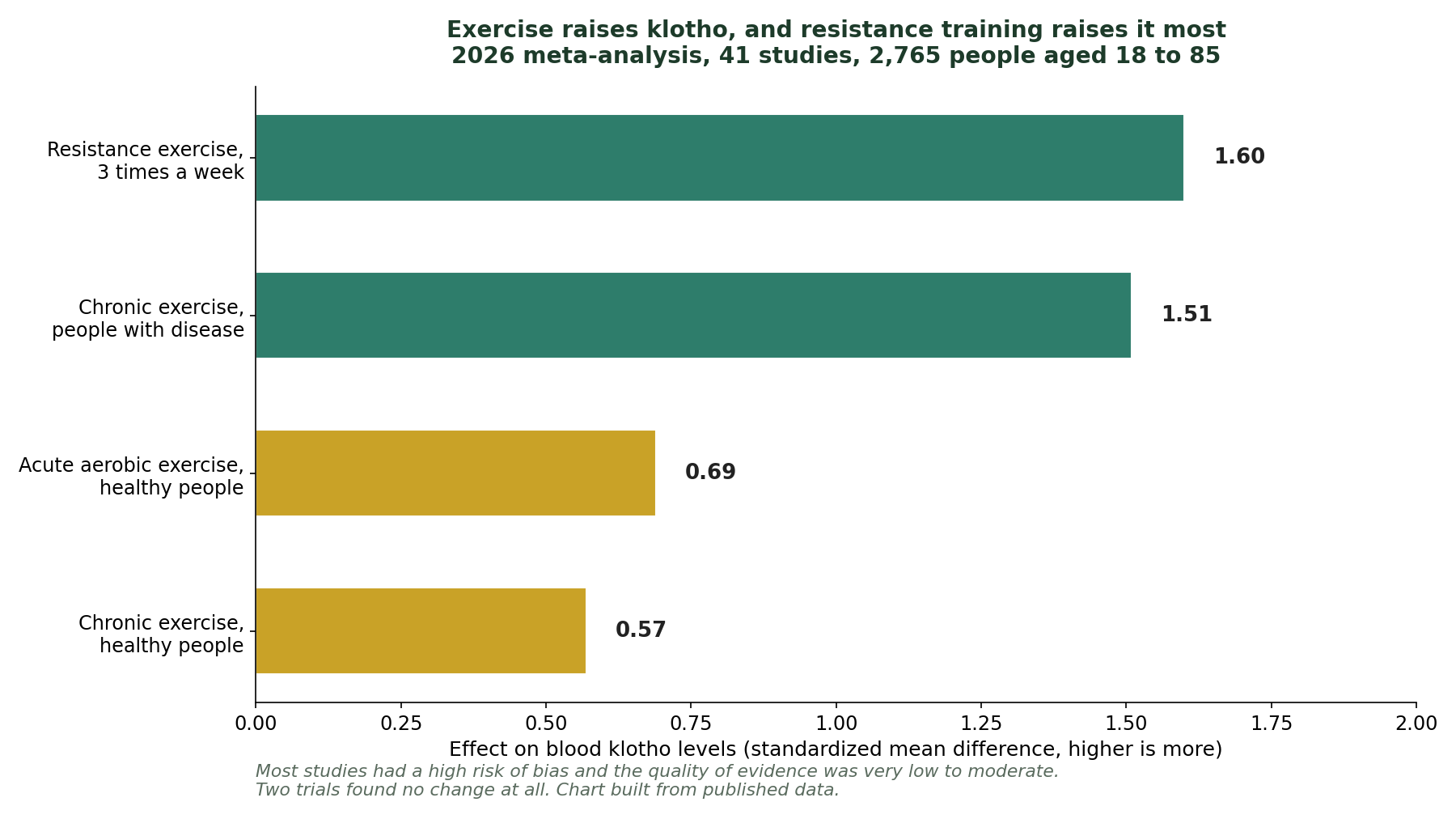
A 2022 review of 12 trials with 621 adults found that klotho rose after at least 12 weeks of training. A 2026 meta-analysis of 41 studies with 2,765 people aged 18 to 85 found that resistance exercise 3 times a week had the largest effect on blood klotho, a standardized mean difference of 1.60, followed by chronic exercise in people with disease at 1.51. Acute aerobic exercise in healthy people scored 0.69, and chronic exercise in healthy people scored 0.57. A second 2026 meta-analysis of 14 randomized trials with 893 adults found that chronic training of 12 weeks or more raised soluble klotho with a large pooled effect, and that resistance training and high-intensity interval training were the most robust modalities. In pre-frail older adults, average age 77, 12 weeks of classical resistance training raised klotho significantly, while power training did not.
But the honest version includes the misses. Most of the studies in these reviews had a high risk of bias, and the quality of evidence ranged from very low to moderate. A 26-week treadmill trial in 23 adults found no change in klotho at all, though klotho tracked closely with changes in fitness. A 24-week trial in 144 young adults also saw no change. And in a 12-week trial of 74 middle-aged adults, changes in klotho moved together with changes in memory scores, which is interesting but still a correlation inside a small trial.
So "exercise raises klotho" is a maybe, not a guarantee. Exercise raising fitness is the part you can watch happen. The klotho rise, if it happens, is a bonus, not the reason to train. Strength training is already the best-evidenced intervention for muscle, bone and healthy aging, and my guide to 30 to 60 minutes of strength training a week covers the beginner protocol. If you want tools that support that training, like recovery tech, the current offers are on my discount codes page.
Can you buy klotho?
No. There is no approved klotho drug, no approved klotho supplement, and no klotho product on my discount codes page. Klotho is a large protein, which makes delivering it as a drug technically difficult, and the human dose is unknown. That is why the first trials are safety studies, not product launches.
Be careful with what is sold online. Unregulated sellers offer "klotho peptides," but klotho is not a small synthetic peptide, and what they sell is not the protein tested in the monkey study. The purity is unverified, the dose is a guess, and injecting an unregulated peptide carries real risks, from contamination to immune reactions. Nothing in any paper tested a product you can buy, and no seller's claim changes that. If a klotho product appears on the market before the human trials report, treat it as a red flag, not a shortcut.
Safety and limitations
Klotho is not a free lunch, even in theory. It helps regulate phosphate, calcium and vitamin D, and it interacts with a hormone called FGF23 that controls phosphate balance. Disturbing that system could affect mineral balance and kidney function, and klotho is made mostly in the kidneys, so people with kidney disease already have low levels for reasons a supplement cannot fix. There is no human safety data for klotho treatment yet, which is exactly what the Phase 1 trials are for.
The limits of the whole story are worth stating plainly. The lifespan data comes from mice. The memory data comes from 18 monkeys given a single low dose. The human data is observational, except for a genetics clue in one study. No trial has tested whether klotho helps a person's memory, strength or lifespan, and no trial has tested repeated dosing. The 2026 reanalysis of the monkey data found statistical shortcomings. The exercise data is promising but biased, with real null trials in the mix. Klotho is worth watching, and it is not worth buying anything over.
What the evidence shows, and what it does not
| Claim | What the evidence shows |
|---|---|
| Extends lifespan | About 20 to 30 percent longer life in mice engineered to make extra klotho; never tested in humans |
| Improves memory | One low dose improved memory in 18 old monkeys for about 2 weeks; higher doses did not help; no human trial has tested it |
| Higher klotho means better thinking | Linked in a 2025 meta-analysis of 6,645 people, but observational, with relatively low evidence quality |
| Higher klotho means less frailty | Linked in a 2026 review of 109 studies; cognition results in the same review were limited and inconsistent |
| Exercise raises klotho | Often, but not always; resistance training 3 times a week had the largest effect, and 2 trials found no change |
| You can buy klotho | No approved product exists; unregulated peptide sellers are not selling the tested protein |
| Klotho slows aging in people | Never tested; the first human trials are safety studies with no results yet |
The bottom line
Klotho has earned its nickname honestly. Mice without it age fast, mice with extra live longer and think better, and one careful monkey study showed a single low dose sharpening an old animal's memory for 2 weeks. The human clues point the same way: a gene variant carried by about 1 in 5 people is tied to more klotho and better thinking, and higher klotho tracks with less frailty across more than 100 studies.
But every step from mice to people is still unproven. No human has been shown to benefit from klotho treatment, because no efficacy trial has reported. The first trials will only tell us whether it is safe and what dose to use. Until then, the only lever with real evidence is the least exciting one: train, especially with resistance exercise, and let klotho be one of many reasons your muscles and brain stay sharper, not the reason you buy something. I will keep watching the Phase 1 results, and if a real human trial reports, this page is where I will break down what it actually found.
FAQ
What is klotho?
Klotho is a protein made mostly in the kidneys. A soluble form circulates in the blood and acts a bit like a hormone, helping regulate phosphate, calcium and vitamin D. Levels decline with age, especially after 40, and low levels are linked to frailty, weaker grip, slower walking and worse cognitive scores in population studies.
Can I take klotho as a supplement?
No. There is no approved klotho drug or supplement, and no human trial has tested klotho as a treatment for memory or aging. Unregulated "klotho peptides" sold online are not the protein used in the research, and their purity and dose are unverified.
Does exercise really raise klotho?
Often, but not always. Reviews of 12 to 41 trials found klotho rose after at least 12 weeks of training, with resistance exercise 3 times a week showing the largest effect. But most studies had a high risk of bias, and 2 trials found no change at all. Exercise is worth doing for fitness, muscle and brain health, with any klotho rise as a possible bonus.
Will klotho help my memory?
Nobody knows. A single low dose improved memory in 18 old monkeys for about 2 weeks, and people carrying the KL-VS gene variant score better on memory tests, but no human trial has tested whether klotho treatment helps memory. The first trials are safety studies, not memory trials.
What is KL-VS?
KL-VS is a variant of the klotho gene. About 1 in 5 people carry one copy, and in a 2014 study of more than 700 adults aged 52 to 85, carriers had higher circulating klotho and better scores on memory and thinking tests than non-carriers.
When will we know if klotho works in people?
Not from the first round of trials. Early safety trials can show whether klotho is safe and what dose people tolerate. Showing a memory or aging benefit will take later, larger trials with a placebo group, and those have not been registered yet as far as anyone has confirmed.
This article is for general information only and is not medical advice. It reports on published studies and does not recommend any supplement, dose, or treatment. Klotho is an investigational protein with no approved product and no human efficacy data. Talk to a qualified health professional before changing your exercise routine or considering any new intervention, especially if you have kidney disease or a condition affecting calcium or phosphate balance.
Looking for tools that support healthy aging and recovery? Browse the current offers on our discount codes page. This article is for general information only and is not medical advice. It reports on a published study and does not recommend any supplement, dose, or treatment.