The short answer
Spermidine is a molecule your body makes and you also get from food, and it has one of the strongest animal records in longevity science. It switches on autophagy, your cells' recycling system, and it extended lifespan in yeast, worms, flies and mice. In people, the story is much thinner. The largest and longest human trial, SmartAge, gave 100 older adults a spermidine extract for 12 months and found no memory benefit over placebo. A 20 year observational study linked higher dietary spermidine with lower mortality, but a larger Japanese cohort found no such link. A 2025 review of 18 observational studies and 4 trials called the evidence mixed. Short term safety looks fine at the doses tested, but nobody knows what dose, if any, reliably triggers autophagy in a person. That is the honest picture: a real mechanism, real animal results, and no proven human benefit yet.
What is spermidine?
Spermidine is a polyamine, a small molecule found in every living cell. Your body makes it, and you also eat it. It is most concentrated in wheat germ, natto, aged cheese, mushrooms, soybeans and fermented vegetables. A typical diet supplies roughly 5 to 10 mg a day, and wheat germ is the richest source at about 24 mg per 100 g.
Spermidine levels fall with age, in animals and in people. That decline is part of why it caught the attention of longevity researchers. If a molecule that supports cellular cleanup drops as we age, replacing it sounds like a logical fix. The question is whether the logic holds up in a human body, and the evidence so far says: maybe, but not yet proven.
Spermidine is sold as a supplement in 2 main forms. The first is wheat germ extract standardized to its spermidine content, usually 1 to 3 mg per serving, which is the form used in the published human trials. The second is synthetic spermidine trihydrochloride, usually 5 to 15 mg per serving, which is cheaper and more common in shops. There is no completed human outcome trial of the synthetic form at those doses, so the trial evidence and the product on the shelf are not the same thing.
What is autophagy, and why does it matter?
Autophagy means self eating, and it is your cells' cleanup crew. When a cell's parts wear out, autophagy wraps the damaged proteins and organelles in a membrane, breaks them down, and recycles the pieces. It is one of the core maintenance systems that keeps cells working, and it was important enough to win Yoshinori Ohsumi the 2016 Nobel Prize in Physiology or Medicine for working out how it works.
Autophagy declines with age in most tissues. When cleanup slows, damaged parts pile up, and that pileup is linked to many age-related diseases, from neurodegeneration to heart disease. That is why autophagy has become a central target in longevity research, and why anything that turns it back on gets attention fast.
But there is a gap between switching on autophagy in a dish and improving a person's health. Autophagy is hard to measure in a living person. No trial has measured autophagy across the whole body in people taking spermidine. Trials measure memory scores, blood markers, or safety, not the cleanup process itself. So when a product says it "activates autophagy," it is describing a mechanism seen in cells and animals, not a measured effect in you.
The animal evidence: genuinely strong
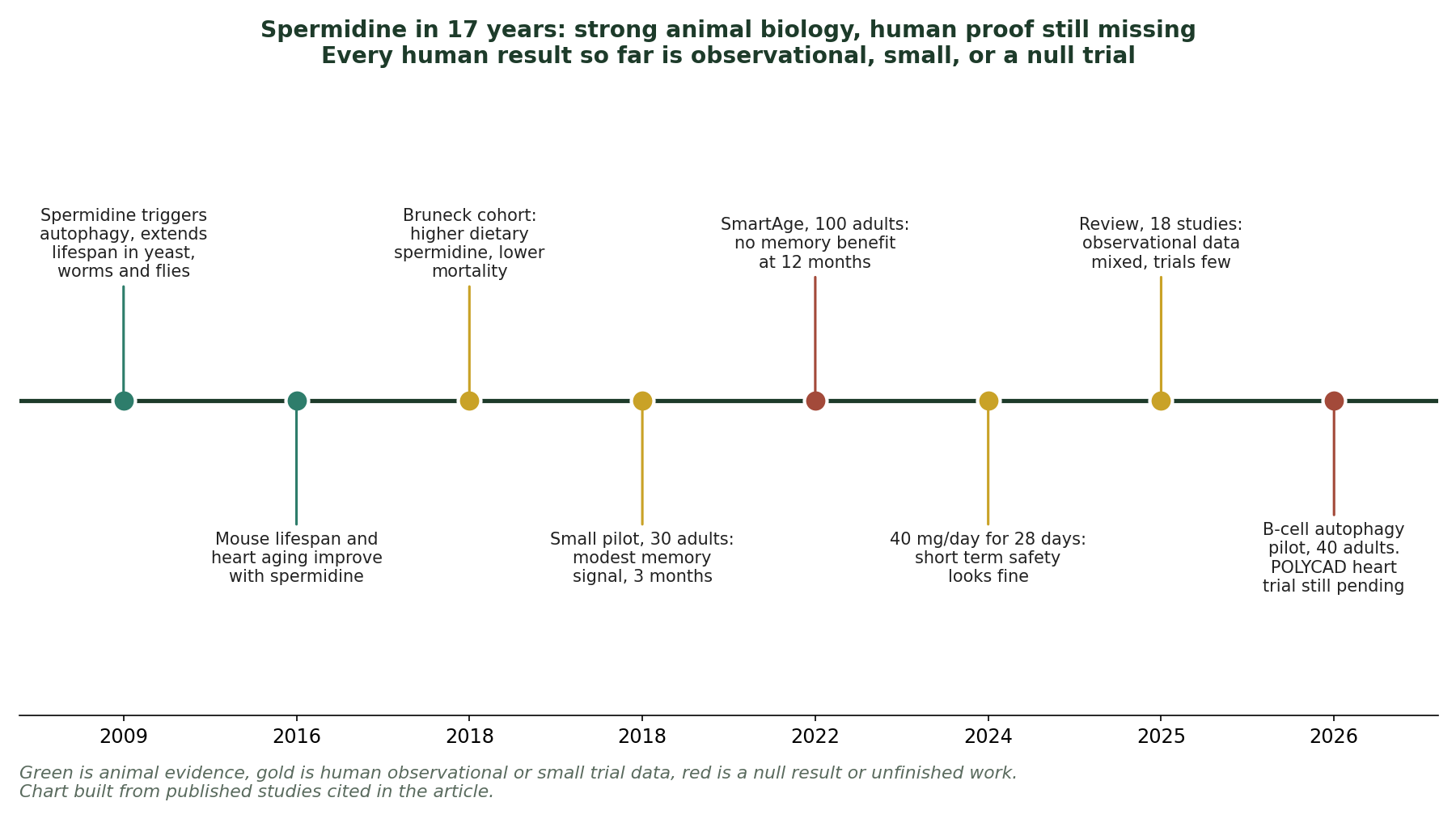
The spermidine story starts in 2009, when Tobias Eisenberg, Frank Madeo and colleagues published in Nature Cell Biology. They showed that spermidine induced autophagy in yeast, flies, worms and cultured human immune cells, and that it extended lifespan in yeast, worms and flies. The key detail was that the benefit depended on autophagy. When the researchers blocked the autophagy machinery, the lifespan benefit disappeared. That is the kind of result that makes a mechanism believable.
In 2016, the same group published in Nature Medicine. Spermidine extended lifespan in mice and improved markers of heart aging, and again the cardioprotection depended on autophagy. A 2024 study in Nature Cell Biology added that spermidine metabolism is essential for fasting-induced autophagy and longevity in model organisms. The animal record is consistent, reproduced across species, and tied to a specific mechanism. That is rare in longevity science, and it is why spermidine deserves to be taken seriously.
None of this proves a human benefit. Mice live about 2 years, eat a controlled diet, and get a controlled dose. People live 80 years, eat varied diets, and take supplements of uncertain purity. The animal work is the reason to run human trials, not a substitute for them.
The human dietary evidence: the Bruneck cohort, and the study that disagreed
The most cited human evidence for spermidine is not a supplement trial. It is the Bruneck Study, a long running observational cohort in Italy. In 2018, Stefan Kiechl and colleagues reported in the American Journal of Clinical Nutrition that 829 adults with higher dietary spermidine intake had lower all-cause and cardiovascular mortality over 20 years of follow-up. People who ate more spermidine-rich foods lived longer, on average.
That is a real finding, but it is observational. People who eat a lot of wheat germ, mushrooms and fermented foods also tend to eat better overall, exercise more, and have higher incomes. Researchers adjust for those factors, but adjustment is never perfect. The study shows that a spermidine-rich diet is linked to longer life. It does not show that a spermidine capsule causes it.
And the link does not always show up. A larger Japanese cohort published in 2023, with more than 29,000 participants, found no significant association between dietary polyamine intake and lower mortality after adjusting for relevant factors. A 2025 review in General Psychiatry looked at 18 observational studies of spermidine and cognitive aging and found a mixed picture. Some studies linked higher spermidine with healthier brains. Others found the opposite: higher spermidine levels tied to smaller hippocampal volume, worse Alzheimer scores, or poorer sleep. Observational data can point in both directions, which is a sign that the signal is weak or that something else is driving it.
The human trials: a small pilot, then a null
The human trial evidence comes mostly from one research program, the SmartAge project, run by a German team led by Agnes Floel with the Madeo group in Graz. It has 2 chapters, and they tell different stories.
Chapter 1 was a pilot. In 2018, Wirth and colleagues published in Cortex a small randomized trial in 30 older adults aged 60 to 80 with subjective cognitive decline. They took a spermidine-rich plant extract, about 1.2 mg a day, for 3 months. Memory performance improved modestly compared with placebo, but the confidence interval crossed zero, and the trial was explicitly framed as hypothesis generating. It was a reason to run a bigger trial, not a result to build a product on.
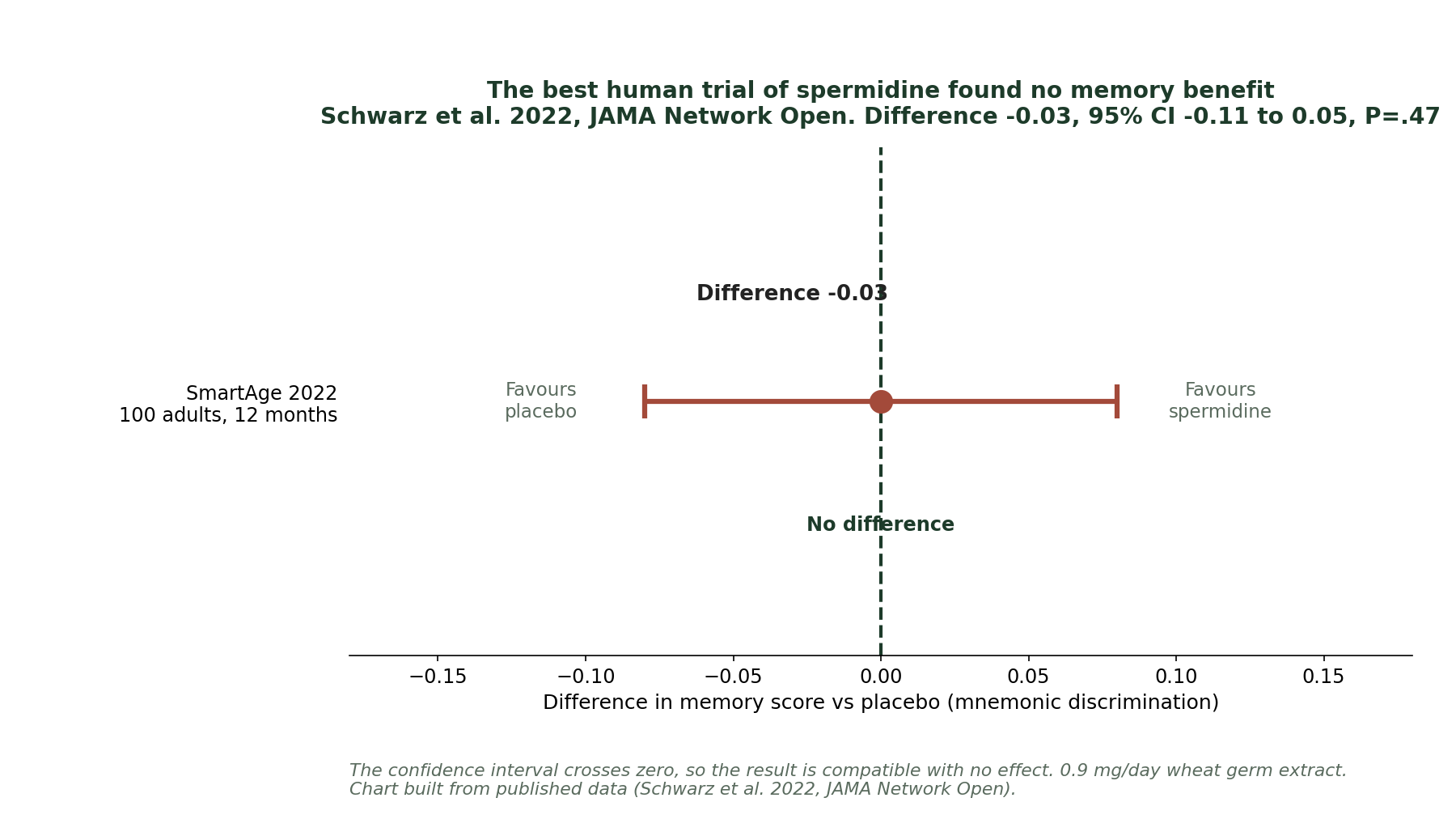
Chapter 2 was the bigger trial. In 2022, Schwarz and colleagues published the SmartAge phase 2b trial in JAMA Network Open. It randomized 100 adults aged 60 to 90 with subjective cognitive decline to 0.9 mg a day of wheat germ spermidine extract or placebo for 12 months. The primary outcome was mnemonic discrimination, a memory test. The difference between the groups was minus 0.03, with a 95 percent confidence interval from minus 0.11 to 0.05, and a P value of .47. In plain language: no difference. The prespecified secondary outcomes were also null. A brain imaging analysis of the same trial reported associations between spermidine intake and brain structure measures, but that is not the same as showing the supplement changed them.
That is the strongest human test of spermidine so far, and it came back null. It tested one dose, one form, one population, and one endpoint, so it does not prove spermidine can never help anyone. But it does mean the best evidence we have does not support taking it for memory.
There is one more trial worth mentioning. A small year-long study in adults with dementia reported an average 5-point improvement on the Mini-Mental State Examination. That is a large change for that population, and it is the most encouraging human result on record. It is also small, and it needs replication in a larger trial before anyone should lean on it.
The dose problem: no one knows the autophagy dose
Here is the central problem with spermidine supplements. Nobody knows what dose triggers autophagy in a person, because no trial has measured it properly.
A 2025 review in Nutrition Research Reviews put it plainly: no clinical evidence defines a specific human dose that reliably triggers measurable systemic autophagy. Human trials have measured memory scores and blood markers, not autophagic flux across the body.
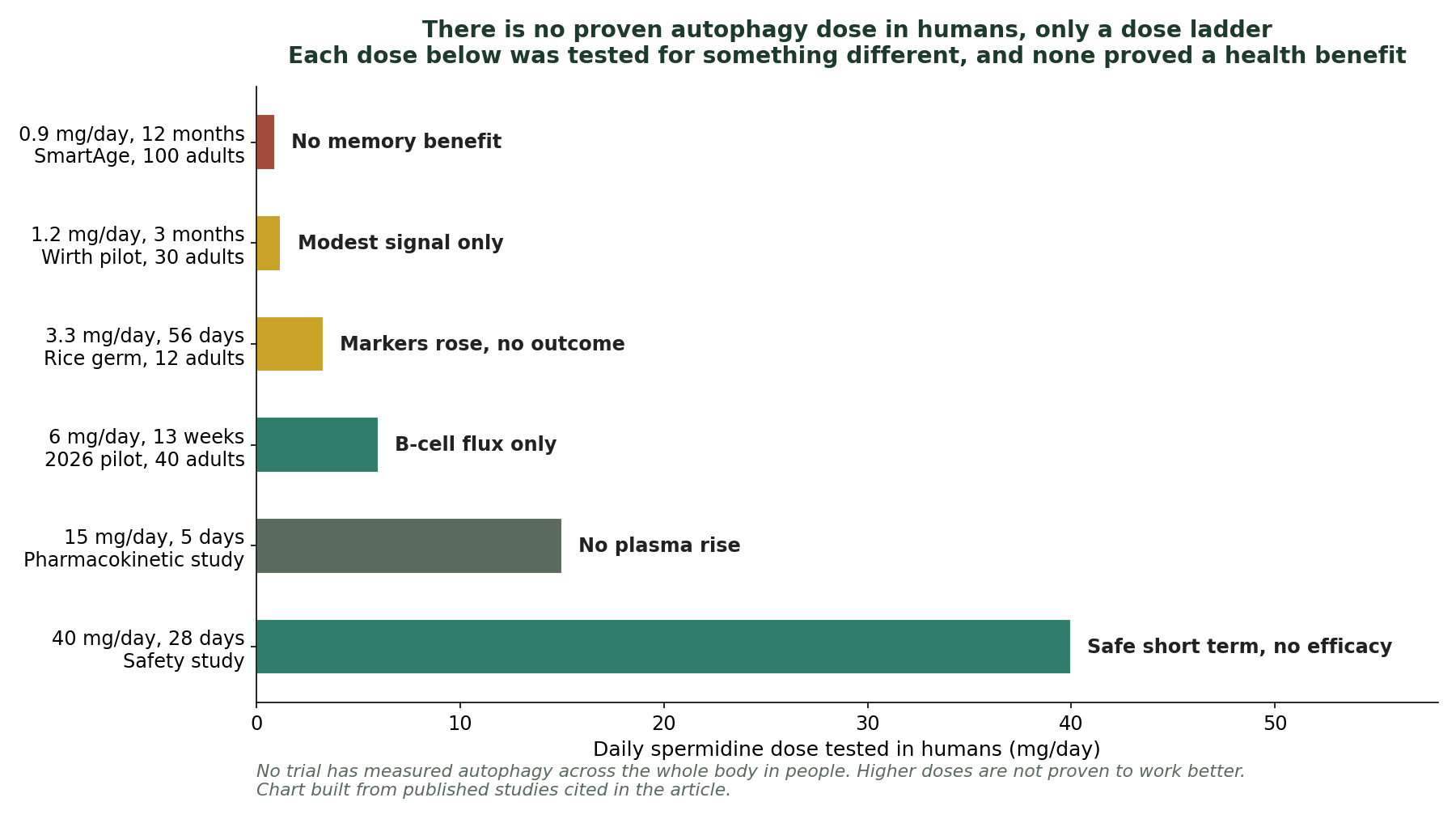
The doses that have been tested form a ladder, and each rung was tested for something different:
- 0.9 mg a day for 12 months (SmartAge): no memory benefit.
- 1.2 mg a day for 3 months (Wirth pilot): modest memory signal, confidence interval crossed zero.
- 3.3 mg a day for 56 days (a 2025 rice germ study, 12 adults): within-group rises in autophagy markers called Beclin-1 and ULK1, with no health outcome measured.
- 6 mg a day for 13 weeks (a 2026 pilot, 40 adults over 65): increased autophagic flux in circulating B cells after 2 weeks, but not in the T cells measured. The study was small, run after a vaccine dose, and designed mainly for safety and feasibility.
- 15 mg a day for 5 days (a 12-person pharmacokinetic study): did not raise plasma or salivary spermidine at all, though plasma spermine rose.
- 40 mg a day for 28 days (a 2024 safety study): no significant changes in clinical, lipid, chemistry or blood markers, and no adverse events attributed to the product. It tested safety, not benefit.
Two things stand out. First, the dose that was tested longest and in the most people, 0.9 mg a day, did not help memory. Second, a much higher dose did not even raise blood spermidine levels in a short study, which raises real questions about how much of an oral dose reaches the bloodstream. Higher is not proven to be better. It is mostly unproven.
What is new in 2025 and 2026
The evidence is still moving, and 2 things are worth watching.
First, the 2025 review in General Psychiatry, led by Lirong Yu and Bin Li, pulled together 18 observational studies and 4 intervention trials on spermidine and brain health. Three of the 4 trials reported encouraging improvements in memory or verbal recall. But the largest and longest trial, SmartAge, was the one that found nothing, and the review's overall verdict was that the evidence is inconsistent. The authors also noted that no serious adverse events were linked to spermidine across the trials, though long term safety remains largely unknown.
Second, the POLYCAD trial is the next big data point. It is a Danish randomized, double-blind, placebo-controlled trial giving 24 mg a day of spermidine for 48 weeks to 187 patients with coronary artery disease. Recruitment finished in 2025, and the primary results were still pending as of mid 2026. If it shows a cardiovascular benefit, the story changes. If it does not, the gap between the animal data and the human data gets wider.
Food first: where spermidine actually comes from
If you want more spermidine, food is the honest route, because food is where the human evidence actually lives. The Bruneck link was about dietary spermidine, not capsules.
Wheat germ is the richest source, at about 24 mg per 100 g. A tablespoon or 2 stirred into yogurt or oatmeal provides roughly 2 to 5 mg. Other good sources are natto, aged cheese, mushrooms, soybeans, edamame and fermented vegetables. A typical diet already supplies roughly 5 to 10 mg a day, which is more than the 0.9 mg dose used in the SmartAge trial, though food spermidine and extract spermidine are not directly comparable.
That comparison matters. The trial dose was small next to normal dietary intake. If 0.9 mg a day for a year did nothing, it is fair to ask whether a 1 to 3 mg capsule adds anything meaningful on top of food. Nobody has answered that yet.
Safety and limitations
Short term safety looks reassuring at the doses tested. The 2024 safety study gave 40 mg a day of highly purified spermidine for up to 28 days and found no significant changes in clinical or lab markers, and no adverse events attributed to the product. The SmartAge trial ran 12 months at 0.9 mg a day with no serious safety signal. The 2025 review found no serious adverse events linked to spermidine across the trials it covered.
That is not the same as proven long term safety. No study has followed people taking spermidine for years. The 28-day safety study cannot tell you about years of daily use, and it did not cover people with existing liver disease.
There is also a theoretical question that applies to autophagy in general. Autophagy clears damaged cells, which should help prevent cancer, but once a tumor exists, autophagy can help cancer cells survive stress. That is a class-wide, bidirectional, theoretical concern, not a finding about spermidine specifically, and it is not a reason to treat spermidine as hazardous at dietary doses. It is a reason to talk to a clinician before supplementing if you have a history of cancer, rather than deciding on your own.
The evidence has other limits. Almost all the human trials come from one research group, use one form (wheat germ extract), and test cognitive endpoints in older adults. There are no large trials in younger people, no trials measuring lifespan or healthspan, and no trials showing spermidine prevents dementia, heart disease, or any disease. The synthetic form sold in most shops has no completed human outcome trial at all.
Who should be careful
Talk to a clinician first if you are pregnant or breastfeeding, if you take prescription medication, if you have liver or kidney disease, or if you have a history of cancer. That is standard advice for any supplement, and it applies here because the long term data does not exist yet.
Do not take spermidine as a replacement for medical care for memory problems. If you notice real memory decline, see a doctor. A supplement trial is not a substitute for an evaluation.
The bottom line
Spermidine has the best animal record of almost any longevity molecule, and the worst kind of human record: a promising pilot, a null trial, and observational data that points both ways. The mechanism is real. The human benefit is not proven. Food is the honest way to get more of it, and the next real answer will come from the POLYCAD heart trial, not from a product label.
If you are looking for tools that support healthy aging and recovery, start with the ones that have verified offers and honest evidence behind them. Browse the current offers on our discount codes page.
FAQ
Does spermidine actually trigger autophagy in humans?
Not proven. Spermidine triggers autophagy in yeast, worms, flies, mice and cultured human cells. A small 2026 pilot found increased autophagic flux in circulating B cells after 2 weeks at 6 mg a day, but not in the T cells measured. No trial has measured autophagy across the whole body in people, and no dose has been shown to reliably switch it on.
Did the SmartAge trial prove spermidine does not work?
No, but it is the strongest evidence we have, and it found nothing. The trial gave 100 older adults 0.9 mg a day of wheat germ spermidine extract for 12 months. Memory did not improve versus placebo, and neither did the secondary outcomes. It tested one dose, one form and one endpoint, so it leaves the door open for other doses or populations. It does not support taking spermidine for memory today.
How much spermidine is in food?
Wheat germ is the richest source at about 24 mg per 100 g. Natto, aged cheese, mushrooms, soybeans, edamame and fermented vegetables are also good sources. A typical diet supplies roughly 5 to 10 mg a day, which is more than the dose used in the SmartAge trial.
Is spermidine safe to take every day?
Short term, the data looks fine. A 2024 study gave 40 mg a day for 28 days with no safety signals, and a 12-month trial at 0.9 mg a day reported no serious adverse events. Long term safety over years is unknown, and the safety data does not cover people with liver disease. Talk to a clinician before supplementing, especially if you are pregnant, take medication, or have a history of cancer.
What dose of spermidine was used in the human trials?
The published trials used 0.9 to 1.2 mg a day from wheat germ extract. Higher doses have been tested only for safety or biomarkers: 3.3 mg a day for 56 days, 6 mg a day for 13 weeks, 15 mg a day for 5 days, and 40 mg a day for 28 days. No dose has been proven to trigger autophagy or improve a health outcome in people.
Should I take spermidine for longevity?
There is no human evidence that spermidine extends lifespan or healthspan. The animal data is strong, the human data is thin and mixed, and the largest trial found no memory benefit. If you want more spermidine, food is the honest route. If you are considering a supplement, talk to a clinician first, and know that you are buying a mechanism, not a proven result.
This article is for general information only and is not medical advice. It reports on published studies and does not recommend any supplement, dose, or treatment. Talk to a clinician before starting any supplement, especially if you are pregnant, breastfeeding, take prescription medication, or have a medical condition.
Looking for tools that support healthy aging and recovery? Browse the current offers on our discount codes page. This article is for general information only and is not medical advice. It reports on a published study and does not recommend any supplement, dose, or treatment.