There is a molecule in mushrooms that your body treats like it matters. Humans cannot make ergothioneine, yet we carry a dedicated transporter, OCTN1, that pulls it from food into the blood and delivers it to the brain, liver, kidneys and red blood cells. That transporter is the reason longevity researchers got interested. Evolution does not usually keep a special door for a molecule it does not use.
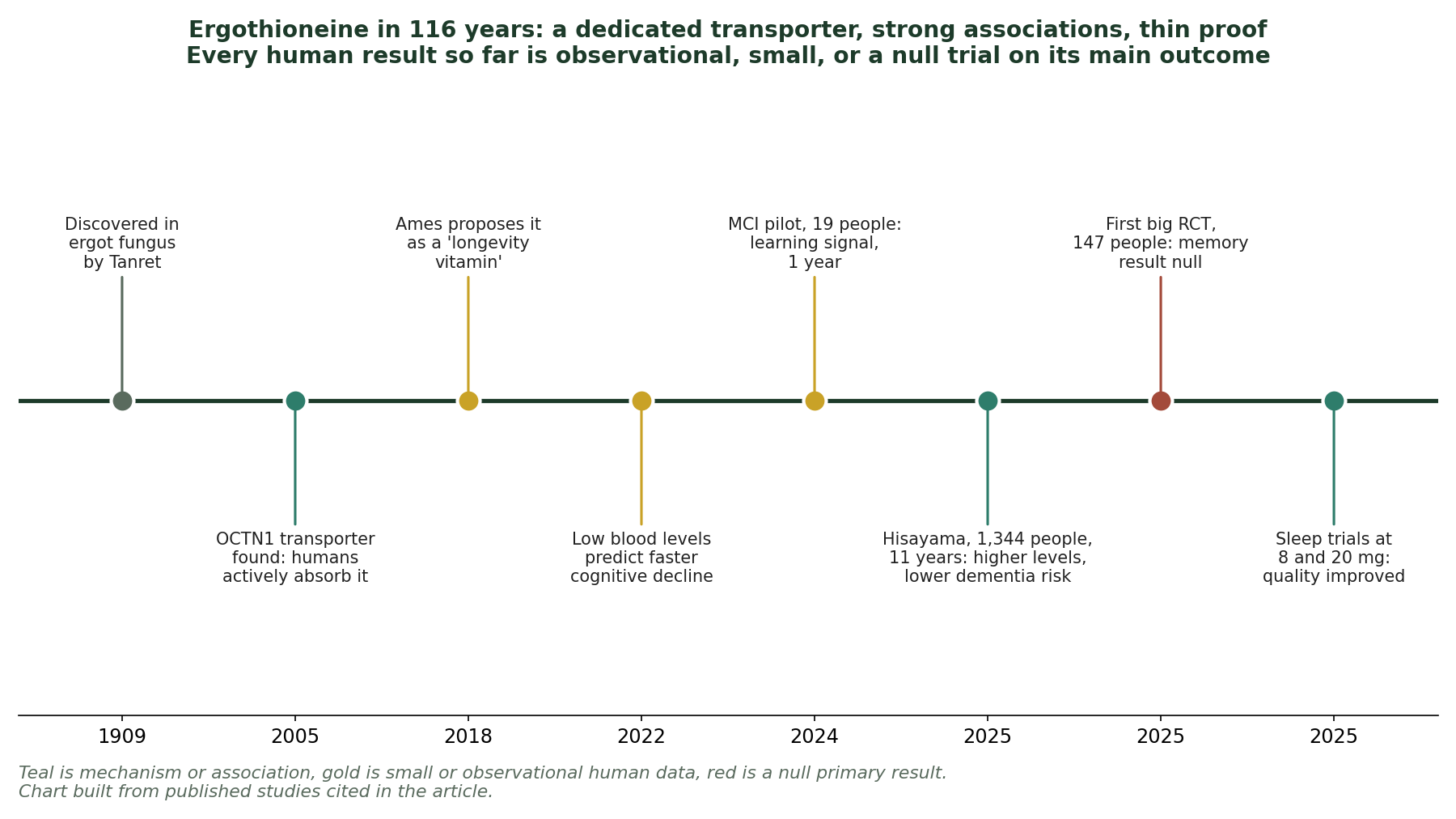
In 2018, biochemist Bruce Ames proposed ergothioneine as a "longevity vitamin", a nutrient whose long term shortfall could raise the risk of age related disease. It was a hypothesis, not a finding. In 2025, the first real human trials finally arrived, and the picture they paint is more interesting, and more honest, than the supplement ads suggest. Blood levels rose 16-fold on the higher dose. Memory did not follow. Sleep did improve. And the strongest evidence, a large Japanese study linking higher blood levels to lower dementia risk, is observational, which means it cannot prove cause and effect.
The short version
- Ergothioneine is a mushroom compound with a dedicated transporter in the human body, which is unusual and genuinely interesting.
- The largest human trial so far, 147 adults over 16 weeks in 2025, found no sustained, placebo separated improvement in memory, its primary outcome.
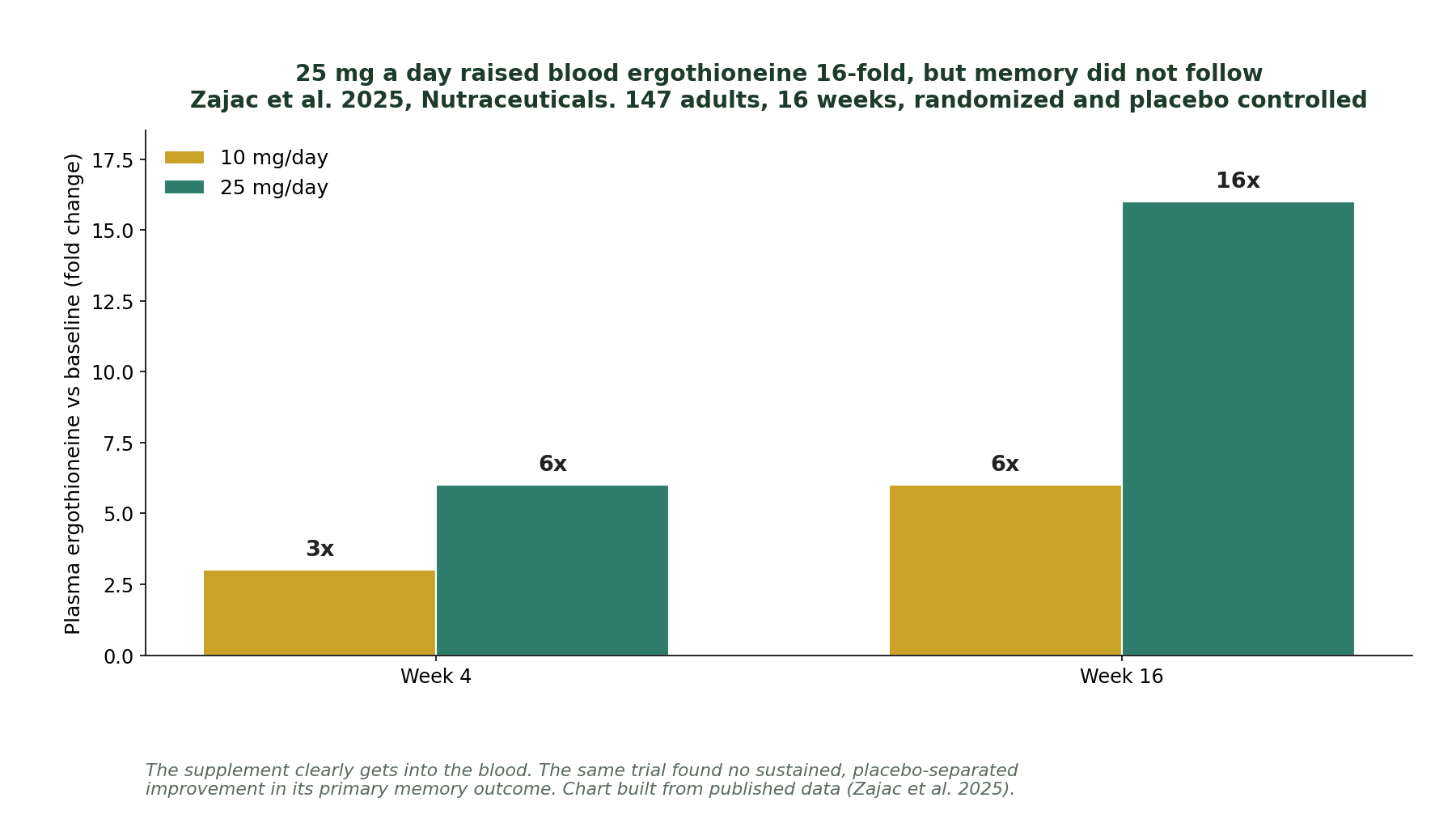
- The same trial found dose dependent improvements in subjective memory and in falling asleep at 25 mg a day, and blood levels rose up to 16-fold.
- A small 2024 pilot in 19 people with mild cognitive impairment reported a learning signal and a stabilized nerve injury marker, but 19 people cannot settle anything.
- A 2025 Japanese study of 1,344 people followed for 11 years found higher blood ergothioneine linked to lower dementia risk. That is an association, not proof that taking it prevents dementia.
- Safety looks good so far. Up to 25 mg a day for 16 weeks, and 25 mg 3 times a week for a year, produced no safety signals.
- Food first. Mushrooms, especially porcini, shiitake and oyster, are the main source, but a normal diet supplies far less than the 25 mg trial dose.
What ergothioneine is
Ergothioneine is a sulfur containing amino acid derivative, discovered in 1909 by the French pharmacist Charles Tanret in ergot fungus. Only fungi and some bacteria can synthesize it. Humans get it entirely from food, and mushrooms are by far the richest source.
What makes it unusual is the transporter. OCTN1, coded by the gene SLC22A4, actively moves ergothioneine out of the gut and into tissues, and it concentrates in places under oxidative stress: the brain, the liver, the kidneys, the eyes and red blood cells. In laboratory studies it is a potent antioxidant that protects mitochondria and dampens inflammation. The body also holds on to it. Unlike most dietary antioxidants, which are cleared within hours, ergothioneine accumulates and is only slowly excreted, which is why a daily supplement can raise blood levels 16-fold in 16 weeks.
Why longevity researchers care
The case for ergothioneine rests on 3 observations. First, the transporter. A dedicated uptake system suggests the molecule does a job the body values. Second, blood levels tend to be lower in older adults and in people with cognitive impairment, according to observational studies from Singapore and Japan. Third, Bruce Ames argued in 2018 that a lifetime of low intake could quietly raise the risk of age related disease, the same logic behind the "longevity vitamin" label.
None of that is proof. Low blood levels in people with cognitive decline could be a consequence of the disease, or of eating fewer mushrooms, rather than a cause. That is the research gap this article is about: the mechanism is plausible and the associations are consistent, but until 2024 there was almost no intervention evidence in humans at all.
The observational evidence: strong links, no proof of cause
The strongest observational study appeared in 2025. The Hisayama Study in Japan followed 1,344 community residents aged 65 and over for a median of 11.2 years. During follow up, 273 people developed dementia. People in the higher quartiles of serum ergothioneine had progressively lower dementia risk, for both Alzheimer's disease and non-Alzheimer's dementia, with all trend tests below 0.05, and the link held regardless of vegetable intake.
A 2025 Chinese longitudinal study of 1,131 older adults without dementia found a similar pattern over 2 years. Each 1 standard deviation higher plasma ergothioneine was linked to a 0.23 point slower decline in MoCA score, roughly equivalent to 1.6 years of cognitive aging, and the protective link levelled off once blood levels reached 1,000 ng/mL. The effect was stronger in men.
Earlier, a Singapore memory clinic study (Wu and colleagues, 2022) found that low plasma ergothioneine predicted faster cognitive and functional decline over 5 years.
Read together, these studies say the same thing: people with more ergothioneine in their blood tend to keep their cognition longer. What they cannot say is whether taking ergothioneine causes that. People with high blood levels eat more mushrooms, and mushroom eaters tend to eat better overall, exercise more and have fewer health problems. Blood ergothioneine may be a marker of a healthy diet and a healthy body, not a lever you can pull with a capsule. Only randomized trials can separate those two stories.
The two trials: a tiny pilot and a real RCT
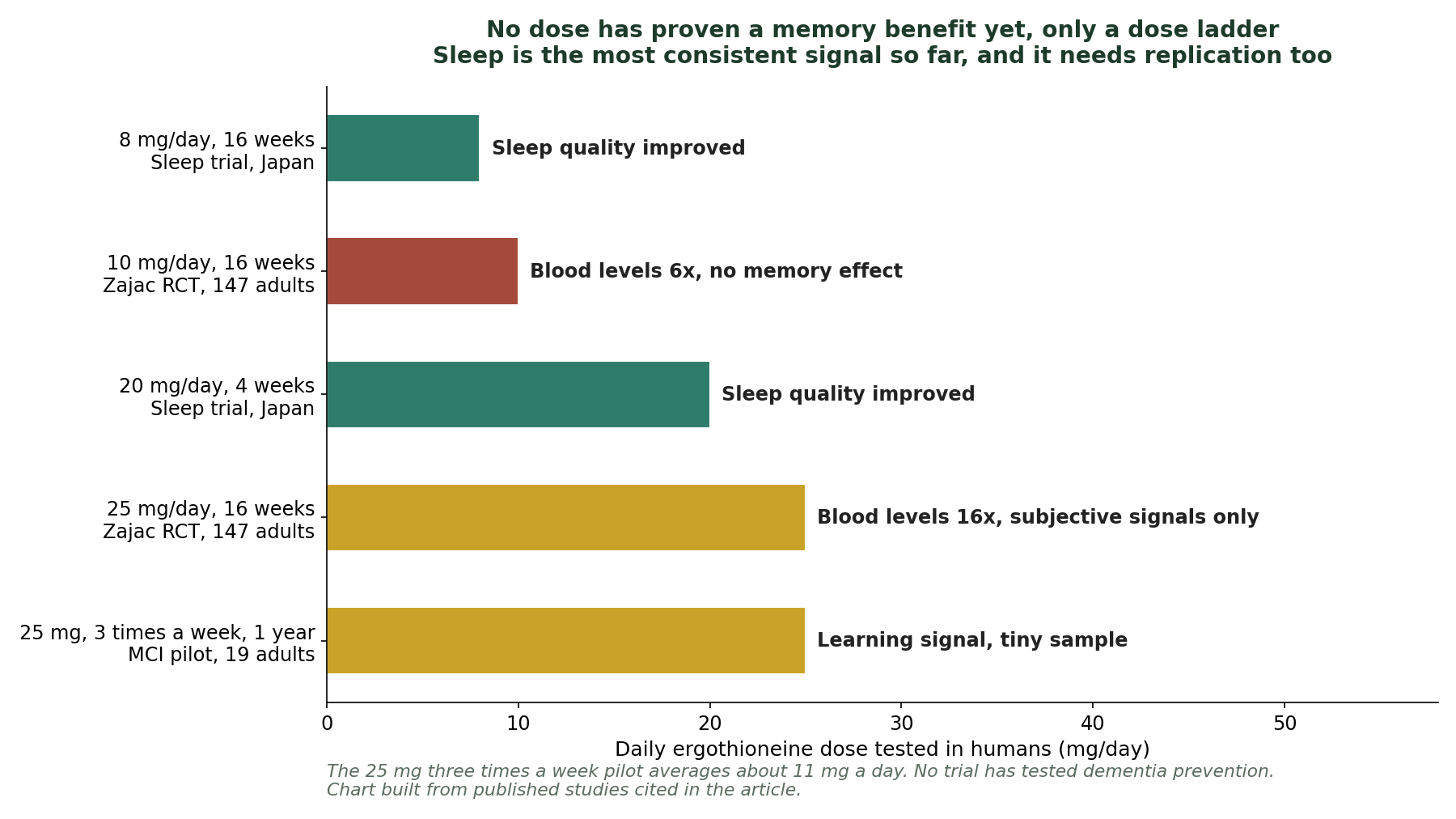
The first intervention trial was a pilot, and it shows in the sample size. Yau and colleagues (2024, Journal of Alzheimer's Disease) enrolled 19 adults aged 60 and over with mild cognitive impairment. Half took 25 mg of ergothioneine 3 times a week for a year, half took a placebo, in a double blind randomized design. The ergothioneine group improved on a word list learning test, the Rey Auditory Verbal Learning Test, and their blood levels of neurofilament light chain, a marker of nerve injury, stayed stable, while the placebo group's levels rose. Routine blood counts, kidney and liver markers showed no safety concerns.
That is worth following up. It is not a foundation for a broad claim. A 19 person pilot is highly vulnerable to chance and baseline imbalance, and no second trial has repeated it yet.
The trial that matters most arrived in June 2025. Zajac and colleagues at CSIRO in Australia ran a 16 week, randomized, double blind, placebo controlled trial of 147 adults aged 55 to 79 with subjective memory complaints, testing ErgoActive ergothioneine at 10 or 25 mg a day against placebo. The primary outcome was change in composite memory on a computerized test battery.
The supplement clearly got into the blood. Plasma ergothioneine rose about 3-fold and about 6-fold at 10 mg a day, and about 6-fold and about 16-fold at 25 mg a day, at weeks 4 and 16. But the primary memory result was null. The 25 mg group showed an early within group memory improvement at week 4, which was not sustained at week 16, and the trial did not establish a clear treatment effect on memory versus placebo.
The secondary outcomes were more encouraging. Subjective prospective memory, remembering to do a planned action, and sleep initiation both improved dose dependently, with significant effects at 25 mg. Liver function improved, and a within group increase in telomere length was noted. The supplement was safe and well tolerated.
Two caveats matter. First, the participants were generally healthy older adults with slightly above average baseline cognition, which makes it hard to detect a memory benefit in 16 weeks. Second, the trial was funded by Blue California, the maker of ErgoActive, so the secondary findings need independent replication before anyone treats them as settled.
Sleep: the most consistent signal so far
If there is one place the early evidence lines up, it is sleep. A 2025 Japanese dose finding study tested ergothioneine for sleep quality in 2 trials. Twenty mg a day for 4 weeks improved sleep quality, and in a randomized, double blind, placebo controlled trial, 8 mg a day for 16 weeks significantly improved subjective sleep quality versus placebo. The Zajac trial also found sleep initiation improved at 25 mg a day.
All of these measures were subjective, the studies were small, and sleep was a secondary outcome in the largest trial. But 3 independent studies pointing the same way is a better pattern than a single positive result. Sleep is the outcome to watch in the next, larger trials, not memory.
Safety and doses
Ergothioneine has a clean safety record so far. The European Food Safety Authority authorized it as a novel food in 2017, at up to 30 mg a day for adults, and it has GRAS status in the United States. The trials used 8 to 25 mg a day for 4 to 16 weeks, and 25 mg 3 times a week for a year, with no safety signals in routine blood, kidney or liver markers.
What is missing is long term data. No trial has followed people beyond a year, there is no safety data in pregnancy or childhood, and no established interaction profile, which is not the same as no interactions. Anyone taking medication or managing a medical condition should talk to a clinician before trying it.
Food first: mushrooms
Mushrooms are the main dietary source, and the type matters. Porcini, also called king bolete, has the highest levels, followed by shiitake, oyster and maitake. White button mushrooms contain far less. Ergothioneine survives cooking well, so sauteed or roasted mushrooms still count.
The honest limit is dose. A mushroom rich diet supplies only a few mg a day, far below the 25 mg used in the trials. Food alone cannot reproduce the trial conditions. That does not make food pointless: the people with the highest blood levels in the cohort studies were mushroom eaters, and their advantage may come from the whole diet, not from one molecule. If you already eat mushrooms regularly, you are already getting ergothioneine. If you do not, adding a couple of mushroom servings a week is the cheapest, lowest risk way to raise your intake.
What it does not prove
No human study shows ergothioneine extends lifespan. No trial shows it prevents dementia. No trial shows it reverses biological age. The memory benefit in healthy adults is unproven, and the "longevity vitamin" label is a proposal from 2018, not a conclusion from human trials. A supplement that raises blood levels 16-fold is not the same as a supplement that changes health outcomes, and the 2025 trial is a useful reminder of that gap.
The bottom line
Ergothioneine is one of the more interesting longevity molecules because the body clearly wants it, the observational data is consistent, and the first trials are real randomized trials rather than marketing. But the best trial so far missed its primary memory outcome, and the positive signals are secondary, subjective, or from a 19 person pilot. If you eat mushrooms, you are already getting it. If you are considering a supplement, the honest summary is: safe so far at studied doses, possibly helpful for sleep, unproven for memory, and dementia prevention is a claim no trial has tested. The next step is a larger, longer, independently funded trial in people with lower baseline levels, which is exactly the population the 2025 authors say should be studied next.
For longevity tools with verified offers, including brain health picks, see our discount codes page.
Safety and limitations
- This article reports on published studies and does not recommend any supplement, dose, or treatment.
- The Zajac 2025 trial was funded by the maker of the ergothioneine used. The MCI pilot had 19 participants. The dementia link is observational and cannot prove cause and effect.
- Ergothioneine supplements are not a treatment for memory loss, mild cognitive impairment, or dementia. Anyone with memory concerns should speak to a clinician.
- Safety data cover up to 1 year of use at studied doses. Long term effects are unknown.
- If you are pregnant, breastfeeding, taking medication, or managing a medical condition, talk to a clinician before trying a new supplement.
FAQ
What is ergothioneine?
Ergothioneine is a sulfur containing amino acid made only by fungi and some bacteria. It is found mainly in mushrooms, and humans absorb it through a dedicated transporter called OCTN1, which delivers it to the brain, liver, kidneys and red blood cells.
Is ergothioneine a longevity vitamin?
Biochemist Bruce Ames proposed the term in 2018, arguing that long term low intake could raise the risk of age related disease. It is a hypothesis, not a proven fact. No human trial has shown ergothioneine extends lifespan.
Does ergothioneine improve memory?
The largest trial, 147 adults in 2025, found no sustained, placebo separated memory improvement. A tiny 2024 pilot in 19 people with mild cognitive impairment reported a learning signal, but it has not been repeated.
Does ergothioneine help sleep?
Early evidence says possibly. Trials at 8, 20 and 25 mg a day reported improved subjective sleep quality or easier sleep initiation. The studies were small and the measures were subjective, so this needs replication.
How much ergothioneine is in mushrooms?
Porcini has the most, then shiitake, oyster and maitake. White button mushrooms have far less. A normal diet supplies only a few mg a day, well below the 25 mg used in the trials.
Is ergothioneine safe?
Trials up to 25 mg a day for 16 weeks, and 25 mg 3 times a week for a year, found no safety signals. EFSA authorized it as a novel food in 2017 at up to 30 mg a day for adults. Long term data beyond 1 year do not exist.
This article is for general information only and is not medical advice. It reports on published studies and does not recommend any supplement, dose, or treatment.
Looking for tools that support healthy aging and recovery? Browse the current offers on our discount codes page. This article is for general information only and is not medical advice. It reports on a published study and does not recommend any supplement, dose, or treatment.