Short answer: Muscle is not just for looking strong. In the largest pooling of the evidence we have, people who did any muscle-strengthening activity lived longer — and the biggest benefit showed up at just 30 to 60 minutes a week. Your grip strength, which takes about a minute to measure, tracks that risk better than your blood pressure does in some of the biggest studies ever run. And unlike most longevity interventions, this one is free, starts working in weeks, and you can do it in your living room with two dumbbells.
Yesterday I wrote about VO2 max and Zone 2 cardio. This is the other half of the exercise equation. Cardio builds your engine. Strength builds the structure that carries you through the decades — the muscle that keeps you out of a wheelchair, off the floor after a fall, and independent at 80.
This is general information, not medical advice. If you have a heart condition, high blood pressure, osteoporosis, a joint replacement, a hernia, or you have been told to limit exercise, talk to your doctor — or a qualified exercise professional — before starting a strength programme.
What the evidence actually says
1. The 2022 meta-analysis: 30–60 minutes a week had the lowest risk
In 2022, Momma and colleagues published a systematic review and meta-analysis in the British Journal of Sports Medicine, pooling 16 prospective cohort studies of adults.
Its findings, in plain terms:
- Muscle-strengthening activity was associated with a 10–17% lower risk of death from any cause, cardiovascular disease, total cancer, diabetes and lung cancer.
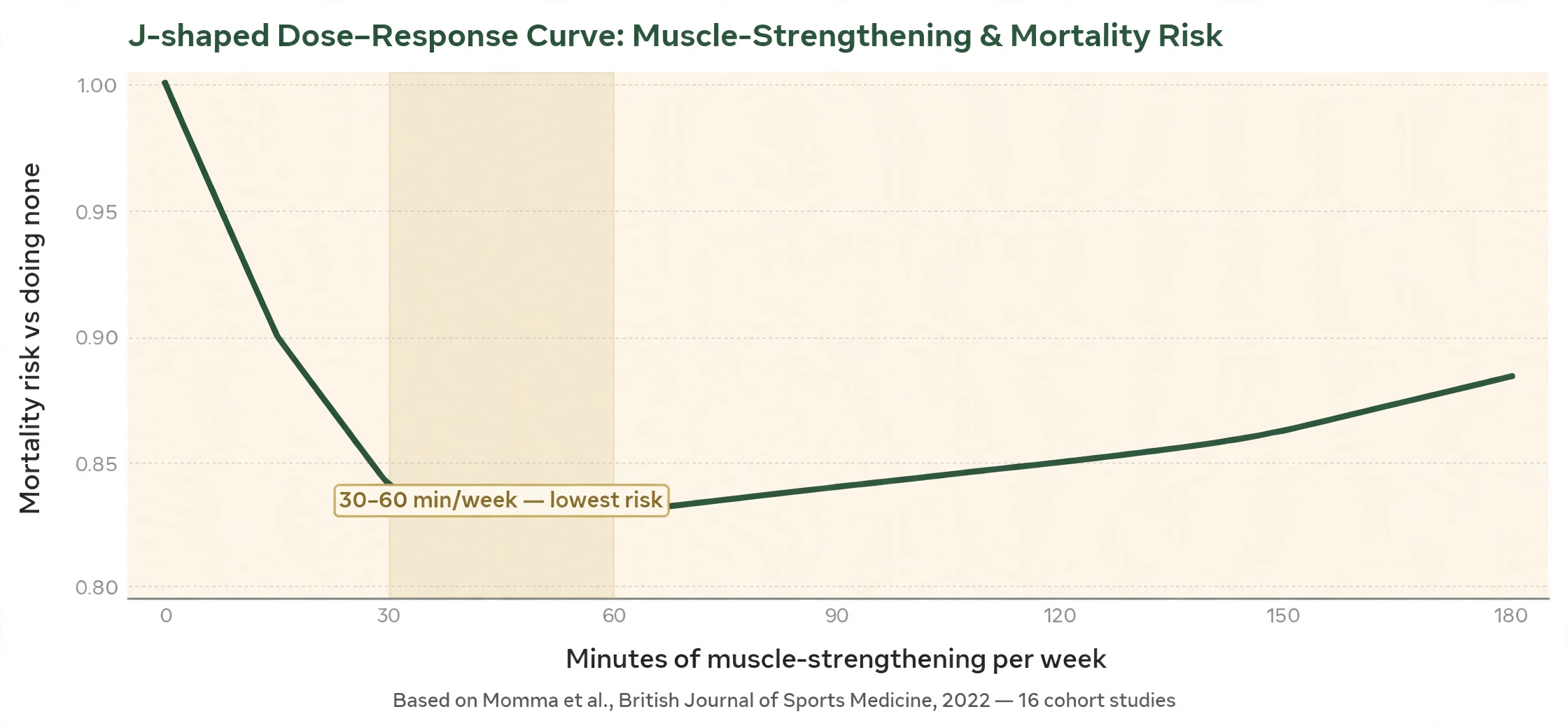
- The relationship was J-shaped: risk fell steeply from zero, reached its lowest point at roughly 30–60 minutes a week (about a 10–20% reduction), then flattened — and the benefit of doing much more was unclear.
- Combining muscle-strengthening with any aerobic activity was associated with an even lower risk: about 40% lower risk of premature death, 46% lower incidence of heart disease and 28% lower risk of dying from cancer, versus doing neither.
That last point is why yesterday's VO2 post and this one belong together. Cardio plus strength beats either one alone.
2. Grip strength: the one-minute test that predicts more than blood pressure
Grip strength is the force you can squeeze with your hand, measured with a small device called a dynamometer. It takes about a minute, costs almost nothing, and researchers use it as a quick stand-in for your overall muscle strength — because grip tracks closely with leg, hip and back strength.
- The PURE study (The Lancet, 2015) followed 139,691 adults aged 35 to 70 across 17 countries for about four years. Each 5 kg lower grip strength was linked to a 16% higher risk of death from any cause and 17% higher risk of cardiovascular death — and grip predicted death better than systolic blood pressure.
- In UK Biobank data (502,293 adults), each 5 kg lower grip was linked to a 20% higher risk of death in women and 16% in men.
- A 2025 study in the Journal of the American Medical Directors Association looked at 308,810 UK Biobank participants over a median of 13.6 years — and found something new: it is not just how strong your grip is, but how even it is. People whose dominant hand was more than 10% stronger than the other had a 13% higher mortality risk and 42% higher odds of frailty.
- Grip peaks around age 32, holds fairly steady through your 40s, and drops faster after 60. The European sarcopenia consensus (EWGSOP2, 2019) uses grip cut-points of 27 kg for men and 16 kg for women as a marker of probable sarcopenia — the age-related loss of muscle.
3. Muscle loss is slow, quiet, and starts earlier than you think
Adults lose roughly 3–8% of their muscle mass per decade after age 30, and the loss accelerates after 60 — especially if you are inactive. This is sarcopenia, and it is not just a body-composition issue: low muscle is independently linked to disability, hospitalisation and earlier death.
The good news is that it responds to training at any age. A 2025 network meta-analysis of 13 randomised trials in 711 older adults with sarcopenia found resistance training improved grip strength, with the largest gains at about three sessions a week at moderate loads — and, interestingly, more was not better. The dose-response was an inverted U, just like the mortality data.
4. What this does NOT prove
This matters, because the headline can be overstated:
- Association is not proof of cause. These are mostly observational studies. People who lift 40 minutes a week differ from people who lift nothing in a hundred ways a questionnaire cannot capture — diet, income, sleep, smoking, and the fact that already-ill people lift less. A weak grip can be a result of illness, not just a cause of it.
- Grip strength is a marker, not a mechanism. No trial has shown that training your grip alone adds years to your life. Grip is useful because it reflects your whole neuromuscular system — training your whole body is what matters, not squeezing a grip trainer all day.
- The J-shape is uncertain at high volumes. The data above roughly two hours a week of strengthening were sparse, and the authors stopped trusting the curve there. "More is better" is not what this evidence says.
- Self-reported exercise is noisy. Most of these cohorts measured activity by questionnaire, not by observation. The 30–60 minute sweet spot is an estimate, not a prescription carved in stone.
The beginner protocol — two sessions a week
You do not need a gym membership, and you do not need five days a week. Start here:
Session structure (2 days a week, 20–30 minutes each, at least one rest day between)
- Squat — goblet squat holding one dumbbell at your chest, 3 sets of 8–10 reps
- Hinge — dumbbell deadlift, 3 sets of 8–10 reps
- Push — dumbbell bench press or floor press, or push-ups from a countertop, 3 sets of 8–10
- Pull — one-arm dumbbell row, 3 sets of 10 per side
- Carry — farmer's carry, dumbbells at your sides, walk 30–60 seconds, 3 rounds
That is five movements, covering legs, hips, chest, back and grip. Rest 60–90 seconds between sets. The last two reps of each set should feel hard — if you could easily do five more, the weight is too light.
Progression (the part most people skip): when you can do all sets and reps with good form, add a little weight, or one more rep. That is the whole secret. Muscle adapts to being asked to do slightly more than last time.
Grip work is built in, not extra: the deadlift and the farmer's carry train your grip every session. If your grip gives out before your legs do, use lifting straps for the heavy sets and keep training grip separately with dead hangs — hang from a bar for 20–30 seconds, 2–3 times, after your session.
Warm up for 5 minutes: easy walking or cycling, then one light set of each movement before your working weight. Cold muscles and heavy weights are how people get hurt.
Protein: the part that makes training work
Training is the signal. Protein is the material. Without enough of it, you are sending the signal with nothing to build with.
- Adults over 65: the PROT-AGE study group recommends at least 1.0–1.2 g of protein per kilogram of body weight per day.
- If you are actively training to build or keep muscle, around 1.6 g per kilogram per day is the commonly cited target in sports-nutrition guidance.
- Spread it across meals rather than eating it all at dinner — your muscles respond to each meal's dose.
For me that means a clean protein source at every meal, and a protein shake on training days. I use Equip Foods Prime Protein (code THRIVETOOLS on our discount codes page) and Zentein protein bars (code EDEN30) when I am travelling. Neither replaces the training — they just make it easier to hit the number.
How this fits with the rest of the Thrive Tools protocol
- VO2 max & Zone 2: cardio plus strength beats either alone. See VO2 Max and Zone 2 Cardio
- HRV: strength training is a stressor — expect HRV to dip the day after a hard session and recover. That dip-then-rebound is normal. See What Is HRV and How to Improve It
- Creatine: the most-studied muscle supplement there is. I have two full guides on the blog — the women's guide and the 10 g brain-dose piece — and it pairs with training, it does not replace it.
- Magnesium: many people are low, and it matters for muscle function and sleep. See Best Supplement Discount Codes 2026 for the verified Bioptimizers code THRIVETOOLS.
- Cold plunge and sauna: recovery tools for the days between sessions, not a substitute for lifting. See Cold Plunge at Home and Contrast Therapy at Home
Who should be careful
- High blood pressure or a heart condition: heavy lifting spikes blood pressure briefly. Get clearance, avoid holding your breath under load (exhale on the effort), and never train to failure.
- Osteoporosis or a joint replacement: strength training helps bone — but only with the right movements and loads. Work with a physiotherapist or qualified trainer first.
- Back, shoulder or knee pain: pain that is sharp, or that gets worse session to session, is a stop signal, not a badge. Reduce the load, change the movement, or get assessed.
- Never trained before: start lighter than you think. Your first two weeks are for learning the movements, not for testing your limits. Soreness for a day or two is normal; pain that lasts a week is not.
- Pregnancy, recent surgery, or a hernia: get individual clearance before starting.
Bottom line
Your muscles are not decoration. They are the organ that keeps you independent — the thing that decides whether you get up off the floor at 80, carry your own groceries, and climb stairs without thinking about it.
The evidence says the dose is smaller than the fitness industry tells you: about 30 to 60 minutes a week, two short sessions, five movements. That is less time than most people spend scrolling in a day.
Start with two dumbbells and a living-room floor. Add a little weight when it gets easy. Eat enough protein. Do it again next week. That is the whole protocol — and it is the one longevity intervention with a one-minute test you can measure at home.
FAQ
How much strength training do I need per week for longevity?
About 30–60 minutes a week had the lowest mortality risk in a 2022 meta-analysis of 16 cohort studies (Momma et al., British Journal of Sports Medicine). Two sessions of 20–30 minutes is enough. More was not clearly better — the benefit flattened, and the data above two hours a week were too sparse to trust.
Is grip strength really a predictor of how long you will live?
In large observational studies, yes. In the PURE study of ~140,000 adults, each 5 kg lower grip was linked to a 16% higher risk of death, and grip predicted death better than systolic blood pressure. But grip is a marker of overall muscle and nervous-system health, not a cause — training your whole body matters, not grip alone.
What is a good grip strength?
The European sarcopenia consensus uses 27 kg for men and 16 kg for women as the cut-point for probable sarcopenia. Average grip for adults aged 40–49 is roughly 47 kg for men and 29 kg for women. A 2025 UK Biobank study also found that a difference of more than 10% between hands was linked to higher mortality and frailty — so even grip matters, not just strong grip.
I am over 50 and have never lifted weights. Where do I start?
Start with two sessions a week, 20–30 minutes, five movements: goblet squat, dumbbell deadlift, push (press or push-ups), one-arm row, and farmer's carry. Use a weight you can lift 8–10 times with good form. Learn the movements first, add weight slowly, and get medical clearance if you have a heart condition, high blood pressure, osteoporosis or joint problems.
Does strength training help bone density?
Yes — resistance training is one of the few interventions with good evidence for maintaining or improving bone mineral density, because loading bone stimulates it to adapt. But the right movements and loads matter, especially with osteoporosis, so get guidance from a physiotherapist or qualified trainer rather than guessing.
How much protein do I need if I lift weights?
For adults over 65, the PROT-AGE group recommends at least 1.0–1.2 g per kilogram of body weight per day. If you are actively training to build or keep muscle, around 1.6 g per kilogram per day is the commonly cited target. Spread it across meals.
Sources
- Momma H, Kawakami R, Honda T, Sawada SS. Muscle-strengthening activities are associated with lower risk and mortality in major non-communicable diseases: systematic review and meta-analysis of cohort studies. Br J Sports Med 2022;56:755–763. doi:10.1136/bjsports-2021-105061
- Leong DP et al. Prognostic value of grip strength: findings from the Prospective Urban Rural Epidemiology (PURE) study. Lancet 2015;386:266–273
- Li Y, Zheng X et al. Handgrip strength asymmetry and mortality/frailty, UK Biobank. J Am Med Dir Assoc 2025
- Network meta-analysis 2025, 13 randomised trials, 711 older adults with sarcopenia — resistance training improved grip strength; largest gains ~3 sessions/week at moderate loads
- Cruz-Jentoft AJ et al. Sarcopenia: revised European consensus (EWGSOP2). Age Ageing 2019
- PROT-AGE Study Group — protein recommendation 1.0–1.2 g/kg/day for adults over 65
- UK Biobank grip-mortality analysis (502,293 adults)
Disclaimer: General information only, not medical advice. Talk to your doctor or a qualified exercise professional before starting a strength programme, especially with a heart condition, high blood pressure, osteoporosis, joint problems, or after surgery.