
Short answer: VO2 max — how much oxygen your body can use during hard exercise — is one of the strongest predictors of how long you live. It is also trainable, at any age. The most useful way to train it for most people is not all-out effort every day. It is mostly slow, conversational Zone 2 cardio, with a small amount of hard work on top.
No supplement in my stack does what this does. And unlike a lot of longevity tools, it costs nothing.
This is general information, not medical advice. If you have a heart condition, chest pain, breathlessness, high blood pressure, or you have been told to limit exercise, talk to your doctor before starting a new training programme, especially high-intensity intervals.
What is VO2 max, in plain English?
VO2 max is the maximum rate your body can take in, transport and use oxygen during intense exercise. It is measured in ml/kg/min — millilitres of oxygen per kilogram of body weight per minute.
In practice, it is a measure of your whole oxygen system working together: lungs, heart, blood, blood vessels and mitochondria in your muscles.
It falls by roughly 10% per decade after age 30 if you do nothing. With consistent training, that decline can be slowed a lot. It is not fixed by your genes, and it is not only for athletes.
What the evidence actually says
1. The 122,000-person study: fitness predicted survival better than smoking or diabetes
In 2018, Mandsager and colleagues published a study in JAMA Network Open of 122,007 patients who had a treadmill stress test at the Cleveland Clinic, followed for a median of 8.4 years.
Its findings, in plain terms:
- Cardiorespiratory fitness was inversely associated with long-term mortality — fitter people lived longer, at every level measured, with no observed upper limit of benefit.
- Each 1-MET increase in fitness (about 3.5 ml/kg/min of VO2 max) was linked to roughly a 13–15% lower mortality risk.
- The least-fit group had roughly five times the mortality risk of the elite-fit group.
- Low fitness was associated with a higher mortality risk than smoking, hypertension or diabetes in that study.
The American Heart Association had already said in 2016, in Circulation, that cardiorespiratory fitness should be treated as a clinical vital sign, alongside blood pressure and heart rate.
2. What this does NOT prove
This matters, because the headline can be overstated:
- Prediction is not proof of cause. These are observational data. People who are already ill tend to have low VO2 max, partly because they are ill — reverse causation. A low number is a signal to investigate, not a personal prophecy.
- It does not prove that raising your VO2 max by itself adds years. Training improves fitness, heart health, insulin sensitivity and mood, and fitter people live longer. That is a strong, consistent pattern across large cohorts, but it is not the same as a randomised trial proving a specific VO2 max target extends life.
- A watch number is not a lab measurement. The gold standard is a cardiopulmonary exercise test (CPET) in a lab, with a mask measuring gas exchange. A smartwatch estimate is a rough proxy from heart rate, pace and your profile. Use it for trend, not as a precise medical number. If two watches disagree, or your number jumps wildly week to week, trust the trend over months, not a single reading.
What is Zone 2, and why does it matter?
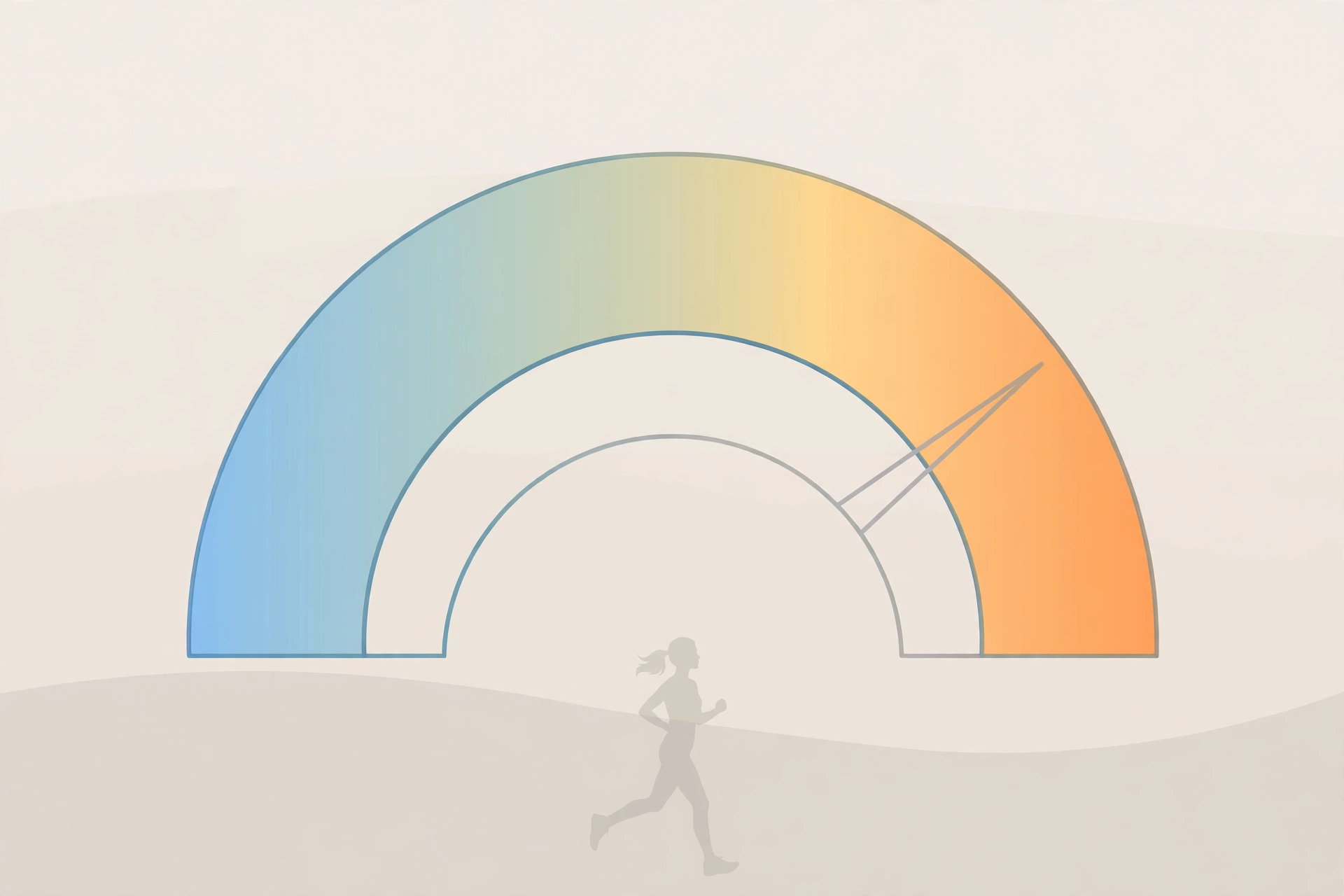
Zone 2 is slow, steady cardio at an intensity where you can still talk in full sentences, but you would rather not sing. For most people that is roughly 60–70% of maximum heart rate, but heart-rate percentages are only rough proxies — the real definition is below your first lactate threshold, the point where lactate starts to build up faster than your body can clear it.
Why this specific intensity gets so much attention in longevity circles:
- At Zone 2, your mitochondria — the energy factories in muscle cells — are working hard on fat for fuel, without the lactate build-up of harder work.
- Work by San Millán and Brooks (2018, Frontiers in Physiology) describes Zone 2 as the intensity that maximally stimulates mitochondrial biogenesis — the creation of new mitochondria — through sustained activation of PGC-1α.
- It improves metabolic flexibility: the ability to switch between fat and carbohydrate for fuel, which declines with age and is linked to metabolic disease.
An honest caveat: a 2025 narrative review in Sports Medicine (Storoschuk et al.) challenged whether Zone 2 is truly unique, arguing that total volume and other intensities also matter, and that the "Zone 2 is special" claim is sometimes overstated. That is a fair challenge. What is not in doubt is that regular moderate aerobic volume helps. Zone 2 is a practical, low-injury way to get that volume — not a magic zone that other exercise cannot match.
The beginner protocol — 150 minutes a week
You do not need 10 hours a week. Start here:
Zone 2: 150–180 minutes a week, in 3–4 sessions of 45–60 minutes
Walk briskly uphill, cycle slowly, swim easy, or jog very slowly. The test is the talk test: you can hold a conversation in full sentences. If you cannot, slow down. If you can chat easily and feel you could go for hours, you are probably in the right place. A rough heart-rate ceiling many coaches use is 180 minus your age — for a 40-year-old, about 140 bpm. Treat that as a starting guess, not a lab result.
One hard session a week, once you have a base (optional, not day one)
After 4–6 weeks of Zone 2, add one short interval session — for example 4 x 4 minutes hard with 3 minutes easy recovery in between. This is the part that pushes VO2 max up fastest. Do not do hard intervals every day, and skip them if you are ill, exhausted, or have a heart condition without medical clearance.
The 80/20 split
Elite endurance athletes do roughly 80% of their training easy and 20% hard. For longevity, the same split is a good guide: most of your cardio should feel easy. If every session leaves you wrecked, you are not training Zone 2 — you are training too hard, too often.
Track trend, not a single number
- Resting heart rate over weeks, not days
- How fast your heart rate recovers in the first minute after hard effort
- Your watch VO2 max estimate as a 3-month trend
- How you feel: energy, sleep, and whether the same pace feels easier
That last one matters. If the same walk feels easier after 8 weeks, your aerobic base has improved, whatever the watch says.
How this fits with the rest of the Thrive Tools protocol
- HRV: Slow aerobic training supports HRV over time. See What Is HRV and How to Improve It: /blog/what-is-hrv-how-to-improve-it
- Cold plunge and sauna: These are recovery and stress tools, not a replacement for cardio. See Cold Plunge at Home: /blog/cold-plunge-at-home-guide and Contrast Therapy at Home: /blog/contrast-therapy-at-home-guide
- Vagus nerve: Slow breathing, cold exposure and easy cardio all work through the same nervous-system regulation. See The Vagus Nerve: /blog/vagus-nerve-vagal-tone-wellness-practices
- Supplements: Creatine, magnesium and protein support training and recovery — they do not replace the training itself. See Best Supplement Discount Codes 2026: /discount-codes
Who should be careful
- Chest pain, unexplained breathlessness, fainting, or a known heart condition — get medical clearance first.
- Start with walking, not running, if you are currently sedentary, overweight, or have joint pain.
- Build volume gradually: add no more than about 10% per week.
- Hard intervals are not for beginners, and not for anyone who has been told to avoid vigorous exercise.
Bottom line
VO2 max is not a vanity metric for athletes. In the largest study we have, it predicted survival more strongly than smoking, diabetes or high blood pressure — and it is trainable.
You do not need a lab, a coach, or a new device to start. You need 150 minutes a week at a pace where you can still talk, most weeks, for months. That is the boring, free, unsexy part of longevity. It is also the part with the strongest evidence.
FAQ
What is a good VO2 max?
It depends on age and sex, and there is no single "good" number for everyone. What matters most is your trend and your fitness relative to your age group. A lab CPET test is the accurate measure; a watch estimate is a rough proxy. Do not compare your number to an elite athlete's — compare it to where you were 3 months ago.
How long does it take to improve VO2 max?
Most beginners see measurable improvement in 6–12 weeks of regular Zone 2 training, with larger gains over 3–6 months. Consistency matters more than any single hard session.
Is Zone 2 cardio better than HIIT for longevity?
They do different jobs. Zone 2 builds your aerobic base and mitochondrial capacity with low injury risk. HIIT / Zone 5 pushes VO2 max up faster. Most longevity protocols use both — about 80% easy, 20% hard — not one or the other.
How many minutes of Zone 2 per week?
A practical target is 150–180 minutes a week, in 3–4 sessions of 45–60 minutes. That aligns with US Physical Activity Guidelines of 150–300 minutes of moderate activity a week. More volume helps up to a point, but 150 minutes is a strong minimum effective dose.
Does walking count as Zone 2?
Yes, if it is brisk enough — uphill walking, fast walking, or walking with a weighted vest for some people. If you can talk in full sentences but feel warm and slightly breathless, you are likely there. If it feels like a stroll, pick up the pace or add incline.
Sources
- Mandsager K et al., JAMA Network Open 2018;1(6):e183605 — 122,007 patients, treadmill testing, median 8.4 years follow-up, no upper limit of benefit, ~13–15% lower mortality per 1-MET increase
- American Heart Association Scientific Statement, Circulation 2016 — cardiorespiratory fitness as a clinical vital sign
- San Millán I, Brooks GA, Frontiers in Physiology 2018 — Zone 2, mitochondrial biogenesis, PGC-1α, lactate threshold
- US Physical Activity Guidelines — 150–300 minutes moderate activity per week
- Storoschuk KL et al., Sports Medicine 2025 narrative review — challenge to Zone 2 uniqueness, total volume matters
Disclaimer: General information only, not medical advice. Talk to your doctor before starting a new exercise programme, especially with a heart condition, chest pain, breathlessness, or high blood pressure.