
Short answer: 7,000 steps a day — not 10,000. In the largest review of step-count research ever published, 7,000 steps a day was associated with a 47% lower risk of dying from any cause compared with 2,000 steps, and going beyond 7,000 added very little for most outcomes. And a 2025 Oxford study found that casual walking — not running, not the gym — was linked to a lower risk of developing cancer. The 10,000-step target was never science. It was a marketing slogan from 1964. Here is what the evidence actually says.
This week I have written about VO2 max and Zone 2 cardio, strength training, and deep sleep. Walking is the fourth pillar, and it is the easiest one to get wrong — because the number everyone chases is made up.
This is general information, not medical advice. If you have a heart condition, joint problems, balance issues, or you have been inactive for a long time, talk to your doctor before starting a new walking routine — especially if you plan to walk briskly or on uneven ground.
Where 10,000 came from: a pedometer ad, not a study
The 10,000-step target was born in Japan ahead of the 1964 Tokyo Olympics, when a company launched a pedometer called Manpo-kei — literally "10,000 steps meter." The number was chosen because it sounded good and the character for 10,000 looked appealing. There was no research behind it. It was a round number on a product box.
It stuck because it is simple, memorable, and just hard enough to feel like an achievement. It also stuck because for decades nobody ran the studies that could replace it. Now somebody has.
The 2025 study that changed the number: 57 studies, one answer
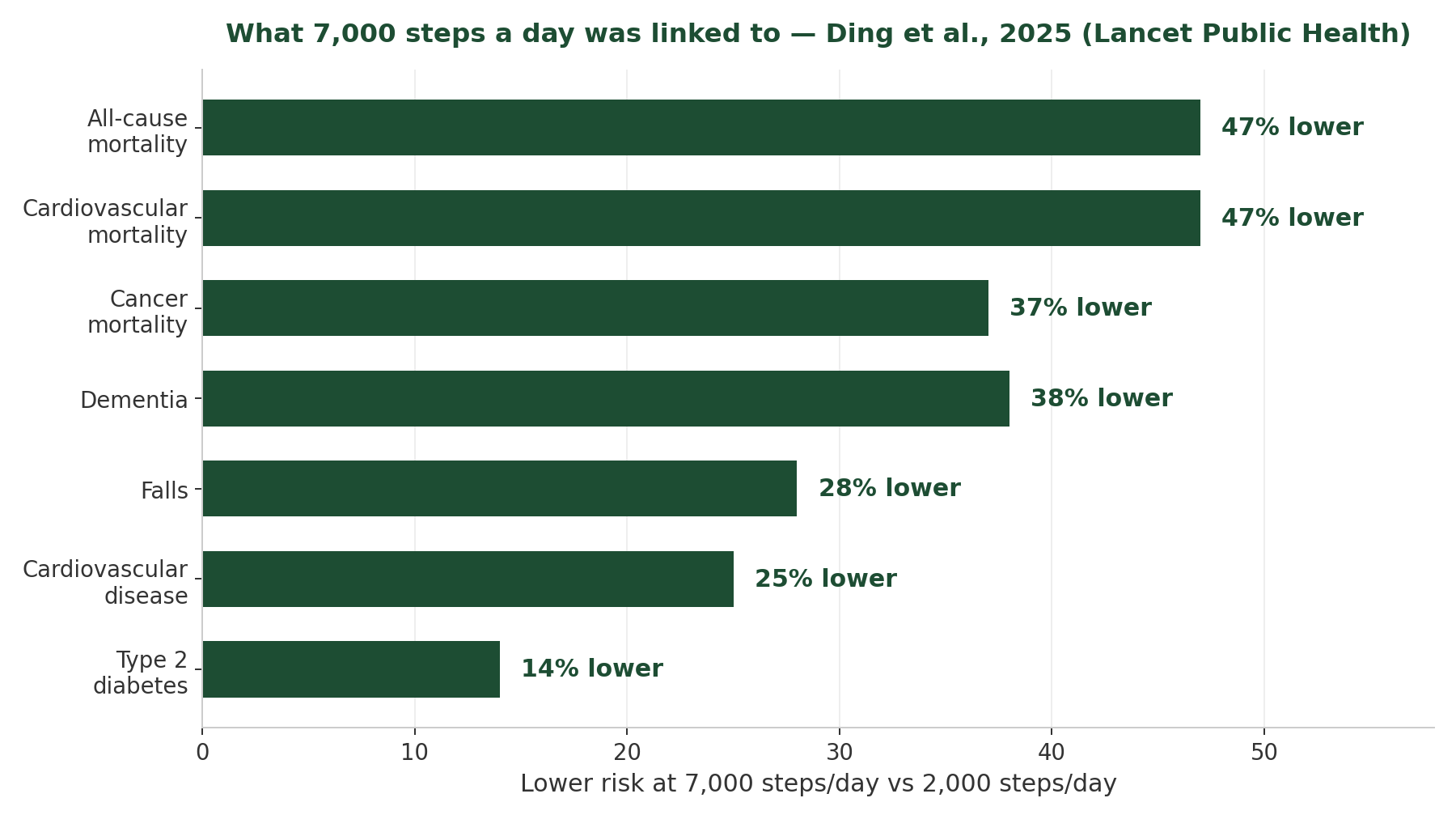
In July 2025, researchers at the University of Sydney published the largest review of step-count research to date in The Lancet Public Health. They pooled 57 prospective studies from more than ten countries, covering eight major health outcomes, all measured with step-counting devices rather than self-report. Their headline comparison: people walking 7,000 steps a day versus people walking 2,000.
Compared with 2,000 steps a day, 7,000 steps was associated with:
- 47% lower risk of dying from any cause
- 47% lower risk of dying from cardiovascular disease
- 37% lower risk of dying from cancer
- 38% lower risk of dementia
- 28% lower risk of falls
- 25% lower risk of developing cardiovascular disease
- 14% lower risk of developing type 2 diabetes
For death from any cause, dementia, and falls, the relationship was non-linear: benefits climbed steeply up to around 5,000–7,000 steps and then largely levelled off. Walking 10,000 steps instead of 7,000 added only about 7% more dementia-risk reduction. For cancer, type 2 diabetes, and depressive symptoms, the relationship was linear — more steps kept helping — but the gains per extra thousand steps were small.
The lead author, Professor Melody Ding, put it plainly: "Aiming for 7000 steps is a realistic goal based on our findings." The review also found that meaningful gains started much lower: going from 2,000 to 4,000 steps a day already moved the needle. You do not need to cross a magic line. You are on a curve, and every step up the curve counts.
Casual walking and cancer risk: the Oxford study
A study led by Oxford researchers, published in the British Journal of Sports Medicine in March 2025, analysed activity-tracker data from 85,394 UK Biobank participants averaging 63 years of age, then compared it with the 2,633 cancer diagnoses that followed over nearly six years.
The findings:
- People walking 7,000 steps a day had an 11% lower cancer risk than people walking 5,000 steps a day.
- At 9,000 steps a day, the risk was 16% lower than at 5,000.
- The number of steps mattered more than the pace. Brisk walking did not beat slow walking once total steps were accounted for.
- People with the highest total daily physical activity were 26% less likely to develop cancer than people with the lowest — after adjusting for lifestyle, body weight, and other health conditions.
- Even light activity counted: shopping and household chores were associated with lower cancer risk.
This is the first large study to use wearable tracker data rather than self-reported exercise to link everyday walking with cancer incidence, which matters — people are notoriously bad at remembering how much they move. Senior author Aiden Doherty, professor of biomedical informatics at Oxford Population Health, said the findings show that "people who often engage in simple low-intensity activities, such as walking, have a lower risk of developing cancer."
Two studies, two different designs, the same conclusion: the walking you already do — to the shops, around the house, to the end of the street and back — is doing more for you than the fitness industry ever told you.
The older evidence agrees
The 2025 review did not come out of nowhere. Three earlier findings pointed the same way:
- Saint-Maurice et al., 2020 (JAMA): in 4,840 US adults, walking 8,000 steps a day was associated with about half the mortality risk of walking 4,000 — and how fast people walked did not matter once total steps were accounted for. The same pattern as the Oxford study, six years earlier.
- Paluch et al., 2021 (JAMA Network Open): a meta-analysis of 15 international cohorts found mortality risk levelled off at around 6,000–8,000 steps a day for adults over 60, and 8,000–10,000 for younger adults. Older adults need fewer steps to get the same benefit — a useful detail if you are starting later in life.
- Banach et al., 2023 (European Journal of Preventive Cardiology): a meta-analysis of 226,889 participants found mortality benefits appearing from as few as roughly 2,300 steps a day. The floor is low. That is good news for anyone who is currently sedentary: the biggest gains come from the first few thousand steps, not the last few.
What this does NOT prove
The numbers are big, so the limits matter:
- All of this is observational. Nobody has randomised people to 7,000 versus 10,000 steps and tracked who lives longer. People who walk more also tend to be healthier, wealthier, less stressed, and less likely to smoke. The studies adjust for what they can measure, not for everything. Reverse causation is real: people who are already ill walk less, which makes walking look more protective than it is.
- Steps are a proxy, not a mechanism. A step counter measures movement, not fitness. Walking 7,000 steps does not raise your VO2 max the way Zone 2 cardio does, and it does not build muscle the way strength training does. Walking is the base layer of movement, not the whole building. If you want the full picture, read my guides on VO2 max and Zone 2 and strength training alongside this one.
- Device step counts are estimates. Wrist trackers undercount slow walking and overcount arm movement. The 7,000 figure is a useful target, not a precise prescription. If your tracker says 6,500 and you walked all day, you probably walked 7,000.
- More is not always better for everyone. The linear outcomes (cancer, diabetes, depression) kept improving with more steps — but joints, feet, and time are real constraints. If walking hurts, the answer is not to push through it. It is to fix the shoes, the surface, or the stride, or to talk to a physiotherapist.
The protocol: how to actually get to 7,000
Nothing here requires a gym, a membership, or a morning you do not have. 7,000 steps is roughly 5–5.6 km, or about 70 minutes of walking spread across a normal day.
1. Find your baseline first. Wear your tracker — or your phone — for a week without changing anything. Most desk workers land between 3,000 and 5,000 steps. That is your starting line, not a failure. The research says the jump from 2,000 to 4,000 already matters.
2. Add 500 steps a day, each week. If your baseline is 4,000, aim for 4,500 next week, then 5,000. You will reach 7,000 in about six weeks without ever having a hard day. Big jumps cause sore feet and abandoned trackers. Small jumps stick.
3. Anchor walks to things you already do. A 10-minute walk after each meal is about 1,000 steps per walk — 3,000 a day before you have done anything special. Walking meetings, parking further away, taking the stairs, and one evening loop around the block will cover the rest. Morning light matters too: a walk within an hour of waking anchors your circadian clock, which is the same mechanism behind the sleep regularity findings I wrote about yesterday.
4. Pace: brisk is nice, but count first. The Oxford study found steps mattered more than pace. If you have to choose between a slow 7,000 and a brisk 4,000, take the 7,000. Once the count is there, brisk walking — fast enough that you can talk but not sing — adds cardiovascular benefit and counts toward your Zone 2 time.
5. Look after your feet. Walking 7,000 steps a day in shoes that hurt is a short experiment, not a habit. Flat, flexible shoes that let your feet move naturally make the distance easier; if you walk on grass or sand, some of those steps barefoot add a grounding element too. Blisters, knee pain, or shin pain that lasts more than a few days is a reason to change the shoe or the surface, not to quit walking.

6. Do not let the number own you. The point of the research is that the curve flattens — the difference between 7,000 and 10,000 is small, and the difference between 5,000 and 7,000 is large. A day at 5,500 steps is not a failed day. The worst thing the 10,000-step myth ever did was convince people doing 6,000 steps that they were not doing enough.
Tools that can help — honestly
Walking is free. Two things on my own list genuinely make it easier to do every day:
- EarthRunners grounding sandals: flat, flexible sandals built for walking long distances with natural foot movement, and the copper plug in the sole keeps you connected to the ground the way barefoot walking does. I walk in them on trails and grass. Code 10THRIVETOOLS on our discount codes page.
- Earthing Harmony grounding sheets: if some of your steps are barefoot on the grass in the morning, the sheets extend the same idea overnight — I reviewed the earthing evidence honestly on the blog, small studies and real limitations included. Code THRIVENOW on our discount codes page.
Neither of these is required to walk 7,000 steps. Comfortable shoes you already own and a pavement you already have are enough. The tools make the habit more pleasant. They do not make it work.
FAQ
How many steps a day should I walk to live longer?
The best current evidence points to about 7,000 steps a day. A 2025 review of 57 studies found 7,000 steps was associated with a 47% lower risk of dying from any cause compared with 2,000 steps, and benefits largely levelled off after that. Older adults get most of the benefit at 6,000–8,000 steps; younger adults at 8,000–10,000.
Is 7,000 steps a day enough, or do I need 10,000?
7,000 is enough for most outcomes. The 10,000-step target came from a 1964 Japanese pedometer marketing campaign, not from research. Going from 7,000 to 10,000 steps added only small extra benefits in the 2025 review — about 7% more dementia-risk reduction, for example. If you enjoy walking 10,000, keep going. If 10,000 feels punishing, 7,000 is a real, evidence-backed target.
Does walking actually reduce cancer risk?
A study published in March 2025 in the British Journal of Sports Medicine found that people walking 7,000 steps a day had an 11% lower cancer risk than people walking 5,000, and 9,000 steps was linked to a 16% lower risk. The number of steps mattered more than the pace. This is observational research — it shows an association, not proof — but it is consistent with the wider evidence that regular physical activity lowers cancer risk.
How far is 7,000 steps?
About 5–5.6 km (3.5 miles), or roughly 70 minutes of walking at a moderate pace, spread across the day. A 10-minute walk after each meal is about 1,000 steps per walk. You do not need to do it all at once — the research counts total daily steps, however you accumulate them.
Does walking speed matter, or just the number of steps?
Just the number, mostly. Both the 2020 JAMA study and the November 2026 Oxford study found that step count predicted outcomes better than walking speed once total steps were accounted for. Brisk walking adds cardiovascular benefit on top, and it counts toward Zone 2 cardio — but a slow 7,000 beats a brisk 4,000.
I only walk 3,000 steps a day. Is it even worth trying?
Yes — that is where the biggest gains are. The 2025 review found meaningful benefits from going from 2,000 to 4,000 steps, and a 2023 meta-analysis of 226,889 people found mortality benefits appearing from as few as roughly 2,300 steps a day. Add 500 steps a day each week and you will be at 7,000 in about two months.
Should I trust my step counter?
Roughly. Wrist trackers and phones estimate steps from movement, and they undercount slow walking and overcount arm movement. Treat the number as a guide, not a lab measurement. What matters is the trend: is your daily average rising over weeks, and are you moving regularly through the day rather than sitting for ten hours and sprinting once?
Sources
- Ding, D. et al. (2025). Daily steps and health outcomes in adults: a systematic review and dose-response meta-analysis. The Lancet Public Health, 10, e668–e681. doi:10.1016/S2468-2667(25)00164-1 — 57 studies; 7,000 vs 2,000 steps: 47% lower all-cause mortality, 47% lower cardiovascular mortality, 37% lower cancer mortality, 38% lower dementia risk, 28% lower falls, 25% lower cardiovascular disease incidence, 14% lower type 2 diabetes.
- Oxford Population Health (2025). Daily steps, light physical activity and cancer incidence: UK Biobank analysis of 85,394 adults. British Journal of Sports Medicine, published March 26, 2025 — 7,000 steps: 11% lower cancer risk vs 5,000 steps; 9,000 steps: 16% lower; highest total activity: 26% lower cancer risk; steps mattered more than pace. Senior author: Aiden Doherty.
- Saint-Maurice, P.F. et al. (2020). Association of Daily Step Count and Step Intensity With Mortality Among US Adults. JAMA, 323(12), 1151–1160 — 4,840 adults; 8,000 vs 4,000 steps associated with about half the mortality risk; step intensity not associated after accounting for total steps.
- Paluch, A.E. et al. (2021). Daily steps and all-cause mortality: a meta-analysis in 15 international cohorts. JAMA Network Open, 4(3), e212769 — mortality risk levelled off at 6,000–8,000 steps/day for adults over 60 and 8,000–10,000 for younger adults.
- Banach, M. et al. (2023). The association between daily step count and all-cause and cardiovascular mortality: a meta-analysis. European Journal of Preventive Cardiology, 30(18), 1975–1985 — 226,889 participants; mortality benefits from as few as ~2,300 steps/day.
Disclaimer: This article is for general information only and is not medical advice. It reports on published research and does not recommend any supplement, dose, or treatment. If you have a medical condition or a health concern, speak to your doctor.