No discount code exists for fisetin on my discount codes page, and this article recommends no product. No partner on the list sells a fisetin supplement. For the tools that support healthy aging with reader offers, see the current list at thrivetools.co/discount-codes.
The short answer
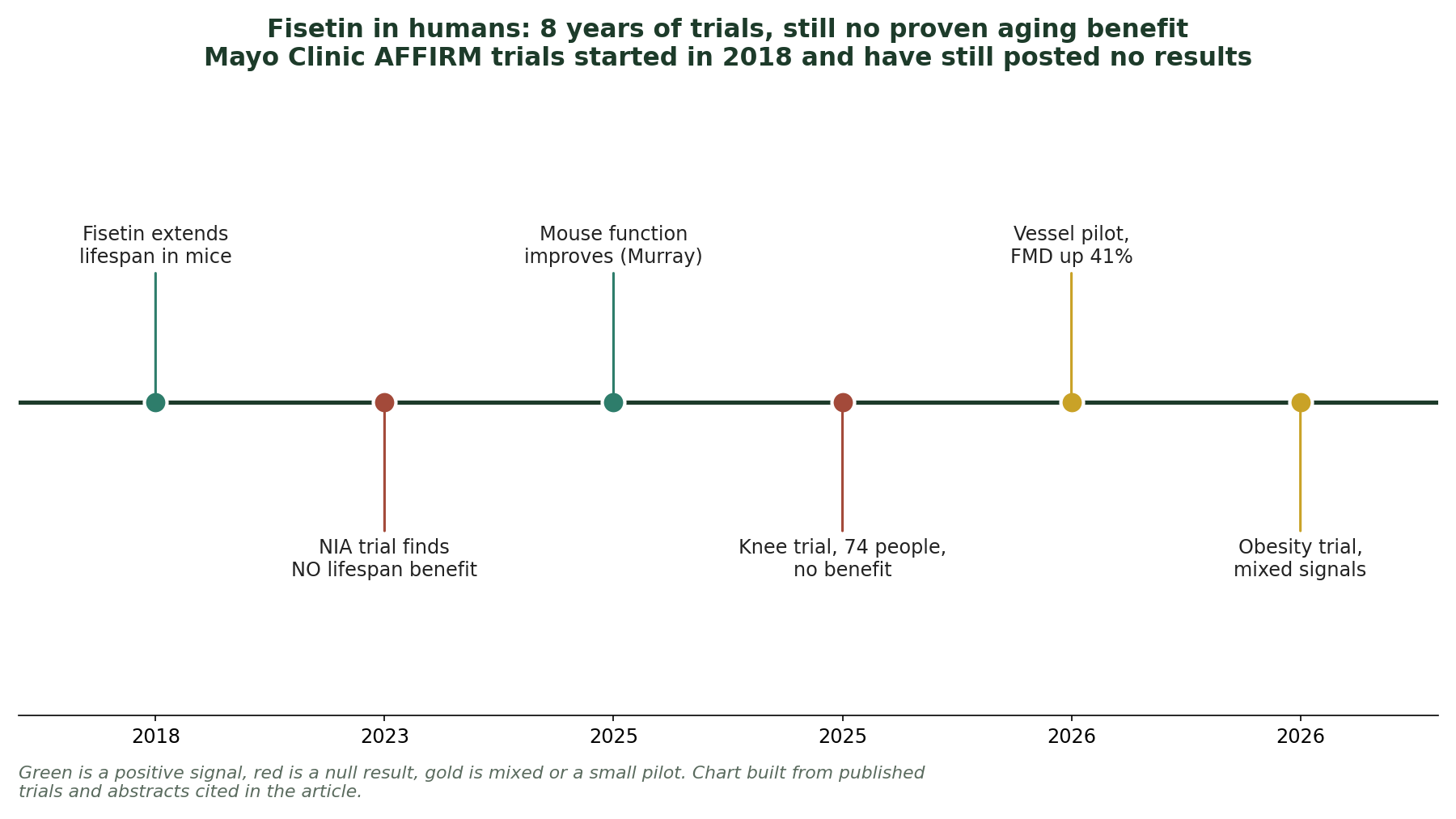
Fisetin is the most hyped senolytic you can buy without a prescription, and the human evidence for it is still almost empty. A flavonoid found in strawberries, it killed senescent cells, the so-called zombie cells, in lab dishes and extended lifespan in mice treated late in life. Then the National Institute on Aging tested it again in a tougher multi-site mouse trial and found no lifespan benefit at all. A strong 2025 mouse study showed it improved frailty and grip strength in old mice, but in people the first real test, a 2025 randomized trial in 74 adults with knee osteoarthritis, found no benefit versus placebo. A small 2026 pilot in 41 older adults did find better blood vessel function, and a 2026 trial in men with obesity found some improved inflammatory markers, but both were small, short, and measured biomarkers, not health outcomes. The biggest fisetin trials, Mayo Clinic's AFFIRM studies, started in 2018 and have still posted no results. Fisetin is an interesting molecule with a real mechanism and a genuine evidence gap, not a proven longevity supplement. Nobody should buy it expecting it to slow aging, because no trial has shown that yet.
What is fisetin, and what is a senolytic?
Fisetin is a flavonol, a type of plant flavonoid, found at its highest concentration in strawberries, with smaller amounts in apples, persimmons, and onions. It has been studied for years as an antioxidant and anti-inflammatory compound. The longevity interest started in 2018, when researchers at the Mayo Clinic and the Scripps Research Institute screened 10 flavonoids for senolytic activity, the ability to selectively kill senescent cells.
Senescent cells are cells that have stopped dividing but refuse to die. They accumulate with age and secrete a cocktail of inflammatory signals, enzymes, and growth factors called the senescence-associated secretory phenotype, or SASP. That secretion damages nearby healthy tissue, degrades the matrix around cells, impairs stem cell niches, and sustains the low-grade chronic inflammation often called inflammaging. Even a small number of senescent cells can drive a disproportionate share of age-related decline, which is why clearing them is such an attractive idea.
Fisetin kills senescent cells in the lab mainly by blocking survival pathways they depend on, including PI3K-Akt and the Bcl-2 family of proteins, the same kind of pathway the prescription senolytic ABT-263 targets. It also crosses into the brain more easily than some other flavonoids, which is one reason it gets attention for cognitive aging. But lab dish potency is not human evidence, and that is where the fisetin story gets complicated.
The mouse story: one lifespan win, one lifespan loss
The 2018 study that started the fisetin boom, Yousefzadeh and colleagues in eBioMedicine, did 2 things that mattered. First, fisetin was the most potent senolytic of the 10 flavonoids screened, killing senescent cells in both mouse and human cell cultures. Second, when old mice were given fisetin late in life, they lived longer, with both median and maximum lifespan extended, and showed lower senescence markers in multiple tissues. That combination, a natural compound in a common fruit, a clear mechanism, and a lifespan result, launched hundreds of supplement brands almost overnight.
Then came the check that rarely makes it into marketing copy. The National Institute on Aging runs the Interventions Testing Program, which tests candidate longevity compounds in genetically diverse mice at 3 independent sites, blinded, with the same protocol. It is the toughest mouse lifespan test in the field. When the program tested oral fisetin, it found no statistically significant benefit on median survival or lifespan in either male or female mice. The 2018 result did not replicate under the stricter test.
Both results are real, and the contradiction is the point. Lifespan in one mouse strain at one site is not a settled fact, it is a result that needs replication. Fisetin failed that replication. That does not mean fisetin does nothing, lifespan is a blunt outcome and a compound can improve function without extending life, but it does mean the claim that fisetin extends lifespan rests on a single unreplicated study. Anyone selling fisetin as a proven lifespan extender is selling the 2018 paper and hiding the 2023 one.
The best fisetin study yet: old mice moved better
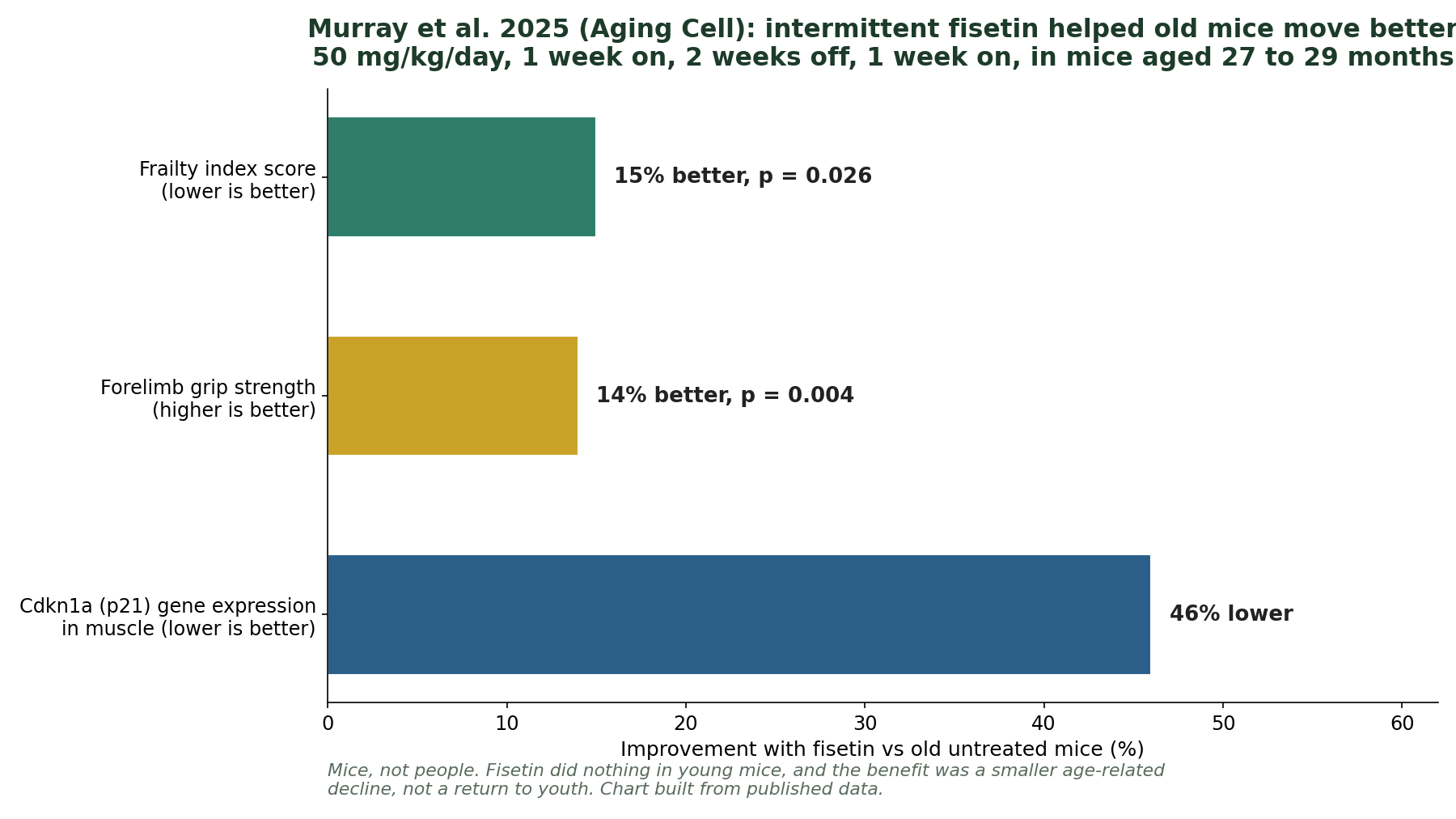
The strongest fisetin paper of 2025 did not measure lifespan at all. It measured function, which is arguably the outcome that matters more. Murray and colleagues at the University of Colorado Boulder, published in Aging Cell in August 2025, gave old mice, 27 month old males and 29 month old females, intermittent fisetin at 50 mg/kg per day, 1 week on, 2 weeks off, 1 week on, the same intermittent pattern human trials use.
The results were clear and statistically strong. Compared with old untreated mice, the fisetin mice had a 15% lower frailty index score (0.23 versus 0.27, p = 0.026) and 14% higher forelimb grip strength (3.30 versus 2.90 grams per gram of body weight, p = 0.004). In muscle tissue, expression of Cdkn1a, the gene for p21, a core marker of senescent cell burden, fell by about 46%, back to the level seen in young mice. Fisetin did nothing in young mice, which is reassuring: it corrected an age-related change rather than pushing a healthy system somewhere new.
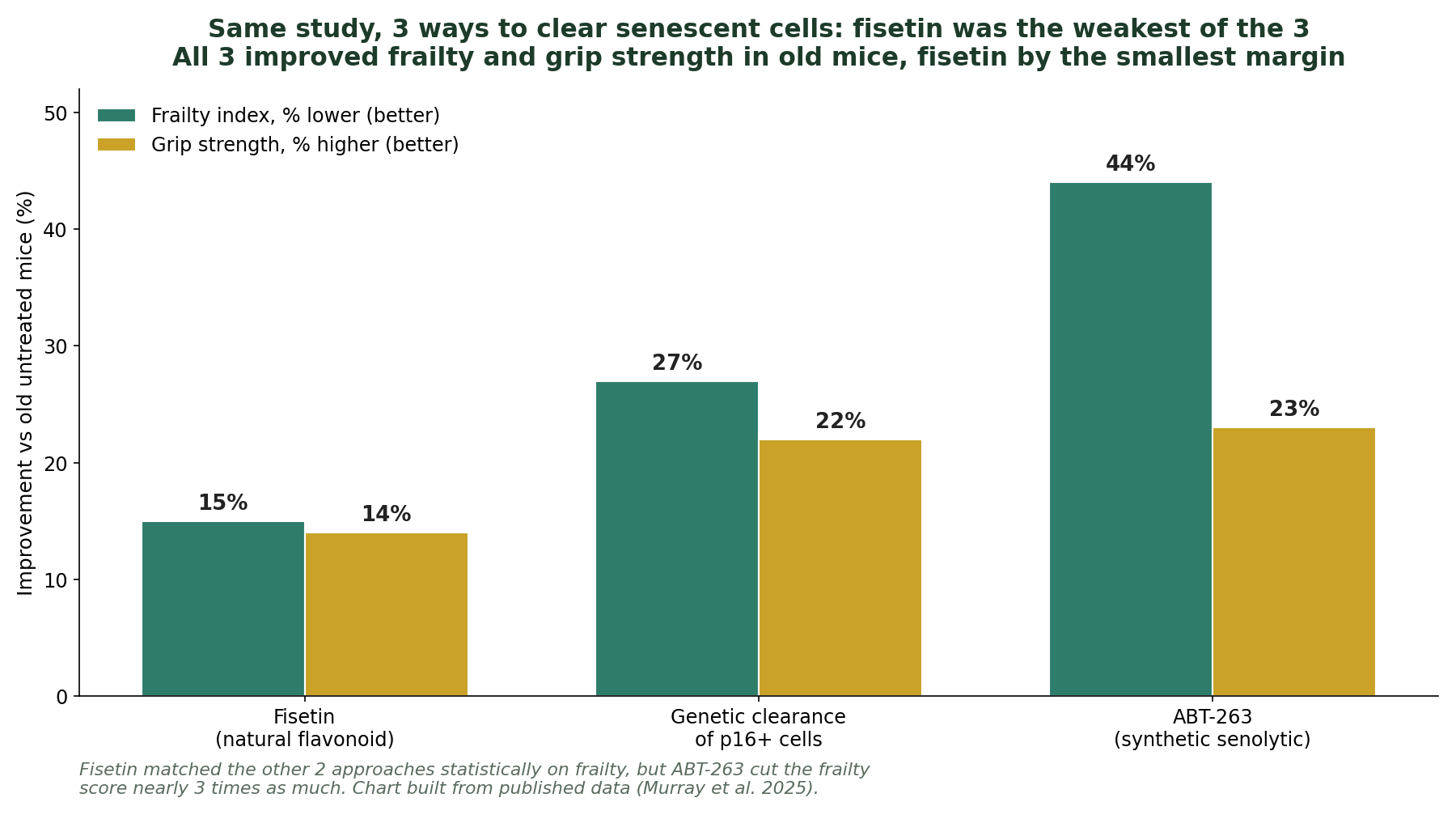
The study also ran the same frailty and grip tests with 2 established ways of clearing senescent cells, genetic clearance of p16 positive cells and the synthetic senolytic ABT-263. All 3 approaches helped. Genetic clearance cut frailty by 27% and raised grip strength by 22%. ABT-263 cut frailty by 44% and raised grip strength by 23%. Fisetin's 15% and 14% were the smallest gains of the 3, though the differences between approaches were not statistically significant on frailty. The honest reading: fisetin works as a senolytic in old mice, about as well as the best tools in the field on function, but weaker than the synthetic drug on the frailty score.
The human trials: 8 years, 3 small answers, and silence from the big one
Here is where the gap between the marketing and the evidence becomes impossible to ignore. A systematic review published in Nutrients in September 2026 found 34 registered fisetin trials and only 4 completed ones with available results. Its conclusion was blunt: clinical evidence for fisetin remains limited and heterogeneous, some studies found favorable changes in metabolic or inflammatory outcomes, others found no clear benefit, and the small sample sizes make it difficult to establish efficacy in humans.
The 3 completed human trials that matter most tell 3 different stories.
The first real randomized test was the knee osteoarthritis trial, published as an abstract in Osteoarthritis and Cartilage in 2025. A total of 74 adults with knee osteoarthritis took intermittent oral fisetin, about 20 mg/kg for 2 consecutive days, repeated for 3 cycles 28 days apart, or a matched placebo. Fisetin was generally well tolerated, but it showed no significant benefit versus placebo for pain, function, or MRI cartilage measures. The first rigorous human test of intermittent high dose fisetin, and it found nothing. Dose and indication matter, and this result is a warning against assuming the mouse data transfers.
The second was a small endothelial function pilot, reported as a 2026 abstract, in 41 older adults. Participants took a much lower dose, 2 mg/kg per day, for two 3 day periods separated by 14 days. Flow-mediated dilation, a measure of how well blood vessels widen, improved by about 41% with fisetin, from 3.9% to 5.5%, versus no change on placebo, with supporting signals in senescence-related gene expression in immune cells. It is a real randomized, placebo controlled signal, and it is also a pilot: 41 people, a surrogate endpoint, and an abstract, not a full peer reviewed paper. Blood vessel function improving for a few weeks is not the same as fewer heart attacks or a longer life.
The third was a 2026 randomized trial in sedentary men with obesity, run at Hakim Sabzevari University. Participants were assigned to fisetin alone at 200 mg per day, interval resistance-aerobic training alone, both combined, or placebo, for 12 weeks. Two papers from the trial reported improved adipokines and inflammatory markers, with the largest changes in the combined arm. Again, biomarkers only, 12 weeks, and the trial was not designed to tell us whether fisetin adds anything beyond what exercise already does.
And then there is the silence. Mayo Clinic's AFFIRM trials, the studies the whole field has been waiting for, started in 2018. AFFIRM and AFFIRM-LITE enrolled older adults to test intermittent high dose fisetin against frailty, inflammation, and senescence markers. Eight years later, neither has posted results. A new trial, Fisetin LOW in Denmark, is now recruiting 120 healthy adults to test a low daily dose of 100 mg, with results expected late in 2026. The STOP-Sepsis trial is testing fisetin in elderly patients with sepsis. The field is still waiting for its first adequately powered human trial of fisetin for aging.
What the evidence does NOT show
This is the part supplement marketing skips, so let me state it plainly.
No human trial has shown that fisetin extends lifespan, prevents disease, or improves a clinical outcome like walking speed, hospital visits, or survival. The positive human signals are changes in blood vessel function and inflammatory markers over weeks, in small groups. The largest randomized trial so far found no benefit at all for its target condition. There is no validated blood test that proves senescent cells were cleared in a person taking fisetin, a gap the field itself acknowledges. A 2024 review co-authored by Mayo Clinic researchers noted that pharmacokinetic limitations and the absence of validated circulating biomarkers of senolysis remain key barriers to translating fisetin to humans.
Eating strawberries does not count either. The researchers behind the 2025 mouse study state it directly: fisetin is not present in foods in high enough concentrations to exert senolytic effects. You cannot eat your way to a trial dose, and the food studies showing flavonoid rich diets track with better health are measuring diets, not fisetin.
Dose and absorption: there is no established dose
There is no established human dose for fisetin, because no dose has been proven to work. The trials have used very different regimens: about 20 mg/kg for 2 days, repeated monthly, in the knee trial, which is about 1,400 mg per day for a 70 kg person on those 2 days; 2 mg/kg per day for two 3 day bursts in the vessel pilot, about 140 mg per day; and 200 mg per day for 12 weeks in the obesity trial. Typical supplements sell 100 to 500 mg per capsule, often daily, which matches none of the trial protocols exactly.
Fisetin is also poorly absorbed on its own. Researchers are testing new formulations, including hydrogel based delivery, to raise blood levels, but none of that formulation work has been tested for health outcomes in people. The dose on a supplement label is a guess, and the label tells you nothing about how much reaches your blood. Do not copy a trial dose from an article, including this one. The trial doses were used under medical supervision in research settings, for a specific purpose, for a short time.
Safety and limitations
In the early human studies so far, fisetin has been generally well tolerated at the doses tested, and a 2024 review described its safety profile in early human studies as favorable. That is reassuring but narrow: small numbers of people, short durations, and no long term safety data. There are no published data on fisetin in pregnancy or breastfeeding, and no data on years of continuous use, which matters because the trial protocols are intermittent, not daily forever.
Senescent cells are not purely harmful. They play roles in wound healing and in suppressing cancer, which is one reason trials use short bursts of fisetin with weeks off, to clear excess senescent cells without disrupting the normal functions senescence supports. Daily high dose fisetin for months on end has never been tested in people, and it is not what the evidence supports.
Talk to a clinician before taking fisetin, especially if you take prescription medication, have a medical condition, or are considering it as a substitute for proven care. Supplement quality varies widely, and a product that says fisetin on the label may contain far less than claimed. If you are over 65, the population the trials actually studied, that conversation matters even more.
My verdict
Fisetin is the most interesting unproven senolytic you can buy, and that sentence cuts both ways. The mechanism is real: it kills senescent cells in the lab and in mice, and the 2025 Murray study is genuinely good science showing old mice became less frail and stronger. But the lifespan claim failed its toughest replication, the first human randomized trial found nothing, and the positive human signals are small, short, and measured in biomarkers. The biggest trials have been silent for 8 years.
If you already take fisetin, you are running an experiment on yourself with no proven benefit and no long term safety data. If you are considering it, the honest order of operations is different: strength training 2 to 3 times a week, which has proven effects on frailty and grip strength in humans, the exact outcomes fisetin improved in mice; 7 to 9 hours of sleep; and a diet rich in flavonoid foods like strawberries, which give you fisetin in food form along with everything else in the fruit. I wrote a beginner strength training guide here: https://thrivetools.co/blog/strength-training-longevity-muscle-guide
The trial to watch is Fisetin LOW in Denmark, testing 100 mg a day in healthy adults, with results expected late in 2026. Until a trial like that reports a real benefit in people, fisetin belongs in the watch list, not the buy list.
FAQ
Does fisetin actually work as a senolytic in humans?
In lab dishes and in mice, yes, it clears senescent cells. In humans, we do not know, because there is no validated blood test that proves senescent cells were cleared in a person, and no human trial has measured senescent cell burden in tissue as its main outcome. The human signals so far are indirect: better blood vessel function in a 41 person pilot and improved inflammatory markers in a 12 week obesity trial. Those are consistent with a senolytic effect, but they do not prove one.
What is the best fisetin dose?
There is no established dose, because no dose has been proven to work in people. Trials have used about 20 mg/kg for 2 days repeated monthly, 2 mg/kg per day in short bursts, and 200 mg per day for 12 weeks. Supplements typically sell 100 to 500 mg. None of those regimens is a recommendation, and the intermittent trial pattern, short bursts with weeks off, is deliberate, not a marketing choice.
Is fisetin safe?
In early human studies it was generally well tolerated at trial doses, but those studies were small and short, with no long term safety data. There are no data for pregnancy or breastfeeding. Talk to a clinician first, especially if you take prescription medication or have a medical condition, and buy from a brand that publishes third party testing.
Is fisetin better than quercetin?
In the 2018 flavonoid screen, fisetin was the most potent senolytic of the 10 flavonoids tested, and quercetin alone was weaker. In practice, quercetin has more human data, but only in combination with the cancer drug dasatinib, which showed small reductions in senescent cells in human fat tissue. Neither fisetin nor quercetin alone has a proven anti-aging benefit in people. Comparing them on potency in a dish misses the point: neither has passed a human trial for aging.
Can I get enough fisetin from strawberries?
No, not at trial doses. Strawberries have the highest fisetin content of any common food, but the researchers behind the 2025 mouse study state directly that food does not contain enough fisetin to exert senolytic effects. Eating strawberries is still a good idea, flavonoid rich diets track with better health, but that is the diet working, not a senolytic dose of fisetin.
When will we know if fisetin works?
The trial to watch is Fisetin LOW, a triple blind placebo controlled trial in Denmark testing 100 mg a day in healthy adults, with results expected late in 2026. Mayo Clinic's AFFIRM trials, running since 2018, could also report. Until one of them shows a real benefit in people, fisetin is an open question, not an answer.
This article is for general information only and is not medical advice. It reports on published studies and does not recommend any supplement, dose, or treatment. Fisetin is sold as a dietary supplement and is not approved to treat, prevent, or slow aging or any disease. Talk to your doctor before taking it, especially if you take prescription medication, have a medical condition, or are pregnant or breastfeeding.
Looking for tools that support healthy aging and recovery? Browse the current offers on our discount codes page. This article is for general information only and is not medical advice. It reports on a published study and does not recommend any supplement, dose, or treatment.