The short answer
About 1 in 3 women and 1 in 5 men over 50 will break a bone because of osteoporosis, according to the International Osteoporosis Foundation. We have known for a long time that bones thin with age, but the molecular reason has stayed fuzzy. A study published today, Nov 20, 2026, in Cellular and Molecular Life Sciences adds a new piece, and it is a strange one.
Researchers at Xiangya Hospital of Central South University in Changsha, China, found that a stress enzyme called angiogenin snips a transfer RNA molecule inside aging bone marrow stem cells. The fragment left behind, called 5'-tiRNA-Glu-CTC, then destroys the messages those cells need to build bone. The stem cells drift toward becoming fat instead, they turn senescent, and bone thins. When the researchers blocked the fragment in old mice, the bone loss reversed. In blood samples from 40 people with osteoporosis, higher levels of the fragment tracked with lower bone density. This is early work, in mice and cells, not a treatment. But it names a new target, and it explains a part of bone aging that calcium alone never explained.
Your bone marrow stem cells must choose: bone or fat
Inside your bones sits marrow, and inside the marrow are bone marrow stromal cells, or BMSCs. These are stem cells with a choice. They can become osteoblasts, the cells that build new bone, or adipocytes, the cells that store fat. In a young adult the balance favours bone. With age it tips toward fat. Marrow gets fattier, bone gets thinner, and that shift is a quiet driver of osteoporosis. The question is what tips it.
Oxidative stress is part of the answer. With age, reactive oxygen species build up in these stem cells, and the cells accumulate damage and turn senescent, meaning they stop dividing and start sending out inflammatory signals. The new study traces a specific chain from that stress to the bone-fat imbalance, and the chain runs through an enzyme most people have never heard of.
The enzyme and the fragment
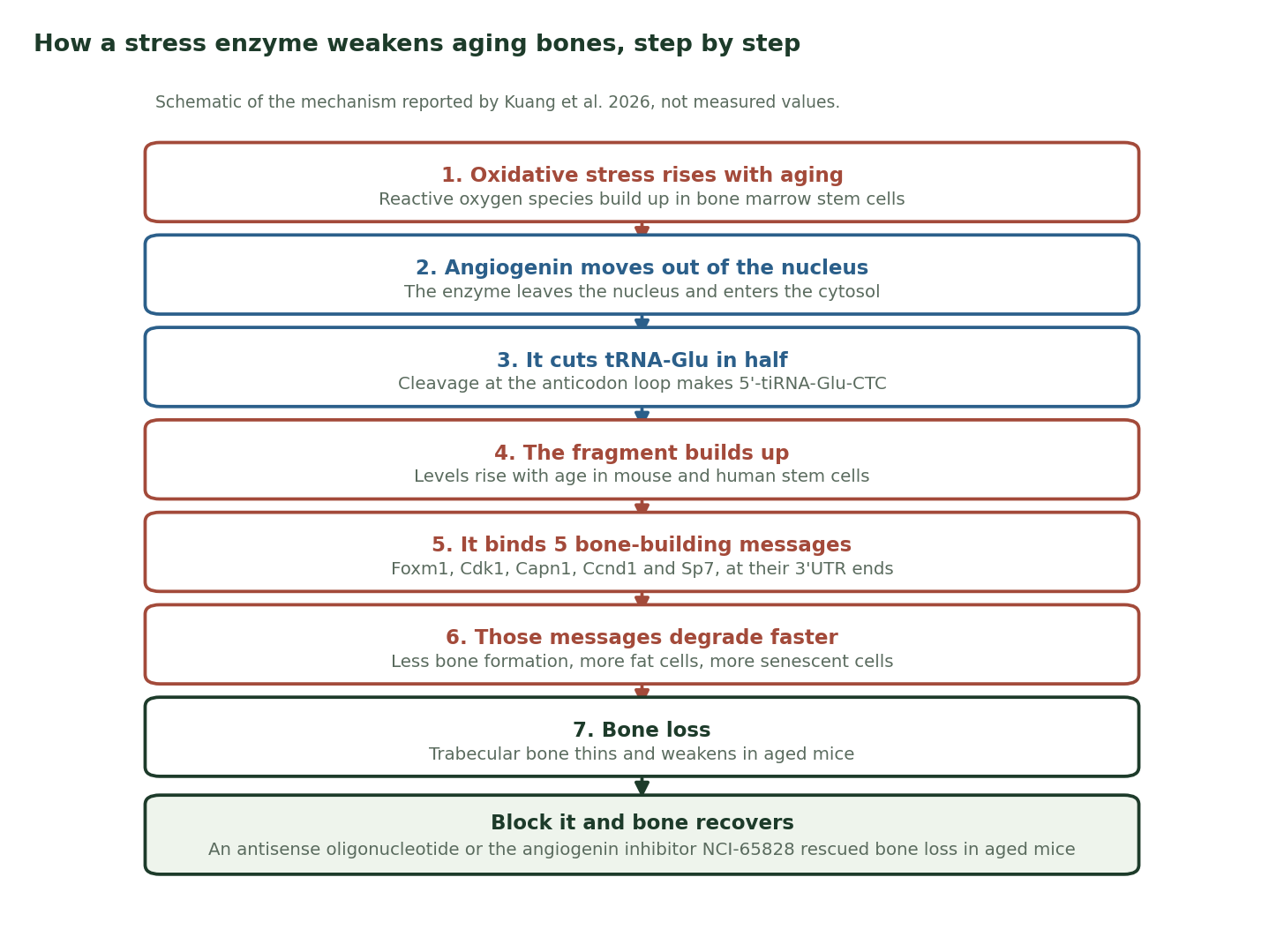
Angiogenin is a ribonuclease, an enzyme that cuts RNA. In a healthy cell it mostly lives in the nucleus, where it helps produce ribosomal RNA and supports cell growth. It also helps grow blood vessels, which is where its name comes from. Under stress, it moves out of the nucleus and into the cytosol, the main body of the cell, and there it starts cutting mature transfer RNAs in half at a spot called the anticodon loop. The halves it produces are called tiRNAs, short for tRNA-derived stress-induced RNAs, and they are 30 to 40 letters long.
This cutting is a normal stress response. It slows down general protein production so the cell can ride out a bad moment. The problem, the study found, is that in aging bone marrow stem cells the response never switches off. Angiogenin levels rise in senescent stem cells, and a particular fragment, 5'-tiRNA-Glu-CTC, cut from a glutamate transfer RNA, accumulates with age in both mouse and human stem cells.
What the fragment does to bone-building messages
The fragment does not just float around. The researchers used a pull-down experiment, fishing out everything the fragment binds to, and found it latches onto the tail ends, the 3'UTR regions, of 5 messenger RNAs that bone marrow stem cells depend on:
- Foxm1, Cdk1, Capn1 and Ccnd1, which keep the cell cycle turning and hold senescence back
- Sp7, also known as osterix, the master switch that tells a stem cell to become a bone-building osteoblast
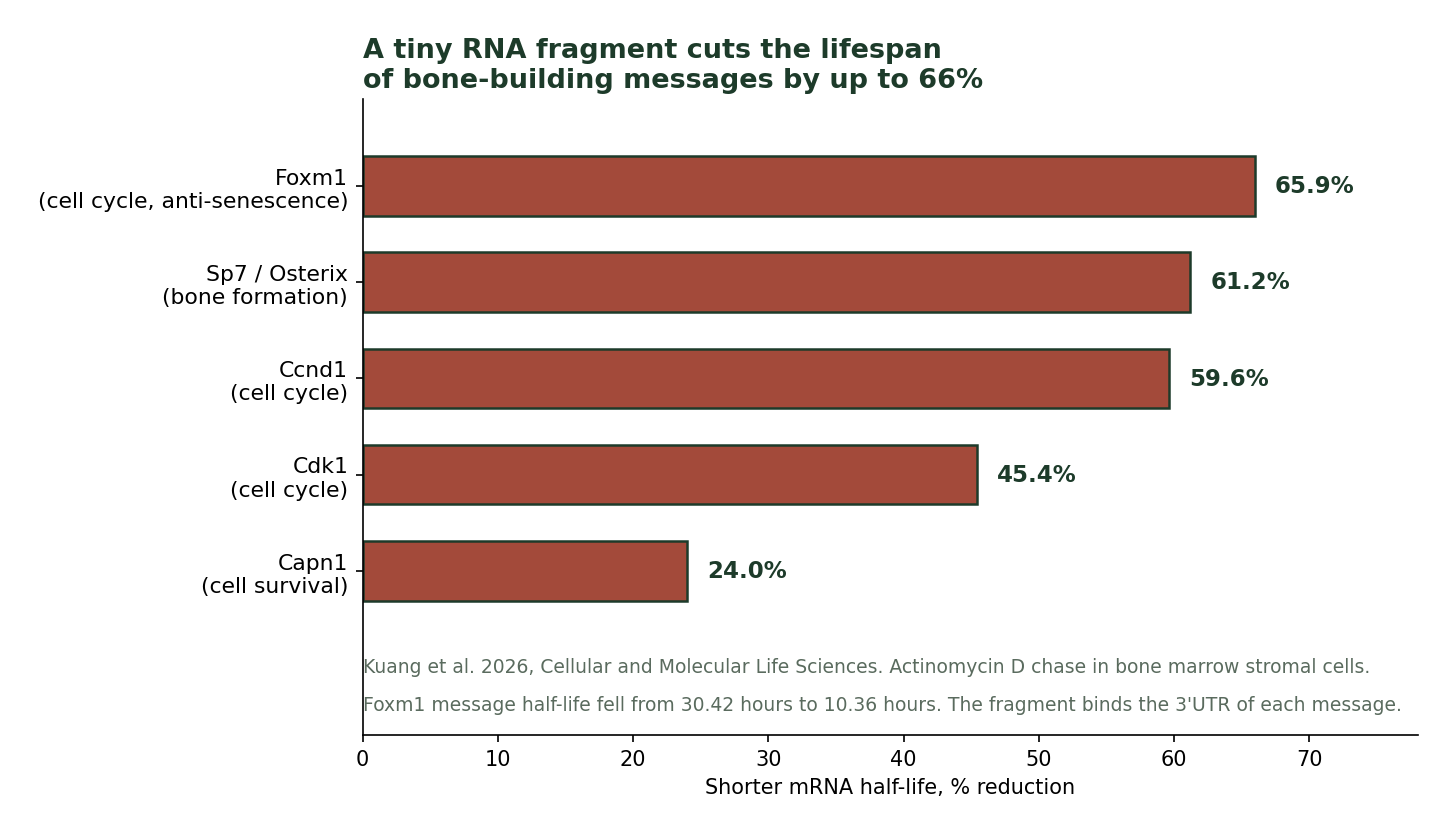
Binding to those tails makes the messages degrade faster. The team measured the effect with an actinomycin D chase, which stops new messages being made so you can watch the old ones decay. The Foxm1 message normally lasts 30.42 hours. With the fragment present, it lasted 10.36 hours, a drop of 65.9%. The other messages fell too: Cdk1 by 45.4%, Capn1 by 24.0%, Ccnd1 by 59.6%, and Sp7 by 61.2%. The proteins those messages code for fell as well, while a fat-making protein, LPL, went up. In total the fragment touched 312 genes, enriched in cell cycle and cellular senescence pathways. The cell loses its bone instructions and gains fat instructions at the same time.
The mouse experiments: adding it made bones worse, blocking it made them better
The team tested the chain in both directions, in young (3 month) and aged (12 month) male and female mice, 8 animals per group.
First they added the fragment, delivered by a viral vector, rAAV2/9. The result was worse bone: less bone mass, fewer trabeculae, the struts inside bone, fewer osteoblasts, fewer Sp7-positive cells, and a slower mineral apposition rate, the speed at which new bone mineral is laid down. In males, bone-resorbing osteoclast numbers rose too. In females the osteoclast effect did not show up, a sex difference the authors note but do not explain.
Then they blocked it. They built an antisense oligonucleotide, or ASO, a short strand designed to bind the fragment and mark it for destruction, and delivered it by injection into the bone marrow of 18 month old male and female mice, 1 dose of 1 x 10^11 viral genomes per mouse, for 1 month. The treated mice had more bone mass, thicker and more numerous trabeculae, less space between them, fewer fat cells in the marrow of females, more osteoblasts, fewer osteoclasts, and a faster mineral apposition rate. The ASO also rescued bone loss in a second mouse model carrying an angiogenin variant, ANG(S28N).
A third test used NCI-65828, a small molecule that inhibits angiogenin itself. It eased stem cell senescence and age-related bone loss in aged mice as well. 3 different ways of interrupting the same chain all pointed the same way, which is what makes this study more than a single observation.
The human link: the fragment tracks bone density in blood
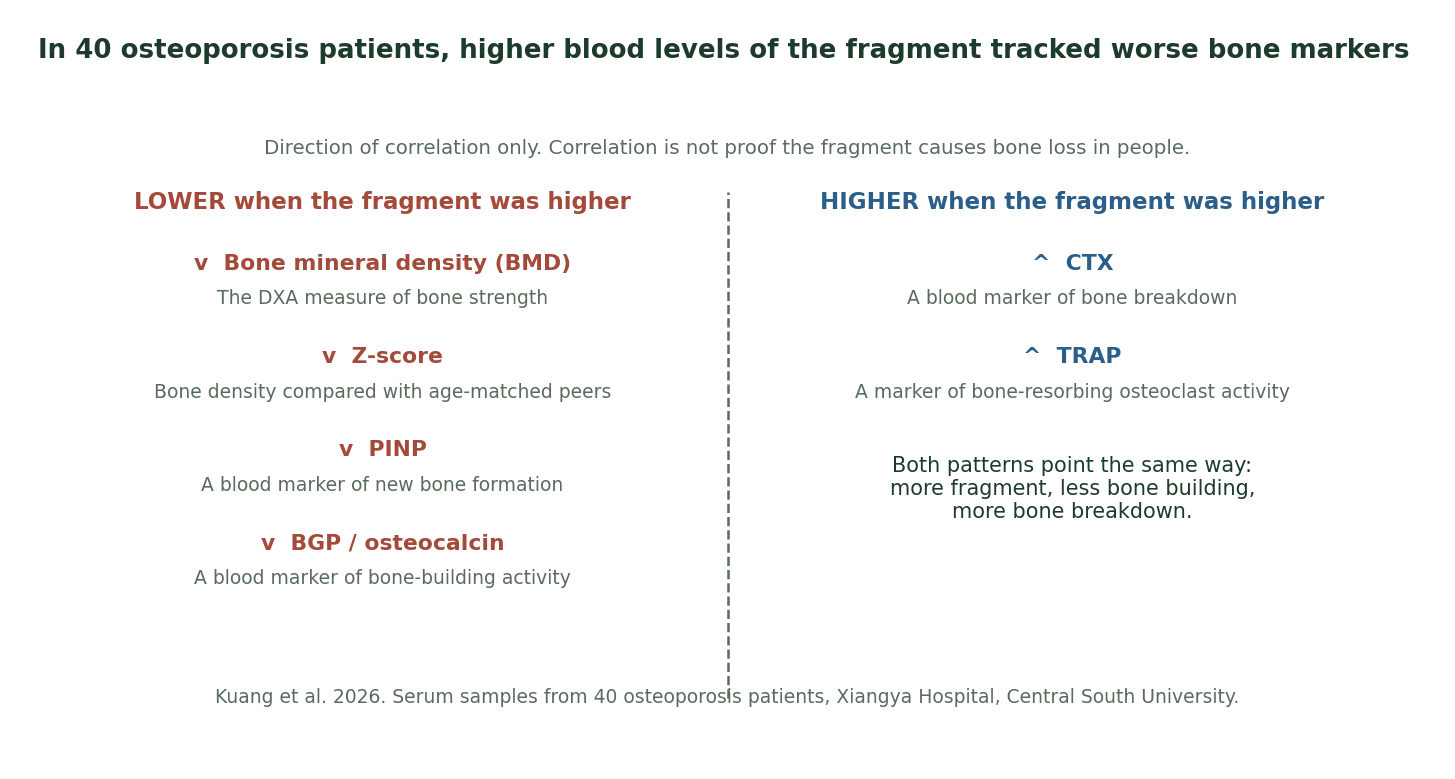
The team also looked at blood. They measured the fragment in serum from 40 osteoporosis patients at Xiangya Hospital, diagnosed by DXA bone density scans. The pattern was consistent. Higher fragment levels went with lower bone mineral density, lower Z-scores, and lower levels of 2 bone formation markers, PINP and BGP (osteocalcin). Higher fragment levels also went with higher levels of 2 bone breakdown markers, CTX and TRAP. Both sides of the bone balance pointed the same way: more fragment, less building, more breakdown.
That makes the fragment a candidate blood biomarker for age-related osteoporosis, a blood test that might eventually flag risk before a fracture. It is a candidate only. This was 40 people at 1 hospital, and a correlation is not proof the fragment causes bone loss in people. A biomarker needs validation in larger, more diverse groups, and it needs to show it adds something beyond a DXA scan, which is already the standard.
What this does not prove
This is a strong mechanistic study, and it is also early. A few things to keep straight.
First, the treatment results are in mice and in cells. No person has received an ASO against this fragment or the angiogenin inhibitor NCI-65828, and neither is a drug. Antisense drugs exist for other diseases, so the approach is plausible, but safety, dosing and delivery in people are all untested.
Second, angiogenin is not a villain. It grows blood vessels, helps cells survive stress, and helps make ribosomes. Blocking it throughout the body could have downsides, which is why the ASO was delivered into the bone marrow in the mouse study rather than given systemically. A 2007 study even found that angiogenin purified from bovine milk inhibited bone-resorbing osteoclasts, the opposite direction of effect in a different context. The enzyme's role depends on where it is and what it is cutting.
Third, bone loss has many drivers. Estrogen loss after menopause, low vitamin D and calcium, low protein, inactivity, smoking, alcohol, and some medicines all matter, and this fragment explains only a small slice of the biology. Nothing in this study changes what already works for bones.
What already works for bones
If you are worried about bone loss, the honest advice is boring and well proven. Strength training has some of the best evidence for maintaining or improving bone mineral density, because loading bone stimulates it to adapt. I covered a beginner protocol in detail here: /blog/strength-training-longevity-muscle-guide. Enough protein, vitamin D and calcium, not smoking, limiting alcohol, balance training to prevent falls, and a DXA scan to know where you stand are the basics. For diagnosed osteoporosis, prescription medicines exist that your doctor can discuss with you. This study is a new target for future drugs, not a new protocol for today.
Safety and limitations
- This article reports on a published study and does not recommend any supplement, dose or treatment.
- The ASO and NCI-65828 are experimental research tools, not available treatments. Do not seek them out.
- The human data are correlational, from 40 patients at 1 hospital. They do not prove the fragment causes bone loss in people.
- The mouse work used young and aged C57BL/6J mice, 8 per group, and a viral vector delivery system. Results in mice often do not translate to people.
- Angiogenin has useful roles elsewhere in the body, so blocking it broadly could carry risks that this study did not test.
- If you have osteoporosis, a fracture history, or a family history of fractures, talk to your doctor about screening and treatment. Do not change any medicine based on a mouse study.
FAQ
What is angiogenin?
Angiogenin is an enzyme, a ribonuclease, that cuts RNA. In the nucleus it helps make ribosomal RNA and supports cell growth, and it also promotes blood vessel growth. Under oxidative stress it moves into the cytosol and cuts transfer RNAs into fragments called tiRNAs. In aging bone marrow stem cells, that cutting activity rises and a fragment accumulates.
What is 5'-tiRNA-Glu-CTC?
It is a 30 to 40 letter fragment cut from a glutamate transfer RNA by angiogenin. It builds up with age in bone marrow stem cells in mice and in people. It binds the tail ends of 5 messenger RNAs that keep stem cells dividing and turning into bone cells, and it makes those messages degrade faster, by up to 65.9% shorter half-life for Foxm1.
Can a blood test for this fragment diagnose osteoporosis?
Not yet. In 40 osteoporosis patients, higher blood levels of the fragment tracked with lower bone density and lower bone formation markers, and higher bone breakdown markers. That is a correlation in a small group at 1 hospital. It needs validation in larger groups before anyone can call it a test. A DXA scan is still the standard way to measure bone density.
Is there a drug that blocks angiogenin?
No approved drug. The study used 2 experimental tools in mice: an antisense oligonucleotide that destroys the fragment, and a small molecule called NCI-65828 that inhibits angiogenin. Both rescued bone loss in aged mice, but neither has been tested in people.
Does this mean antioxidants prevent bone loss?
No. Oxidative stress is the trigger in this chain, but this study did not test antioxidants, and antioxidant supplements have a poor record in human trials for bone outcomes. Do not take this study as a reason to start a supplement.
What can I do for my bones now?
Strength training, enough protein, vitamin D and calcium, not smoking, limiting alcohol, balance training, and a DXA scan to know your baseline. My beginner strength protocol is here: /blog/strength-training-longevity-muscle-guide. If you already have osteoporosis, talk to your doctor about prescription options.