The short answer
Alpha-ketoglutarate, or AKG, is one of the most talked about longevity molecules right now, and the marketing is ahead of the evidence by a long way. The claim you will see everywhere is that AKG made people 8 years younger. That number comes from 42 people who took a commercial product, with no placebo group and no control group at all. The authors themselves said a proper trial was needed. Since then, the story has split in two directions. A 2026 study of 4,260 supplement users found a small association between one AKG formulation and a lower biological age reading. But the gold standard mouse longevity program tested AKG twice and found no lifespan gain in either sex. And the one properly designed human trial, the ABLE trial, enrolled 120 people and has still not published any results. So the honest verdict is this: AKG has real biology, a striking mouse result, a weak human signal, and a failed replication. It is a research question, not a proven anti-aging tool. No Thrive Tools partner sells AKG, so there is no discount code for it here. You can browse the longevity tools that do have verified offers on the discount codes page.
What is AKG?
AKG is a molecule your body already makes. It sits at the center of the Krebs cycle, the process your mitochondria use to turn food into energy. Your cells produce it every day, and your blood levels of it fall as you age. That decline is one reason researchers got interested: if a metabolite drops with age, does topping it up slow aging?
The supplement form is almost always calcium alpha-ketoglutarate, or Ca-AKG. The calcium salt is more stable than plain AKG, which breaks down quickly in the stomach. The best known product is Rejuvant, sold by Ponce de Leon Health. It uses a sustained-release form called LifeAKG, 1,000 mg of Ca-AKG per serving, plus vitamins. That exact formulation matters, because it is the only one with any human data behind it, and the human data is thinner than the ads suggest.
AKG also has real jobs in the body beyond energy. It is a cofactor for enzymes that remove methyl marks from DNA and histones, which is part of how cells control which genes are switched on. That is the mechanistic link to the epigenetic clocks used in the human studies. It also helps make collagen, and it feeds into the balance between glutamate and GABA, two brain chemicals. All of that is plausible biology. Plausible is not the same as proven.
The worm study that started it all
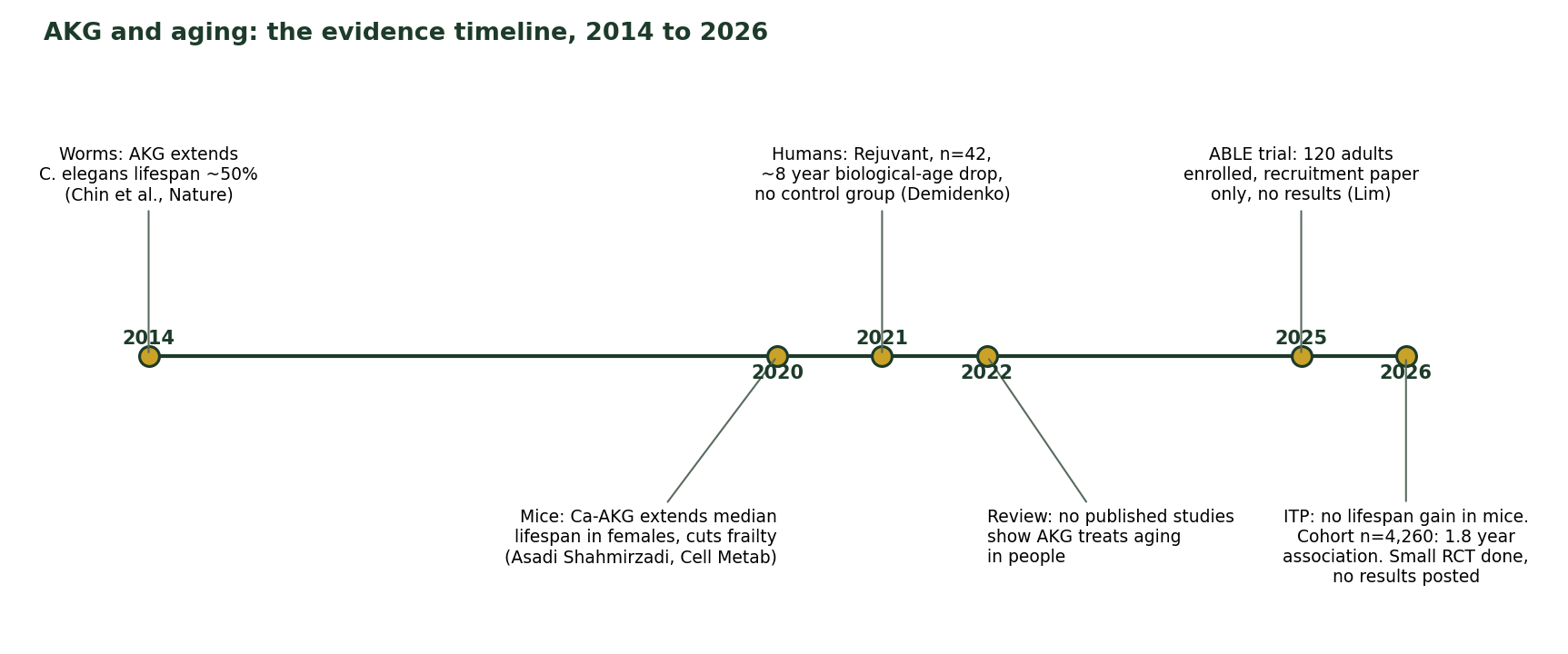
The AKG story starts in 2014, in worms. Chin and colleagues at the Buck Institute found that AKG extended the lifespan of C. elegans worms by about 50 percent. The mechanism ran through ATP synthase and the TOR pathway, two of the most studied aging pathways in biology. A 50 percent lifespan extension in a worm is a genuine finding, and it is also a long way from a human. Worms live about 3 weeks, they have no bones, no immune system like ours, and no blood pressure to worry about. Hundreds of compounds extend worm lifespan. Very few of them do anything in mammals.
The mouse study: real, but only in females
The study that made AKG famous came in 2020. Asadi Shahmirzadi and colleagues at the Buck Institute fed aging mice a diet with 2 percent calcium AKG, starting at 18 months of age, which is late middle age for a mouse. They ran 2 independent cohorts, 182 mice in total.
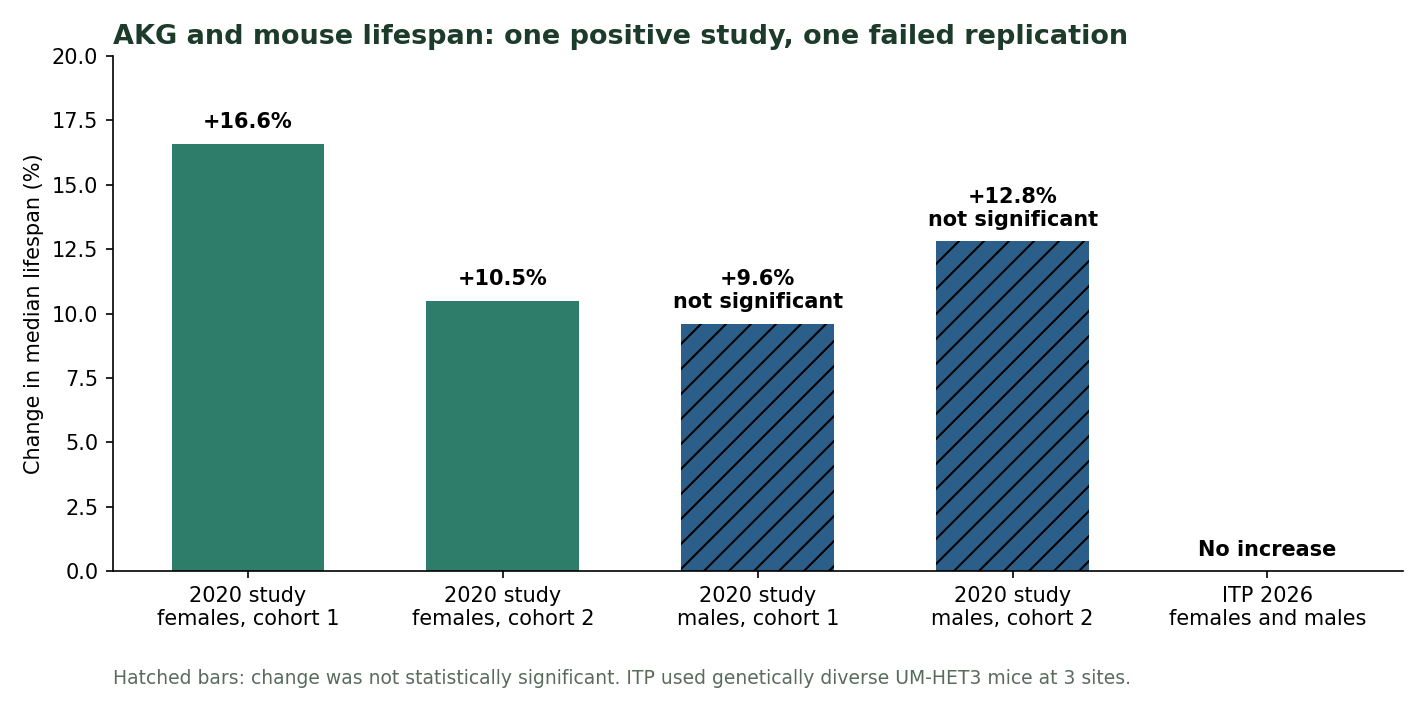
The results were striking, and uneven. In female mice, median lifespan rose by 16.6 percent in the first cohort and 10.5 percent in the second, and the longest-lived 10 percent lived 19.7 percent and 8 percent longer. In male mice, median lifespan rose by 9.6 percent and 12.8 percent, but neither result reached statistical significance, which means it could have been chance. The more consistent finding was frailty: frailty scores fell by 46 percent in females and 41 percent in males, and the mice spent less of their lives frail. The treated mice also had lower levels of chronic inflammation and higher levels of IL-10, an anti-inflammatory signal.
That is a real result, published in Cell Metabolism, and it is the strongest evidence AKG has. It is also one study, in one mouse strain, C57BL/6, with the lifespan benefit significant only in females. Good science asks whether a result repeats. In 2026, we got an answer, and it was not the one sellers wanted.
The 8-year claim, and what it actually was
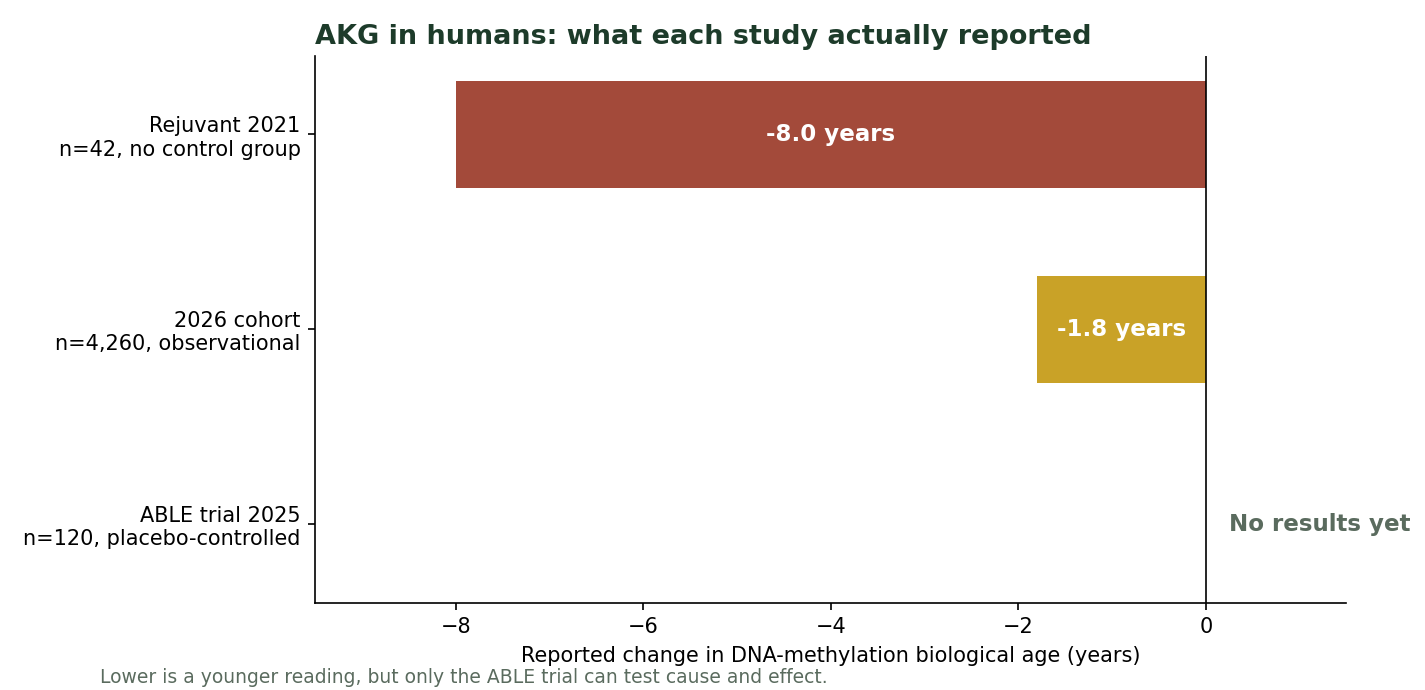
Before the replication question, there was the human claim. In 2021, Demidenko and colleagues published a study of Rejuvant in the journal Aging. They looked back at 42 people who had been taking the product and had taken a TruAge DNA methylation test before and after, about 7 months apart on average. Their biological age score fell by an average of about 8 years.
Read that again carefully, because the details matter. There was no placebo group. There was no control group. The 42 people chose to buy the product themselves, which means they were probably healthier, wealthier, and more health-conscious than average. The product contains vitamins as well as Ca-AKG, so even if something changed, you cannot say it was the AKG. And several of the authors were linked to the company selling it. The study itself is honest about this: it calls for randomized trials. But the marketing took the 8-year number and ran with it.
A DNA methylation age score is also not the same as being younger. It is a prediction based on chemical marks on your DNA. It can move for reasons that have nothing to do with aging, including changes in blood cell types, short-term illness, or the test itself. An 8-year change in that score is not 8 more years of life, and it is not proof of better health.
The 2026 plot twist: the replication failed
In 2026, the National Institute on Aging's Interventions Testing Program, the ITP, published its verdict. The ITP is the most rigorous mouse longevity program in the world. It tests compounds in genetically diverse mice, UM-HET3, at 3 sites, with large numbers and strict methods. It is designed to catch exactly the kind of result that looks great in one lab and vanishes in others.
Korstanje and colleagues reported that AKG did not significantly increase lifespan in male or female mice. They tried starting at 7 months of age, and an earlier ITP attempt starting at 18 months, the same age as the 2020 study, also found nothing. That is 2 failed replications in the program built to replicate.
This does not erase the 2020 study. The 2020 mice were a different strain, the dose and delivery differed, and the ITP result is about lifespan, not frailty. It is possible AKG improves health without extending life, or that it works in some genetic backgrounds and not others. But it does weaken the core claim. "Extends lifespan in mice" now needs a qualifier: in one study, in females, in one strain. Most AKG marketing does not include that qualifier.
The human evidence since then
There are 3 human data points after 2021, and none of them is a finished trial.
First, a 2026 study in Aging Cell looked at 4,260 people who had bought a saliva-based epigenetic test and filled in questionnaires about supplements and lifestyle. People using a delayed-release Ca-AKG plus vitamin formulation had an average age residual about 1.8 years lower than comparable people, after adjusting for several factors. Ordinary AKG did not show the same association. This is a big sample, but it is observational: people who buy a premium AKG product are different from people who do not, in ways a questionnaire cannot fully capture. It is an association, not a treatment effect.
Second, the ABLE trial is the study designed to settle this. It is a double-blind, placebo-controlled trial in 120 generally healthy adults aged 40 to 60 whose DNA methylation age was higher than their chronological age. Half get 1 gram a day of sustained-release Ca-AKG, half get a placebo, for 6 months. A 2025 paper by Lim and colleagues reported that recruitment worked: 120 people enrolled out of 467 who expressed interest. That paper reports no results on whether AKG works. The trial's primary completion date was August 15, 2025, and as of November 2026 no results had been posted. The answer exists, or is coming, but it is not public yet.
Third, a smaller placebo-controlled trial, NCT07114536, gave 34 adults aged 40 to 75 either 4 tablets of 0.5 grams of Ca-AKG a day or a starch placebo, and measured PhenoAge change at 12 weeks. It finished on November 30, 2025, with no results posted. A 2022 review of AKG in humans had already concluded there were no published studies showing it treats aging or age-related disease in people. That is still true today: there is no published randomized, placebo-controlled trial of AKG on any aging outcome in humans.
Dose, forms, and price
There is no established dose of AKG for healthy aging, because no trial has proven that any dose works. The dose used in the human study and in the ABLE trial is 1 gram a day of sustained-release calcium AKG. Rejuvant's standard formula is 1,000 mg per serving, 2 tablets a day. Its Pro version is 2,000 mg a day.
Price is where the story gets awkward. Rejuvant LifeTabs cost about $99 for a 30-day supply, roughly $3.33 a day. The Pro version is $180 a month. Generic calcium AKG powder from brands that publish third-party testing costs far less, around $0.42 a day at the same 1,000 mg dose, according to a November 2026 price check. But the generic powder is not the sustained-release formulation used in the human study, and no trial has tested whether it does the same thing. So the honest choice is between the expensive formulation with weak evidence, and the cheap formulation with no evidence at all. Neither is a good deal until the ABLE results are out.
Safety and limitations
AKG is a normal metabolite, and short-term use in the small human studies reported no serious safety signals. That is a thin safety record. There are no published safety results from a placebo-controlled human trial of Ca-AKG for aging, and long-term safety in people is unknown. If you have kidney disease, are pregnant or breastfeeding, or take medication, talk to a clinician before considering it. Calcium AKG also adds calcium, which matters if you already take calcium supplements.
The limitations of the whole field are worth stating plainly. No human study has measured lifespan, disease, or physical function as an outcome of AKG. Every human number so far is a clock reading, and clock readings are not health outcomes. The mouse evidence is now mixed. The best-designed human trial has not reported. Anyone selling AKG as a proven longevity intervention is selling ahead of the data.
The bottom line
AKG is a genuine research question with a real mechanism, one strong mouse study, and a human evidence base that is mostly promise. The 8-year claim is not a finding, it is a retrospective look at 42 self-selected customers with no control group. The 2026 replication failure should have changed how this molecule is talked about, and mostly it has not. The ABLE trial is the study that matters, and its results are the thing to watch. Until they are published, the most honest thing to say about AKG is that it might help, it might not, and the $99 a month is a bet on a result that has not arrived yet. If you want to follow the evidence, watch for ABLE, and in the meantime put the money toward the things with real human data: sleep, strength training, and the tools on the discount codes page.
Related reading
AKG sits upstream of several better-known longevity pathways, including NAD+ metabolism. My review of Cymbiotika Liposomal NAD+ covers the only human study of liposomal NAD+, where the tested dose was 3 times what the product contains. For the autophagy side of the story, my spermidine article covers the best human trial of a longevity molecule, which came back null.
FAQ
Does AKG really make you 8 years younger?
No. That number comes from 42 people who took Rejuvant for about 7 months, with no placebo group. Their DNA methylation age score fell by about 8 years on average. That is a change in a test score, not 8 more years of life, and without a control group it cannot be attributed to the product.
What is the ABLE trial, and when will it report?
ABLE is a double-blind, placebo-controlled trial of 1 gram a day of sustained-release Ca-AKG versus placebo for 6 months, in 120 adults aged 40 to 60 with a biological age older than their real age. Its recruitment paper came out in 2025. No efficacy results have been published yet.
Did AKG extend lifespan in mice?
In one 2020 study, yes for females: median lifespan rose 16.6 percent in one cohort and 10.5 percent in another, with frailty down 46 percent. But the National Institute on Aging's Interventions Testing Program tested AKG twice in genetically diverse mice and found no lifespan increase in either sex. The mouse evidence is now mixed.
What dose of AKG do the studies use?
1 gram a day of sustained-release calcium AKG. That is the dose in the Rejuvant human study and the ABLE trial. There is no established dose, because no trial has proven that any dose works.
Is AKG safe?
Short-term use in small human studies reported no serious safety signals, but there are no published safety results from a placebo-controlled trial, and long-term safety is unknown. Talk to a clinician first if you have kidney disease, are pregnant or breastfeeding, or take medication.
Is there a discount code for AKG?
No. No Thrive Tools partner sells AKG, so there is no code for it. The verified offers for longevity tools that do have partner codes are on the discount codes page.
This article is for general information only and is not medical advice. It reports on published studies and does not recommend any supplement, dose, or treatment.
Looking for tools that support healthy aging and recovery? Browse the current offers on our discount codes page. This article is for general information only and is not medical advice. It reports on a published study and does not recommend any supplement, dose, or treatment.