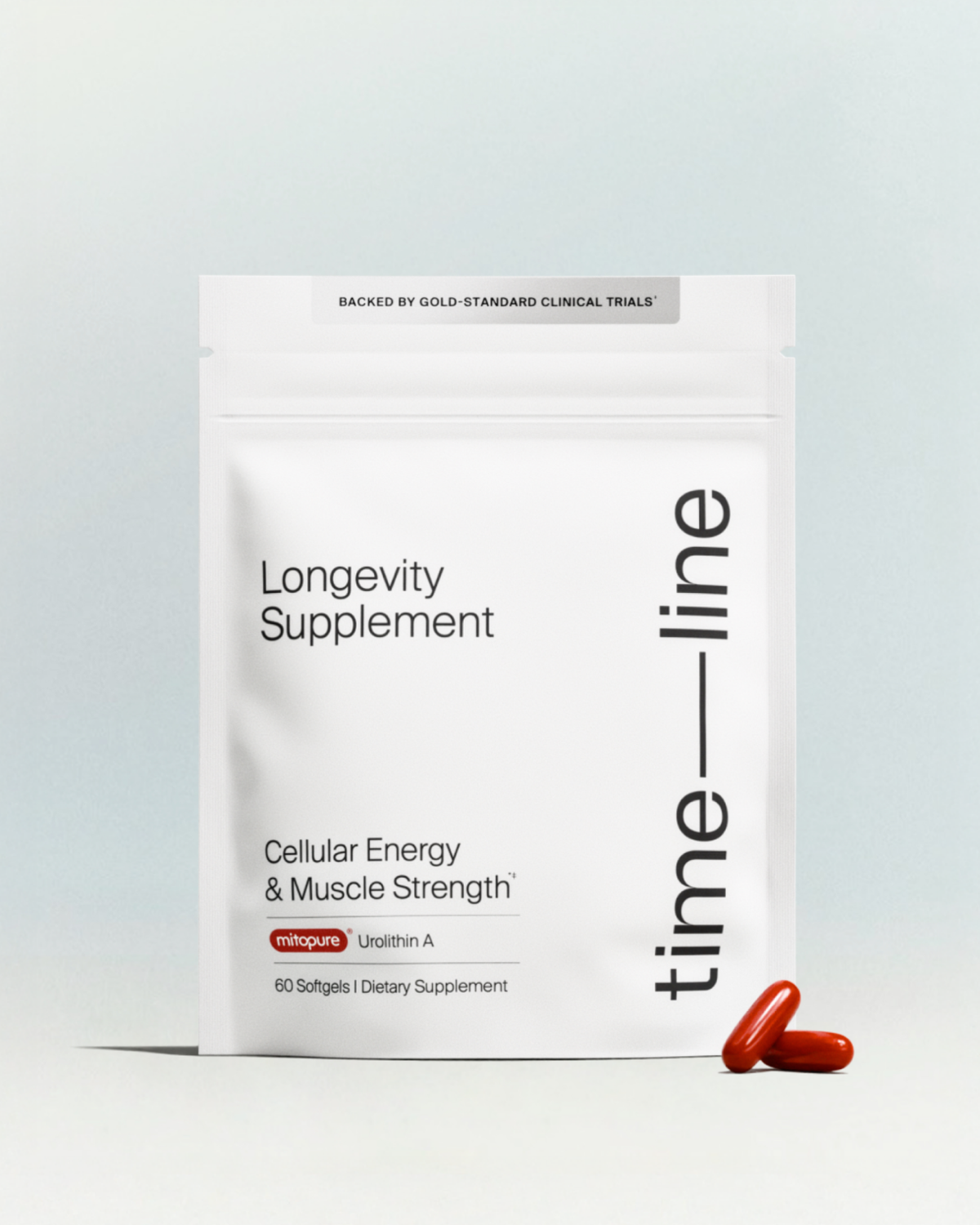
Timeline Mitopure is listed on my discount codes page as a link-based offer, not a checkout code, so check the current offer there before you buy. There is no reader discount code to type at checkout.
The short answer
Urolithin A is the most studied mitophagy compound in humans, and the evidence is better than most longevity supplements get, but it is still small and short. Five small randomized trials, 236 people in total, show modest gains in some muscle strength and endurance measures, and a 2025 Nature Aging trial found a shift toward a more youthful immune cell profile after 28 days. What no trial has shown is longer life, fewer infections, or any disease prevented. The honest verdict is promising signals, unproven benefits, and a dose, 1,000 mg a day, that costs real money to reach.
What is urolithin A?
Urolithin A is not a vitamin and it is not in food. It is a postbiotic, a compound your gut bacteria make from ellagitannins, the polyphenols in pomegranate, walnuts, raspberries, strawberries and pecans. You eat the raw material, specific bacteria do the conversion, and urolithin A is the finished product.
Here is the catch that changes the conversation. Not everyone can make it. Researchers sort people into 3 urolithin metabotypes: A, B, and 0. Metabotype 0 means the gut makes essentially no final urolithins. In Spanish and Chinese populations, about 10% of people are metabotype 0. In a US study of 100 people, about 33% produced no urolithin A at all and another 27% produced very little. Only about 1 in 3 people robustly produce it from food. The bacteria doing the work include Gordonibacter and Ellagibacter species for the early steps, and Enterocloster bolteae for the final step. If your gut lacks them, pomegranate every day still gives you little to no urolithin A.
That is the whole case for a supplement: it delivers the finished compound directly, bypassing a conversion many guts cannot do.
What is mitophagy, and why does it matter?
Mitochondria are the power plants inside your cells. Over time, some of them become damaged and inefficient, producing less energy and more waste. Mitophagy is the cell's quality control process: it identifies damaged mitochondria, dismantles them, and recycles the parts so healthier ones can take over.
In worms and mice, urolithin A triggers mitophagy, preserves muscle function with age, and extends lifespan in worms. That animal work is the reason the compound got famous. But worms are not people, and a mechanism is not a health outcome. The question that matters is what happens in humans, and that is where the trials come in.
What the human trials showed before 2025
Two randomized, double-blind, placebo-controlled trials anchor the muscle story, and it is worth being precise about each.
The first, Singh and colleagues, Cell Reports Medicine, 2022, gave middle-aged adults 500 or 1,000 mg of urolithin A a day for 4 months. Muscle strength improved by about 12% in some measures, and aerobic endurance and 6-minute walk distance improved. But the study's primary endpoint, peak power output, did not improve significantly.
The second, Liu and colleagues, JAMA Network Open, 2022, enrolled 66 adults aged 65 to 90 and gave them 1,000 mg a day for 4 months. Muscle endurance improved, meaning muscles resisted fatigue longer during repeated contractions, in both leg and hand muscles. Blood markers of mitochondrial efficiency improved too. But again the primary endpoints, 6-minute walk distance and hand muscle energy, did not reach statistical significance.
A 2024 systematic review pooled 5 studies covering 250 healthy adults, doses from 10 to 1,000 mg a day, over 28 days to 4 months. Its conclusion: urolithin A was well tolerated, produced dose-dependent anti-inflammatory effects, upregulated genes tied to mitochondrial function, and increased muscle strength and endurance. It also found no effect on body composition or general physical function.
So before 2025, the pattern was consistent: real signals on muscle strength and endurance, mixed results on whole-body function, and no trial measuring aging itself.
The 2025 trial that made headlines: MitoImmune
The most recent major human trial was published in Nature Aging on November 31, 2025. Denk and colleagues ran a randomized, double-blind, placebo-controlled trial at Goethe University Hospital in Frankfurt. Fifty healthy adults aged 45 to 70 received either 1,000 mg of urolithin A or a placebo daily for 28 days.
The trial met both of its primary endpoints, and both were laboratory markers. Urolithin A raised the share of naive-like CD8+ T cells, a less worn-out type of immune cell, by 0.50 percentage points against placebo (95% confidence interval 0.16 to 0.83). It also raised a measure of those cells' capacity to burn fatty acids for energy by 14.72 percentage points (6.46 to 22.99). The T cells became less dependent on glucose and more capable of oxidizing fats and amino acids. Natural killer cells shifted toward a more mature, cytotoxic subset, monocytes shifted toward a less inflammatory state, and immune cells from the urolithin A group cleared E. coli particles more effectively in lab tests.
What the trial did not measure is the part most coverage skips. It did not test whether participants had fewer infections, recovered faster, responded better to vaccination, or felt any different. Plasma levels of the inflammatory signals IL-6, TNF and IL-1beta did not change significantly. Side effects were rare and similar to placebo, mostly common colds, with no significant changes in kidney or liver markers over 28 days.
The trial was funded in part by Amazentis, the company behind Mitopure, which is a reason to want independent replication, not a reason to dismiss the result. The design was rigorous, the endpoints were prespecified, and the authors reported the null results alongside the positive ones. But 50 people over 28 days is a proof of concept, not a verdict on immune aging.
The 2025 runner study: a useful reality check
A second 2025 trial tested urolithin A in a very different population: 42 highly trained male distance runners, average age 27, during a 4-week altitude training camp. They took 1,000 mg a day or a placebo. The 3,000 m time trial did not improve significantly in either group. Ratings of perceived exertion fell, and markers of post-exercise muscle damage were lower in the urolithin A group. VO2 max rose within the urolithin A group by 5.4%, but the difference against placebo was not statistically significant.
The honest reading: in already fit young athletes, urolithin A helped recovery markers, not performance. That is a narrower claim than the marketing suggests, and it fits the pattern from the older-adult trials, where endurance and recovery signals show up more reliably than performance gains.
A small 2024 trial in 20 resistance-trained men, 1,000 mg a day for 8 weeks, found improvements in selected strength and endurance measures plus changes in inflammation and oxidative stress markers. Twenty people is not enough to generalize, and findings in trained young men may not apply to anyone else.
The 2026 meta-analysis: what 5 trials add up to
A systematic review and meta-analysis published in Frontiers in Nutrition in 2026 pooled the randomized human trials: 5 trials, 236 people. Quantitative pooling was only possible for one outcome, the 6-minute walk test, and it showed a directionally favorable but statistically inconclusive effect, plus 17.03 metres (95% confidence interval minus 5.33 to 39.40, p = 0.135), with the certainty of evidence rated low. Strength, endurance, aerobic capacity and mitochondrial biomarkers were too heterogeneous across populations, doses and measurement methods to pool, and the authors called them exploratory signals rather than reproducible effects.
A separate 2026 evidence review counted 10 published placebo-controlled trials of oral urolithin A, 10 to 88 participants each, lasting 4 weeks to 4 months. Five of the 10 found no effect on their main outcome, and none measured aging or lifespan. That is the fairest single summary of where this compound stands: real signals, small trials, no aging outcome ever measured.
What the evidence shows, and what it does not
| Claim | What the trials show |
|---|---|
| Improves muscle strength | About 12% gains in some measures in middle-aged adults (Singh 2022); mixed on primary endpoints |
| Improves muscle endurance | Improved in adults 65 to 90 (Liu 2022); 6-minute walk pooled effect not significant (2026 meta-analysis) |
| Shifts immune cell profile | Naive-like CD8+ T cells up 0.50 points, fatty acid oxidation capacity up 14.72 points in 28 days (Denk 2025) |
| Prevents infections or improves vaccine response | Never tested in a human trial |
| Extends lifespan or reverses aging | Never tested in humans; worm and mouse data only |
| Improves athletic performance | No significant 3,000 m improvement in trained runners (2025); recovery markers improved |
| Replaces exercise | No trial supports this; exercise remains the proven intervention for muscle and mitochondrial health |
Food first: can you get it from pomegranate?
Pomegranate, walnuts, raspberries, strawberries and pecans all supply ellagitannins. But as the metabotype data shows, eating them only helps if your gut bacteria can do the conversion, and only about 1 in 3 people do it robustly. In a pomegranate juice challenge study, only about 12% of people had detectable urolithin A at baseline, and only about 40% became high producers after the juice.
If you enjoy those foods, eat them. They are healthy for many reasons beyond urolithin A. But food alone is not a reliable way to reach the 500 to 1,000 mg doses used in the trials. Nobody knows the exact urolithin A yield of a glass of pomegranate juice, because it depends on your microbiome, and there is no home test for your metabotype. That uncertainty is the honest reason a direct supplement exists.
Disclosure: I'm affiliated with Timeline, but I only recommend things I can actually stand behind so here's my honest breakdown.
Timeline Mitopure: the product, the price, and the value
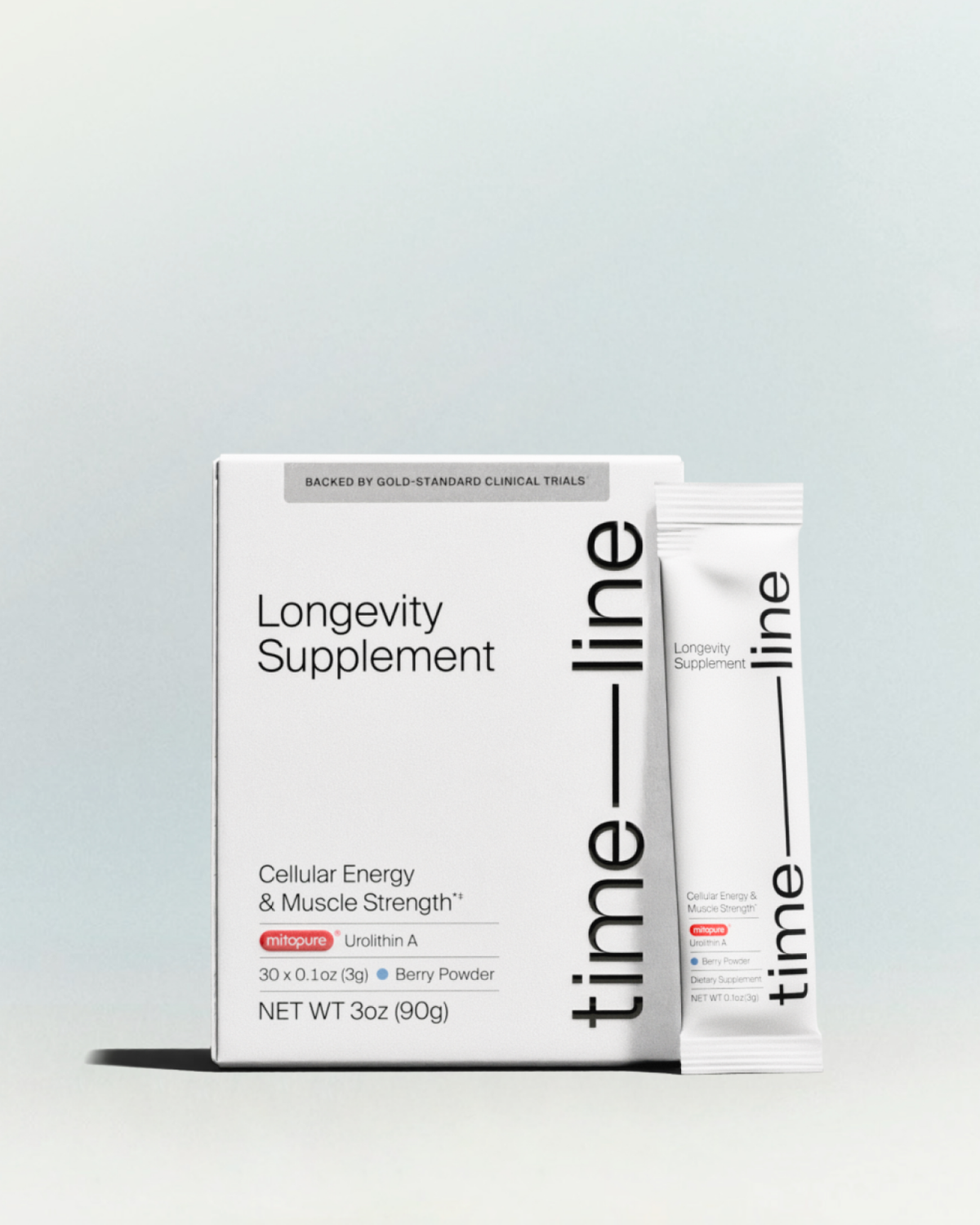
Timeline sells Mitopure in 3 formats: softgels, powder and gummies. All 3 deliver the same dose, 500 mg of Mitopure per recommended daily serving, and all 3 cost the same. Softgels are 2 vegan softgels a day, 60 per sachet. Powder is 1 berry stickpack a day, 30 per box, to mix into yogurt or a smoothie. Gummies are 2 sugar-free strawberry gummies a day, 60 per pack. Each pack is a 1-month supply at the recommended dose.
The price, checked on timeline.com on November 17, 2026: $99 for a one-time purchase. Subscribe and Save brings it to $89 a month for a 1-month plan, $79 a month for 2 months, $74 a month for 4 months, labelled clinically recommended, and $69 a month for 12 months, labelled best value. Every order carries a 30-day money-back guarantee and free US shipping. Timeline ships to the US, Canada, Switzerland, Germany and the UK.
Here is the dose math that matters. Timeline recommends 500 mg a day for a minimum of 4 months. But the strongest trial signals came from 1,000 mg a day, which is 2 servings, so 2 packs a month. At the 1-month subscription price, that is $178 a month, or $198 one-time. At the 12-month subscription price, it is $138 a month. The 500 mg dose is cheaper and is what Timeline recommends, but it is not the dose the best trials used. Be honest with yourself about which dose you are buying.
Mitopure is the product of Amazentis, a Swiss health science company, and Timeline describes it as the first and only clinically tested urolithin A supplement. The published human trials used Mitopure specifically, which is why it costs more than generic urolithin A from other brands. Whether that premium is worth it depends on how much you value trial data on the exact product you are buying.
Timeline Mitopure is listed on my discount codes page as a link-based offer, not a checkout code, so check the current offer there before you buy. There is no reader discount code to type at checkout. If you want to try it, my affiliate link is https://shop.timeline.com/EDENKAWTHARLARAKI.
The bottom line
Urolithin A has something most longevity compounds do not: several small, well-run human trials with real, if modest, results. Muscle endurance is the best-replicated finding. The 2025 immune trial is genuinely interesting and genuinely preliminary: a cell population shifted, not a health outcome proven. The 2026 meta-analysis is the reality check, with 5 trials and 236 people adding up to an inconclusive pooled effect and low certainty.
If you are over 45, you train, and you want to experiment with the best-evidenced mitophagy compound available, urolithin A is a reasonable, eyes-open choice at 1,000 mg a day for at least a month, ideally 4. If you want proof it makes you live longer or get sick less often, that proof does not exist yet, and no honest review should tell you otherwise. And whatever you take, it does not replace resistance training, which remains the proven way to keep muscle and mitochondria working as you age.
Safety and limitations
Urolithin A is a food ingredient with one FDA GRAS notice (GRAS Notice 791, 2018, FDA had no questions), not an approved drug. In the human trials so far, side effects looked similar to placebo, and no serious side effects were attributed to urolithin A. That is reassuring for short-term use in healthy adults, and it is not the same as long-term safety data, which does not exist yet. Trials lasted 4 weeks to 4 months, enrolled 10 to 88 people each, and mostly healthy adults. There is no published data on use in pregnancy or breastfeeding, in children, or alongside specific medications. The MitoImmune trial was partly funded by the company behind Mitopure. If you have a medical condition, take medication, or are pregnant or breastfeeding, talk to a qualified healthcare professional before trying it.
Frequently asked questions
Does urolithin A actually work?
In small human trials, it improved some measures of muscle strength and endurance and shifted immune cell markers. It has not been shown to extend lifespan, prevent disease, or improve athletic performance. The evidence is promising and preliminary.
How much urolithin A should I take?
The human trials used 500 to 1,000 mg a day, and the strongest signals came from 1,000 mg a day. Lower doses were used in some trials with weaker effects. There is no established optimal dose, and more is not proven better.
Can I get urolithin A from food?
Only if your gut bacteria can make it. About 1 in 3 people robustly convert ellagitannins from pomegranate, walnuts and berries into urolithin A. In a US study of 100 people, about 33% made none at all. A supplement delivers the finished compound directly.
What is Mitopure?
Mitopure is Timeline's purified urolithin A ingredient, the form used in most of the human trials. Other brands sell urolithin A, but the published trial data was generated with Mitopure specifically, which is why it costs more than generic options.
Is urolithin A safe?
In trials of 4 weeks to 4 months, side effects were similar to placebo. It has FDA GRAS status as a food ingredient. Long-term safety data does not exist yet, and there is no data for pregnancy, breastfeeding or children.
Does urolithin A replace exercise?
No. Exercise is the proven intervention for muscle strength, endurance and mitochondrial health. Urolithin A is, at best, a complement to training, not a substitute for it.
Is there a Timeline Mitopure discount code?
There is no checkout code listed for Timeline on my discount codes page. The offer is link-based, so check the current offer on the discount codes page before you buy, or use my affiliate link: https://shop.timeline.com/EDENKAWTHARLARAKI.
This article is for general information only and is not medical advice. It reports on published studies and does not recommend any supplement, dose, or treatment. Talk to your clinician before starting a new supplement, especially if you have a medical condition, are pregnant or breastfeeding, or take medication.
Looking for tools that support healthy aging and recovery? Browse the current offers on our discount codes page. This article is for general information only and is not medical advice. It reports on a published study and does not recommend any supplement, dose, or treatment.