No discount code exists for rapamycin on my discount codes page, and this article recommends no product. Rapamycin is a prescription drug, not a supplement, and no partner on the list sells it. For the tools that support healthy aging with reader offers, see the current list at thrivetools.co/discount-codes.
The short answer
Rapamycin is the most convincing lifespan drug ever tested in mice, and the human evidence is still almost empty. In genetically diverse mice, it extended median lifespan by 9% to 26%, depending on dose and when it was started. In people, the first year-long randomized trial, PEARL, published in April 2025, missed its primary goal completely. Visceral fat, the deep belly fat the trial was designed to reduce, did not change at all (p = 0.942). The trial did find small secondary signals: women on the higher dose gained lean tissue mass and reported less pain, and people on the lower dose reported better general health. Then a 2026 trial delivered the first real warning: weekly rapamycin did not help older adults get more from exercise, and in the most adherent participants it modestly blunted their gains. No human trial has ever measured lifespan, disability, or death as an outcome. Rapamycin is prescription only, its longevity use is off-label, and the honest verdict today is promising mouse data, a tolerable 1 year safety record at low weekly doses, and no proof it slows human aging.
What is rapamycin?
Rapamycin, also called sirolimus, was discovered in the 1970s in soil bacteria from Easter Island, known locally as Rapa Nui. The bacterium, Streptomyces hygroscopicus, makes the compound as a natural antifungal. It became a drug, not a supplement. The US Food and Drug Administration approved sirolimus in 1999 to prevent organ rejection after kidney transplants, and it is still used as an immunosuppressant at much higher daily doses than the weekly doses used in longevity trials.
It works by blocking a protein complex called mTORC1, the mechanistic target of rapamycin complex 1. mTORC1 is a nutrient sensor. When food is plentiful, it tells cells to grow and build. When it is blocked, cells switch from growth mode to maintenance mode: they recycle damaged parts through a process called autophagy, repair themselves, and slow down protein production. That switch is the whole theory of rapamycin for aging. If aging is partly a failure of cellular maintenance, then a drug that forces cells into maintenance mode might slow the process down.
The idea is biologically serious. mTOR signaling is one of the most conserved aging pathways in biology, from yeast to worms to flies to mice. The question was never whether the mechanism is real. The question is whether it works in people, at doses people can tolerate, without costing more than it gives.
Why the mouse data made it famous
The mouse evidence is the reason rapamycin dominates longevity conversations, and it deserves to be stated precisely, because it is genuinely impressive.
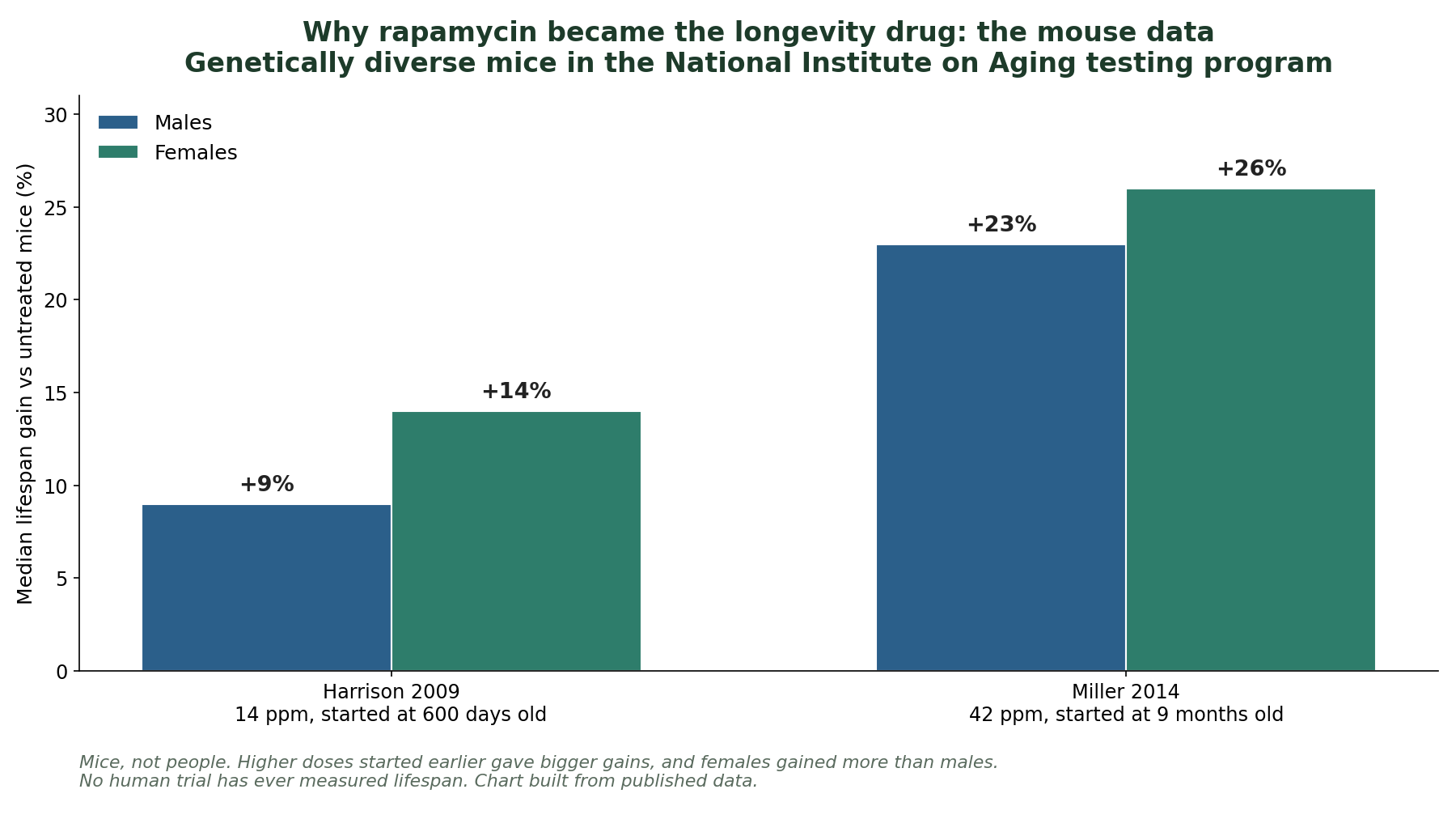
In 2009, Harrison and colleagues at the National Institute on Aging Interventions Testing Program fed rapamycin to genetically diverse mice starting at 600 days old, roughly equivalent to a 60 year old person. Median lifespan rose by 9% in males and 14% in females. That was the first time a drug given late in life had extended lifespan in mammals, and it launched the field.
A later testing program study used a higher dose, 42 parts per million in food, started at 9 months old. Median lifespan rose by 23% in males and 26% in females. Higher doses started earlier gave bigger gains, and females gained more than males in both studies.
Two things about these numbers matter. First, they are the best lifespan results any drug has produced in mice. Second, they are mouse results. Mice live about 3 years, they live in cages, they die mostly of cancer, and a drug that extends their life by 25% has never been shown to extend a human life by any amount. The gap between a mouse and a person is exactly what the human trials were supposed to start closing.
The human evidence before PEARL
Before PEARL, the human evidence for mTOR inhibition and aging was encouraging but indirect. It came from related drugs, not from rapamycin itself, and that distinction matters.
In 2014, Mannick and colleagues published a trial in Science Translational Medicine in which low dose everolimus, a rapamycin-like mTOR inhibitor, improved the antibody response to flu vaccination in older adults by about 20%. In 2018, the same group reported that another related compound, RTB101, reduced respiratory infections in older adults. These were real, randomized results in people, and they showed that dialing down mTOR could improve immune function in aging.
But everolimus and RTB101 are not rapamycin. They have different dosing, different side effect profiles, and different evidence bases. What the field lacked until 2025 was a proper randomized trial of rapamycin itself in healthy older adults, run for long enough to say anything about safety and body composition. That is what PEARL was.
PEARL: the first year-long human trial
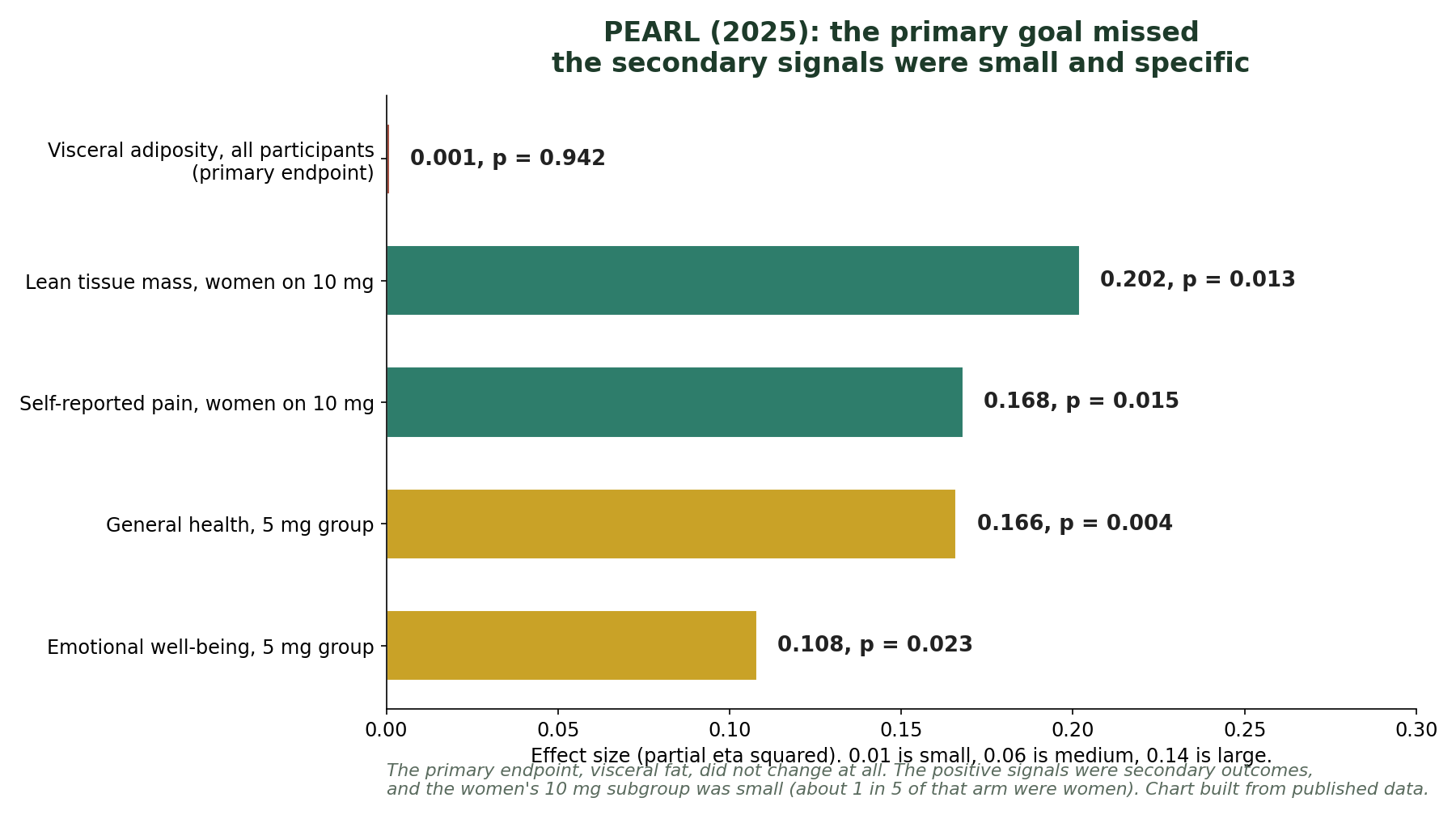
PEARL, the Participatory Evaluation of Aging with Rapamycin for Longevity, was published in the journal Aging on April 4, 2025. It was a 48 week, decentralized, double blind, randomized, placebo controlled trial in 129 healthy adults aged 50 to 85. A total of 114 people finished and were analyzed: 40 on 5 mg of compounded rapamycin once a week, 35 on 10 mg once a week, and 39 on placebo. The trial is registered as NCT04488601.
The primary outcome was visceral adiposity, the deep abdominal fat around the organs, measured by DXA scan. It did not change significantly. The effect size was 0.001, essentially zero, with a p value of 0.942. That is about as flat as a trial result gets. The trial missed its primary endpoint.
The secondary outcomes were more interesting, and more equivocal:
- Women on 10 mg gained lean tissue mass compared with placebo, with a mean difference of 6.19 kg at 48 weeks, and reported less pain. Both effects were statistically significant.
- People on 5 mg reported better general health and better emotional well-being.
- Blood biomarkers stayed within normal ranges in all groups.
- Bone mineral content and density did not change significantly.
- Epigenetic age, a biological age test, showed no meaningful change, but it was only measured in 24 people.
Three caveats belong next to those findings, because they change how much weight to give them.
First, the positive signals were secondary outcomes. PEARL was designed and powered to test safety, not to prove benefits, and secondary outcomes in a small trial are hypothesis generating, not proof. Second, the women's 10 mg subgroup was tiny. Women were 35.1% of the trial overall, and only about 1 in 5 of the 10 mg group were women, so the lean mass finding rests on roughly 7 women. Third, the trial used compounded rapamycin, and the authors reported partway through that it reached only about 1 in 3 of the blood concentration of commercial sirolimus. A 10 mg compounded dose was roughly equal to 3.33 mg of the commercial drug, so the trial tested lower exposures than the labels suggest.
There is also a conflict of interest to state plainly. The trial was sponsored by AgelessRx, a telehealth company that sells rapamycin prescriptions, and all the authors were affiliated with AgelessRx. That does not make the result wrong. The primary endpoint was a miss, which is not the result a sponsor would want. But a reader deciding what to make of the secondary signals should know whose trial it was.
On safety, the news was genuinely reassuring within its limits. Adverse events and serious adverse events were similar across all three groups, and placebo actually recorded the most serious events. Gastrointestinal symptoms were more common on rapamycin, 8 cases on 10 mg, 7 on 5 mg, and 4 on placebo, and 1 person on 5 mg developed anemia, was treated, and finished the trial. The authors concluded that low dose, intermittent rapamycin over 48 weeks is relatively safe in healthy, normally aging adults. That is a real finding. It is also 1 year, in 114 health-conscious people, at exposures lower than the labels say.
The 2026 exercise trial: a warning for lifters
The second human trial that matters was published in April 2026, and it is the one that should worry anyone who lifts weights and takes rapamycin.
RAPA-EX-01, published in the Journal of Cachexia, Sarcopenia and Muscle, asked a precise question. Rapamycin blocks mTORC1, and mTORC1 is also the switch exercise uses to build muscle. If you take rapamycin on a rest day, far from your workout, can you get the longevity signal without blunting the training adaptation? That idea is called the cycling hypothesis, and it was the best case for combining the drug with exercise.
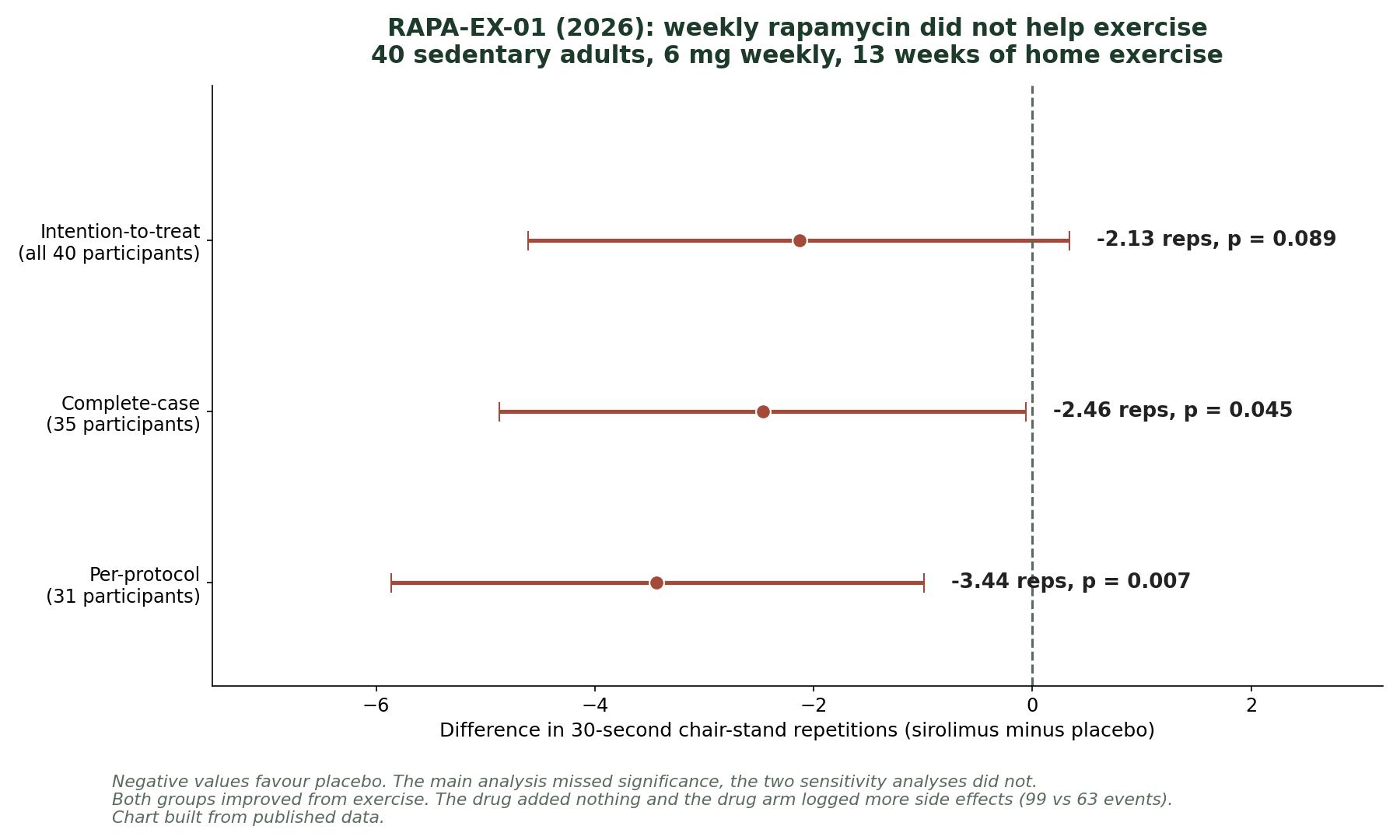
The trial randomized 40 sedentary adults aged 65 to 85, mean age 72.2, to 6 mg of sirolimus once a week or a matched placebo for 13 weeks. Everyone did the same home exercise program 3 times a week: chair stands for resistance and a stationary bike for endurance. The drug was taken on the rest day furthest from training, about 24 hours after the last session.
Both groups improved. Exercise worked. The question was whether adding rapamycin made it work better or worse, and the answer leaned worse. In the main intention-to-treat analysis, the rapamycin group finished 2.13 fewer chair stand repetitions behind placebo, a difference that missed statistical significance (p = 0.089). In the two sensitivity analyses, the gap reached significance: 2.46 fewer reps in the complete-case analysis (p = 0.045) and 3.44 fewer reps in the per-protocol analysis of the most adherent participants (p = 0.007). Every secondary outcome leaned the same way, toward placebo: 6 minute walk distance was 4.87 m shorter, grip strength was 1.13 kg lower, and quality of life scores were slightly lower, though none of those reached significance.
The side effect burden was also higher on rapamycin. The same share of participants in each arm reported at least 1 adverse event, 85%, but the drug arm logged 99 events versus 63 on placebo, including 1 possibly drug related serious event, pneumonia. The authors concluded that once weekly sirolimus did not enhance, and in sensitivity analyses may have modestly attenuated, short term functional improvements from a home exercise program.
This trial has real limits. It ran only 13 weeks, it had 40 people, the training was gentle, and it tested 1 dose on 1 schedule. It was also funded independently, by a physician researcher and a public crowdfund, not by industry. But it is the first direct human test of the cycling hypothesis, and the hypothesis failed its first test. The lead author, Brad Stanfield, put it plainly: exercise remains the single best intervention for preserving function in older adults. Full stop.
What this does NOT prove
This matters, because the headlines around rapamycin routinely outrun the data:
- No trial has shown rapamycin extends human life. PEARL measured body fat, blood work, and questionnaires. RAPA-EX-01 measured chair stands. No human trial has used disability, disease, or death as an outcome. Mouse lifespan does not transfer to people by assumption.
- PEARL did not show rapamycin slows aging. Epigenetic age did not meaningfully change in the 24 people tested, and the trial was not designed to measure aging itself. Visceral fat, its main measure, did not move.
- The lean mass finding in women is a signal, not a result. It came from a secondary outcome in a subgroup of about 7 women, in a trial sponsored by a company that sells the drug. It needs replication in a larger, independent trial before anyone acts on it.
- The exercise finding is narrow but real. One small, short trial cannot prove rapamycin always blunts training. But it does prove that the cycling hypothesis is not a safe assumption, and that anyone combining the two should know the only direct test went the wrong way.
- Related drugs are not rapamycin. The immune benefits seen with everolimus and RTB101 are encouraging, but they do not prove rapamycin does the same thing at the same dose.
Safety: what is known, and who should be careful
Rapamycin is a prescription drug, and its longevity use is off-label, which means no regulator has judged it safe and effective for aging. That has practical consequences.
At the low weekly doses used in PEARL, 5 to 10 mg of compounded drug for 48 weeks, adverse events looked similar to placebo, with more stomach symptoms and 1 case of anemia. At the higher daily doses used after organ transplants, the known risks are mouth ulcers, raised cholesterol and triglycerides, rash, diarrhea, swelling, a higher risk of infection, and slower wound healing. The FDA label carries warnings about infection and lymphoma risk at immunosuppressive doses.
Rapamycin is processed by the liver enzyme CYP3A4, so many common drugs and foods change its levels. Grapefruit juice raises them. Some antibiotics, antifungals, and seizure medicines do too. Anyone taking it needs a doctor who knows the full medication list, and blood monitoring, because the difference between a low weekly dose and a transplant dose is large, and compounded products vary in strength. PEARL itself found its compounded product delivered about 1 in 3 of the expected blood level.
Do not take rapamycin, or buy it online without a prescription, if you are pregnant or trying to conceive, if you have an active infection, if you are about to have surgery, if you take drugs that suppress the immune system, or if you take medicines that interact with CYP3A4. This is a conversation for a physician who knows your history, not a purchase decision.
The honest verdict
Here is where the evidence actually stands in November 2026.
Rapamycin is the best lifespan drug in mice, by a wide margin. In people, the best trial we have says it is relatively safe for 1 year at low weekly doses, it did not reduce belly fat, it produced small secondary signals in women and in self reported health that need replication, and a second trial suggests it may blunt the benefits of exercise, which is the one longevity intervention with proof in humans.
That is not a reason to take it, and it is not a reason to dismiss it. It is a reason to wait for bigger, longer, independent trials with clinical outcomes, and in the meantime to do the thing with proven benefit. Strength training 2 days a week, 30 to 60 minutes total, is the intervention with the strongest evidence for staying strong and independent as you age, and it is free. My full guide, with the beginner protocol, is here: Strength Training for Longevity: 30 to 60 Minutes a Week, Grip Strength and the Evidence, at /blog/strength-training-longevity-muscle-guide.
Rapamycin is prescription only, and no partner on my discount codes page sells it. The tools on that page are the legal, evidence-based ones, and the one that matters most for this topic costs nothing. If you want to support healthy aging and recovery with tools that have reader offers, browse the current list at thrivetools.co/discount-codes.
FAQ
Does rapamycin actually slow aging in humans?
No trial has shown it. The PEARL trial, the only year-long randomized trial in healthy adults, missed its primary endpoint, visceral fat did not change, and epigenetic age did not meaningfully change in the 24 people tested. The mouse data is strong, up to 26% longer median lifespan, but no human lifespan trial exists.
What did the PEARL trial find?
PEARL gave 5 or 10 mg of compounded rapamycin or placebo once a week for 48 weeks to 129 healthy adults aged 50 to 85, and 114 finished. Visceral fat did not change (p = 0.942). Women on 10 mg gained lean tissue mass and reported less pain, and people on 5 mg reported better general health, but these were secondary outcomes in a small trial sponsored by a company that sells rapamycin, and they need replication.
Is rapamycin safe to take for longevity?
At low weekly doses for 1 year, PEARL found adverse events similar to placebo, with more stomach symptoms and 1 case of anemia. That is reassuring but narrow: 114 people, 1 year, lower exposures than the label suggests. At transplant doses, the risks include mouth ulcers, raised cholesterol, infection, and slow wound healing. It is prescription only and interacts with many drugs through the liver enzyme CYP3A4, so it needs a doctor and blood monitoring.
Does rapamycin interfere with exercise and muscle gains?
The only direct test says it might. RAPA-EX-01, a 2026 trial in 40 sedentary adults aged 65 to 85, found 6 mg of weekly sirolimus did not enhance gains from 13 weeks of home exercise, and in the most adherent participants it modestly reduced them, by 3.44 fewer chair stand repetitions. Both groups improved from exercise, and the drug arm logged more side effects.
How is rapamycin different from metformin or NAD boosters?
It works on a different pathway. Rapamycin blocks mTORC1, the nutrient sensing switch that controls growth and cellular recycling. Metformin acts mainly on energy sensing through AMPK, and NAD boosters aim to restore a coenzyme that declines with age. Each has its own evidence base, and none has been proven to extend human life.
Can I buy rapamycin online without a prescription?
In most countries, no, not legally, and you should not try. Rapamycin is a prescription immunosuppressant, and products sold online vary in strength and purity. PEARL itself found its compounded product delivered about 1 in 3 of the expected blood level. If you are curious about it, that conversation belongs with a physician who knows your history.
This article is for general information only and is not medical advice. It reports on published studies and does not recommend any supplement, dose, or treatment. Rapamycin is a prescription drug, and its use for longevity is not approved. Talk to your doctor before considering it, especially if you take other prescription drugs, have an infection, or are planning surgery.
Looking for tools that support healthy aging and recovery? Browse the current offers on our discount codes page. This article is for general information only and is not medical advice. It reports on a published study and does not recommend any supplement, dose, or treatment.