No discount code exists for methylene blue on my discount codes page, and this article recommends no product. For brain health tools with reader offers, see the current list at thrivetools.co/discount-codes.
The short answer
Methylene blue is a 150 year old drug that biohackers now take for brain fog, focus and longevity. The mechanism is real. It shuttles electrons inside mitochondria, the energy factories of your cells, and it blocks monoamine oxidase A, the enzyme that breaks down serotonin. The human evidence is much thinner than the hype. One small 2016 study found a single 280 mg dose improved short term memory retrieval by 7%. Two hospital trials found a single IV dose cut delirium after surgery in older patients. A 2026 Phase 3 trial of a methylene blue derivative found a real signal in early Alzheimer disease, but it had no true placebo group and the drug is not approved. No trial has tested daily oral methylene blue in healthy adults for memory, energy or ageing. And the safety warning is not a footnote. Methylene blue carries an FDA boxed warning for serotonin syndrome when combined with antidepressants and opioids, and that combination can be fatal. For most people, the risk outweighs evidence that does not yet exist.
What is methylene blue?
Methylene blue is a synthetic blue dye first made in 1876. It stains almost everything it touches, including skin, urine and lab equipment, which is why it is still used as a biological stain and a fish tank treatment. It is also a drug. Its only FDA approved use is the treatment of acquired methemoglobinemia, a rare blood disorder in which haemoglobin cannot carry oxygen properly. The approved product, an injection sold as ProvayBlue, was first approved in the United States in 2016.
Two properties explain both the interest and the danger. First, methylene blue is a redox agent. It cycles between its blue form and a colourless reduced form, picking up and handing on electrons inside mitochondria. In theory, that helps damaged mitochondria make energy more efficiently, which is why it is pitched as a mitochondrial support compound. Second, it is a potent, reversible inhibitor of monoamine oxidase A (MAO-A), the enzyme that clears serotonin from the brain. That second property is the reason for the boxed warning below.
The products sold online as blue drops are neither the approved drug nor a regulated supplement. Methylene blue is not a dietary supplement under the law. Bottles sold for human use sit in a grey zone with no required purity testing, and industrial grade dye is not the same as pharmaceutical grade. Some sellers print "USP grade" on the label with no independent verification. If a product was not made for human use, do not take it.
Why is everyone taking it?
The pitch you will see on social media goes like this: a low dose of methylene blue boosts mitochondrial energy, clears brain fog, sharpens focus, lifts mood and slows ageing, all for a few drops a day. The claims borrow from real biology, a real drug with a real mechanism, and a handful of real studies. The problem is what happens between the study and the sales page. The studies were done in hospital patients under anesthesia, in 26 healthy volunteers given a single dose, and in people with diagnosed Alzheimer disease taking a different compound. None of them tested what is actually being sold: daily drops, taken at home, by healthy people, for months or years.
What the human trials actually show
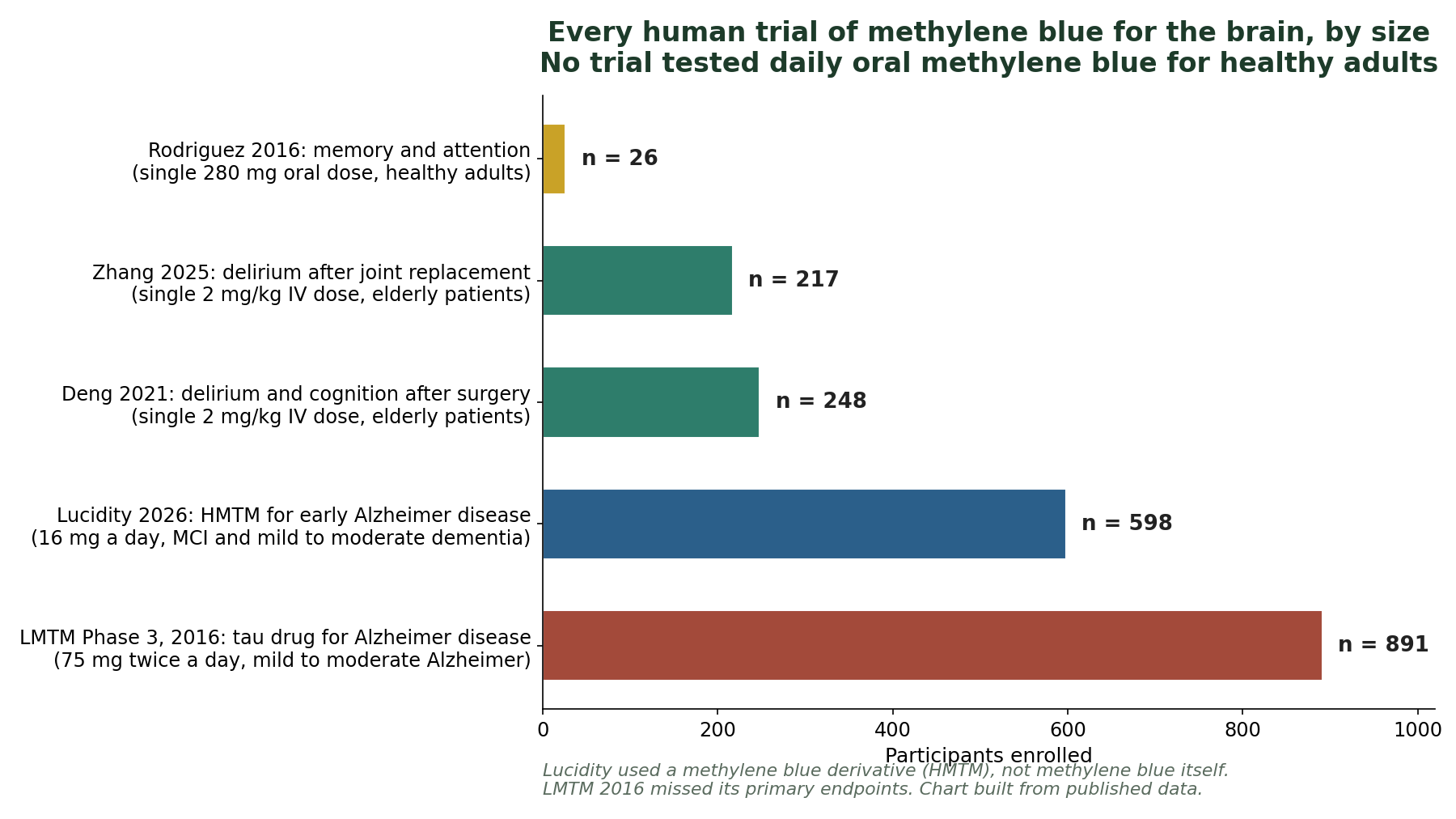
There are only 5 human trials that matter for the brain claims, and they are worth describing one by one, because each one answers a different question.
1. Memory: one small study, one single dose
In 2016, Rodriguez and colleagues at the University of Texas Health Science Center published the only controlled trial of oral methylene blue for memory in healthy adults. It appeared in Radiology. The design was careful: 26 healthy adults aged 22 to 62 were randomized, double blind, to a single 280 mg oral dose or a placebo made of blue food colouring, chosen so the blue urine would not give away who got the drug. One hour later, they did attention and short term memory tasks inside an fMRI scanner.
The results were real but narrow. Brain activity rose in the insular cortex during the attention task, and in the prefrontal, parietal and occipital cortex during the memory task. Correct responses on memory retrieval rose by 7% (P = 0.01). That is the entire human evidence base for methylene blue and memory in healthy people: 26 people, one dose, one hour, a 7% gain on one task. It did not test long term memory, repeated dosing, daily use, older adults, or anyone with cognitive impairment. It is 10 years old and nobody has repeated it in healthy adults since.
2. Delirium after surgery: the strongest signal
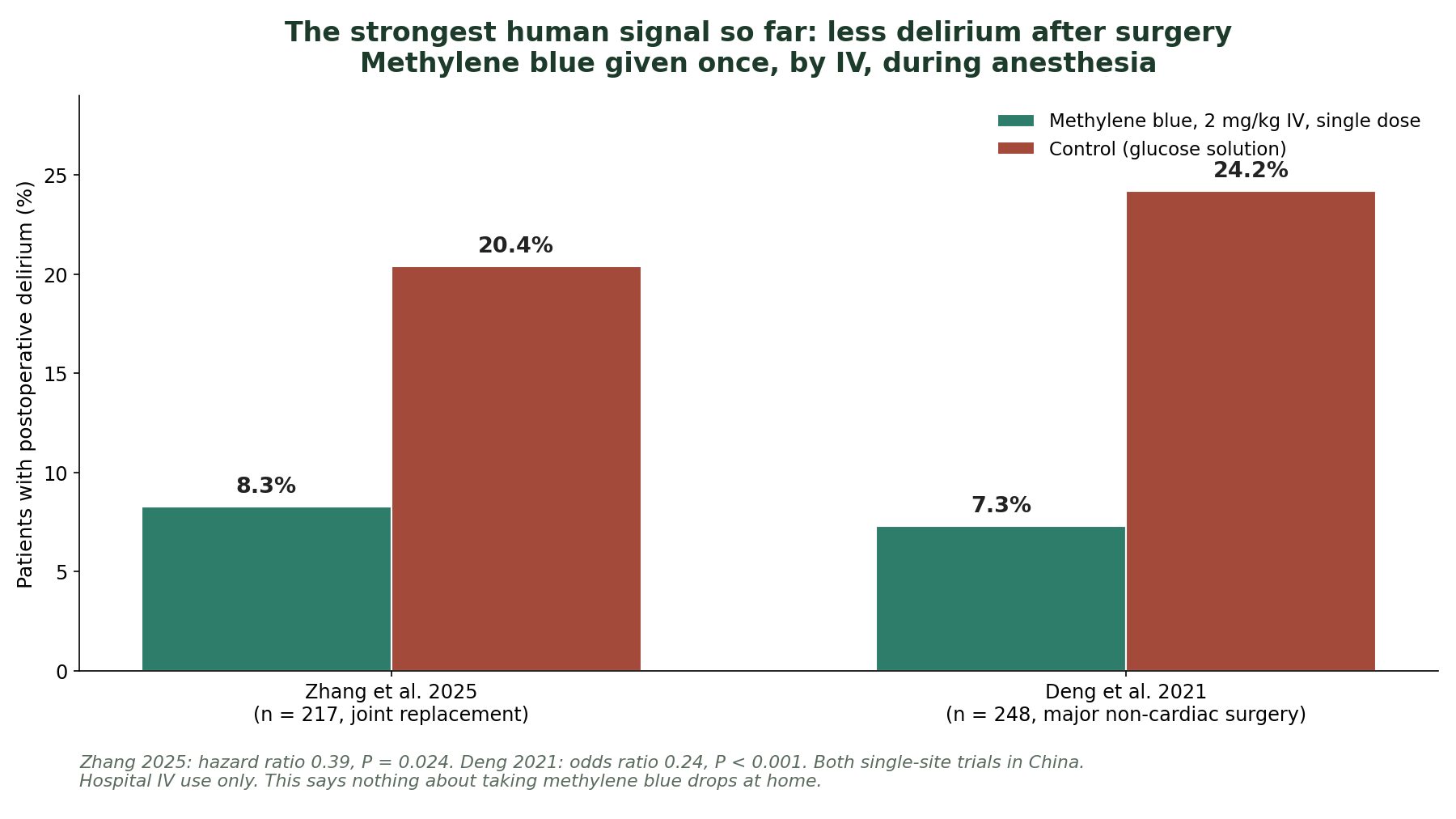
The best human results for methylene blue have nothing to do with daily use. They come from operating rooms, where a single IV dose was given to older patients during anesthesia.
Deng and colleagues (2021, Journal of Clinical Anesthesia) randomized 248 elderly patients having major non-cardiac surgery to a single IV infusion of 2 mg/kg methylene blue or a glucose solution. Delirium in the days after surgery fell from 24.2% in the control group to 7.3% in the methylene blue group (odds ratio 0.24, P < 0.001). Early cognitive dysfunction on day 7 fell from 40.2% to 16.1%. The trial was open label, which is a real limitation.
Zhang and colleagues (2025, International Journal of Surgery) ran the same idea in 217 elderly patients having joint replacement surgery. Delirium fell from 20.4% to 8.3% (hazard ratio 0.39, P = 0.024). Fever was more common in the methylene blue group, 16.5% versus 7.4%. This was a single site trial in China.
A 2026 meta-analysis pooled 3 such trials, 779 patients in total, and found delirium was about a third as likely with methylene blue (odds ratio 0.35). All 3 trials were in China, all used a single IV dose during surgery, and the authors called for larger trials.
This is a genuine signal, and it is also the easiest result in this article to misread. A single IV dose, given by an anesthesiologist, to a patient under general anesthesia, tells you nothing about drops taken at home every morning. The dose, the route, the setting and the patient are all different.
3. Alzheimer disease: two Phase 3 trials, two different stories
Methylene blue has been tested twice in large Alzheimer trials, and the two results point in opposite directions.
The first, published by Gauthier and colleagues in The Lancet in 2016, tested LMTM, a stabilized methylene blue derivative, in 891 patients with mild to moderate Alzheimer disease. Patients took 75 mg twice a day. The trial missed both of its primary endpoints: cognition and daily function did not improve versus placebo.
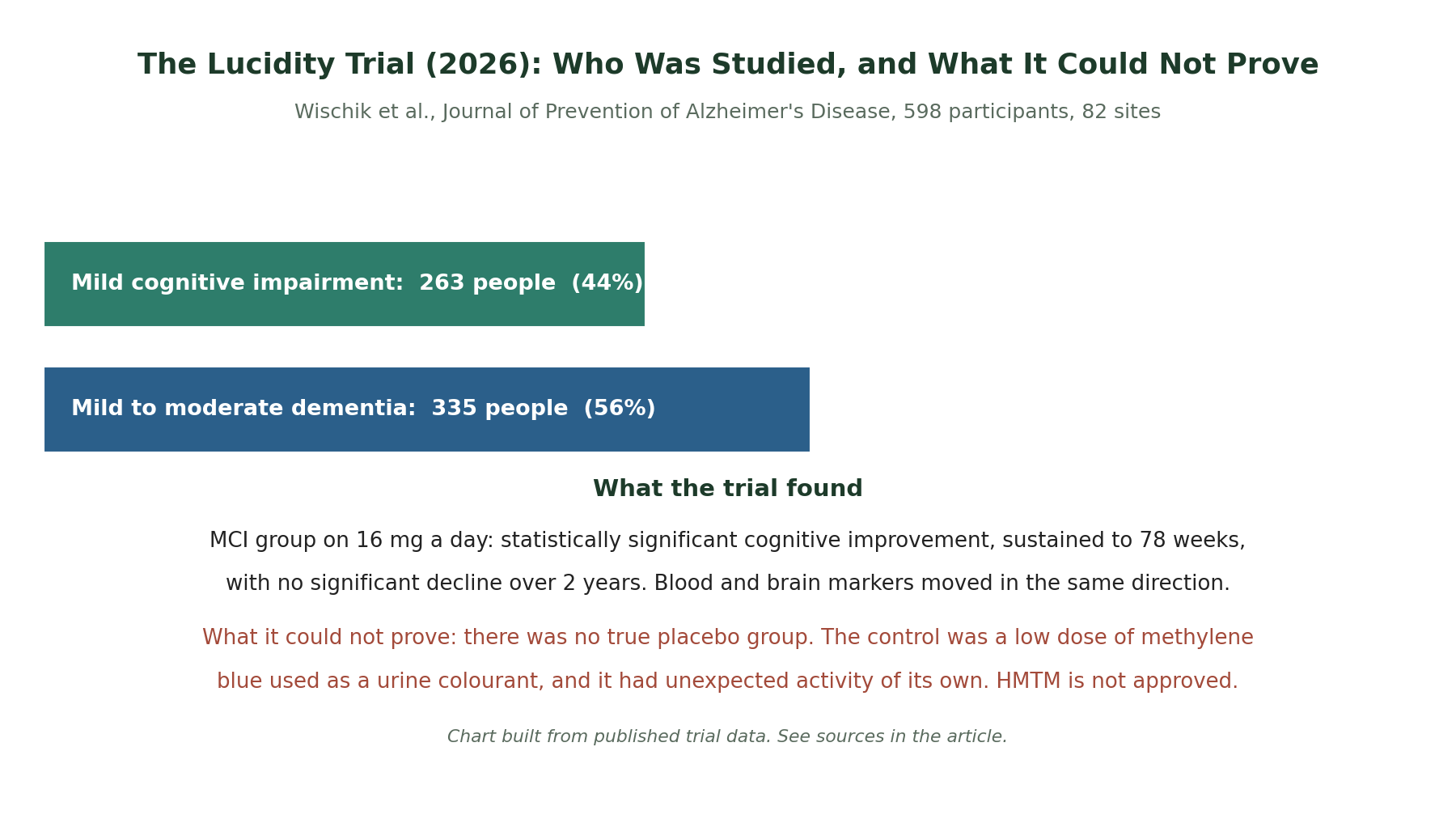
The second, the Lucidity trial, published by Wischik and colleagues in the Journal of Prevention of Alzheimer's Disease in February 2026, tested a related derivative called hydromethylthionine mesylate (HMTM) in 598 people with mild cognitive impairment or mild to moderate dementia due to Alzheimer disease, across 82 sites. Patients took 16 mg a day. In the mild cognitive impairment subgroup, 263 people, cognition improved significantly and the improvement held to 78 weeks, with no significant decline over 2 years. Blood and brain markers moved the same way: lower neurofilament light chain, less brain shrinkage on MRI, and slower progression of the tau marker pTau217. The most common side effects were headache (1.5%) and diarrhoea (1.2%).
That sounds like a breakthrough, and it might be the start of one, but the trial has a flaw that changes how much weight it can carry. There was no true placebo group. Because methylene blue turns urine blue, the researchers used a low dose of methylene blue itself as the control, to preserve blinding. That control dose turned out to have unexpected activity of its own, which meant the planned 52 week comparison against the primary endpoints could not be interpreted as designed. The positive results come from longer term analyses in the mild cognitive impairment subgroup, not from a clean win against placebo. The trial was also run by TauRx, the company developing the drug, which is a reason to want independent replication. HMTM is not approved anywhere. A marketing application is under review by the UK regulator, the MHRA.
The point that matters for a healthy person reading this: both Alzheimer trials tested a prescription derivative, in people with diagnosed disease, at a fixed dose, under medical supervision. Neither trial says anything about methylene blue drops for a healthy brain.
What no trial has shown
This is the gap the sales pages skip. As of late 2026, I could find no published trial that tested daily oral methylene blue in healthy adults for memory, focus, energy, mood or ageing. No trial has shown that it slows ageing, extends lifespan, prevents dementia, or helps brain fog. No trial has established a safe daily dose for a healthy person, because no trial has tried to. The compound has a real mechanism and real signals in narrow, medical settings. The leap from those signals to a daily supplement is untested, and the safety warning below is the reason that leap is not a small one.
The safety warning that matters most
Methylene blue injection carries an FDA boxed warning, the strongest warning the agency issues. It reads, in the current DailyMed label: methylene blue may cause serious or fatal serotonin syndrome when used in combination with serotonergic drugs and opioids. Avoid concomitant use with SSRIs, SNRIs, MAOIs and opioids. Most reported cases of serotonin syndrome with methylene blue involved a serotonergic drug, and the label advises against taking serotonergic drugs within 72 hours of the last dose.
Serotonin syndrome is not a mild side effect. It can cause confusion, agitation, fever, muscle rigidity, seizures and death. The mechanism is the MAO-A inhibition described above: methylene blue stops the brain clearing serotonin, and a second drug that raises serotonin pushes levels into dangerous territory.
Do not combine methylene blue with any of these unless a doctor who knows your full medication list tells you to: SSRIs such as sertraline, fluoxetine, escitalopram, citalopram and paroxetine; SNRIs such as venlafaxine and duloxetine; MAOIs; triptans for migraine; tramadol, fentanyl and methadone; dextromethorphan, the cough suppressant in many cold medicines; the antibiotic linezolid; bupropion, buspirone and mirtazapine. That list covers a large share of the adults most likely to be tempted by a brain fog supplement, which is exactly why the warning matters.
There are other cautions. The label warns that methylene blue can break down red blood cells in people with G6PD deficiency, a common inherited enzyme deficiency that many people do not know they have. It warns that it may cause harm in pregnancy. It turns urine and stool blue or blue green, which is harmless but startling, and it can throw off pulse oximeter readings in a hospital, which is not harmless. High doses reverse the benefit: animal data show the memory effect at 0.5 to 4 mg/kg, with opposite effects above 10 mg/kg. More is not better, and nobody knows the right dose for a healthy person, because nobody has tested one.
If you take any prescription drug, especially an antidepressant, talk to your doctor or pharmacist before considering methylene blue. If you take it and develop confusion, agitation, fever, sweating, shaking or muscle stiffness, treat it as an emergency.
Dose: there is no established dose for brain health
Look at the doses in the trials and the problem becomes obvious. A single 280 mg oral dose for memory. A single 2 mg/kg IV dose for delirium. Sixteen mg a day of a different compound for Alzheimer disease. Seventy five mg twice a day of yet another form in the failed 2016 trial. There is no dose that has been shown safe and effective for daily use in a healthy adult, and the doses sold online, often 1 to 10 mg of drops, are not tied to any of these trials. They are numbers chosen by sellers, not by studies.
What actually helps your brain
If the goal is a sharper brain in 10 or 20 years, the interventions with real evidence are boring, and they are not in a blue bottle. Deep sleep is the strongest lever I have written about: in a 2023 study of 346 adults over 60, each 1% yearly loss of deep sleep was linked to a 27% higher risk of dementia. I covered the full evidence in my deep sleep guide: https://thrivetools.co/blog/deep-sleep-longevity-guide. Regular exercise, including the zone 2 cardio and strength training I have covered on the blog, has randomized trial evidence behind it. A regular sleep schedule costs nothing and beats most supplements on the evidence. For brain health tools with reader offers, my discount codes page is the place to look: https://thrivetools.co/discount-codes.
My honest verdict
Methylene blue is interesting science with a real mechanism, real signals in operating rooms and in early Alzheimer disease, and a safety profile that makes casual daily use a bad bet for most people. It is not a proven memory supplement, not a longevity supplement, and not something I can stand behind as a product. The Alzheimer signal from the Lucidity trial deserves a properly controlled follow up, and the delirium signal deserves a large multi centre trial. Until those exist, the honest position is to watch the research and leave the blue drops on the shelf, especially if you take an antidepressant or any other serotonergic drug. The boring basics, sleep, exercise, strength, a regular schedule, have far more evidence and no boxed warning.
Sources
- Rodriguez P et al. Multimodal randomized functional MR imaging of the effects of methylene blue in the human brain. Radiology. 2016;281(3):743-753. doi:10.1148/radiol.2016152893
- Deng Y et al. Methylene blue reduces incidence of early postoperative cognitive disorders in elderly patients undergoing major non-cardiac surgery. J Clin Anesth. 2021;68:110108.
- Zhang W et al. Effect of intraoperative methylene blue on postoperative delirium in elderly patients undergoing joint replacement: a randomized controlled trial. Int J Surg. 2025;111(12):9384-9391. doi:10.1097/JS9.0000000000002981. PMID 40696945.
- Intraoperative methylene blue administration and postoperative delirium: a meta-analysis of surgical patients. Ir J Med Sci. 2026. doi:10.1007/s11845-026-04440-w
- Gauthier S et al. Efficacy and safety of tau-aggregation inhibitor therapy in patients with mild or moderate Alzheimer's disease: a randomised, controlled, double-blind, placebo-controlled, phase 3 trial. Lancet. 2016;388(10039):2873-2884.
- Wischik CM et al. Clinical, imaging and blood biomarker outcomes in a Phase 3 clinical trial of tau aggregation inhibitor hydromethylthionine mesylate in mild cognitive impairment and mild to moderate dementia due to Alzheimer's disease. J Prev Alzheimers Dis. 2026. PMID 41570392.
- DailyMed, US National Library of Medicine. Methylene blue injection, USP, prescribing information. Revised January 2026. Boxed warning: serotonin syndrome with concomitant use of serotonergic drugs and opioids.
FAQ
Does methylene blue improve memory?
One small trial found a single 280 mg dose improved short term memory retrieval by 7% in 26 healthy adults, measured 1 hour later. No trial has tested repeated or daily use for memory in healthy adults, so there is no evidence it helps memory over weeks or months.
Is methylene blue safe to take every day?
There is no safety data for daily oral use in healthy adults, because no trial has tested it. The FDA boxed warning covers serotonin syndrome with antidepressants and opioids, and the label also warns about G6PD deficiency and pregnancy. Products sold online are unregulated, so purity is unverified.
Can I take methylene blue with an antidepressant?
No. The FDA label says to avoid combining methylene blue with SSRIs, SNRIs, MAOIs and opioids, because the combination can cause serious or fatal serotonin syndrome. Ask your doctor or pharmacist before considering it.
Does methylene blue help Alzheimer disease?
A 2026 Phase 3 trial of a methylene blue derivative, HMTM, found a significant benefit in people with mild cognitive impairment due to Alzheimer disease, but the trial had no true placebo group and the drug is not approved. An earlier 2016 Phase 3 trial of a related compound missed its primary endpoints. There is no evidence it prevents Alzheimer disease in healthy people.
What dose of methylene blue is used for brain health?
There is no established dose. Trial doses range from a single 280 mg oral dose to a single 2 mg/kg IV dose to 16 mg a day of a different compound. Doses sold online are not tied to any trial.
Why does methylene blue turn urine blue?
Methylene blue is a dye, and the kidneys clear it unchanged. Blue or blue green urine is expected and harmless, but it is also the reason blinding is so hard in methylene blue trials, and why the Lucidity trial had to use a low dose of the drug itself as its control.
This article is for general information only and is not medical advice. It reports on published studies and does not recommend any supplement, dose, or treatment. Methylene blue is a prescription drug for a specific blood disorder, and its use for brain health is not approved. Talk to your doctor or pharmacist before considering it, especially if you take an antidepressant or any other prescription drug.
Looking for tools that support healthy aging and recovery? Browse the current offers on our discount codes page. This article is for general information only and is not medical advice. It reports on a published study and does not recommend any supplement, dose, or treatment.