In August 2025, a study in Nature made a claim that stopped me mid-scroll: the brains of people with early Alzheimer's are running low on lithium, and giving a low-dose lithium salt to mice reversed the disease. Within days, supplement sellers were calling lithium orotate the brain's missing nutrient and claiming most people are deficient. I read the actual paper instead of the headlines, and the gap between the two is exactly why I am writing this.
The study is real, it is from a serious lab, and it is genuinely interesting. It is also a mouse study with a postmortem human half, and nobody has tested lithium orotate in a person with Alzheimer's yet. Here is what it found, what it did not find, and what the sellers are leaving out.
What the study actually did
The paper comes from Bruce Yankner's lab at Harvard Medical School, with brain tissue data from the Rush Alzheimer's Disease Center in Chicago. It was published in Nature on August 6, 2025 (Aron et al., Nature 645, 711 to 720).
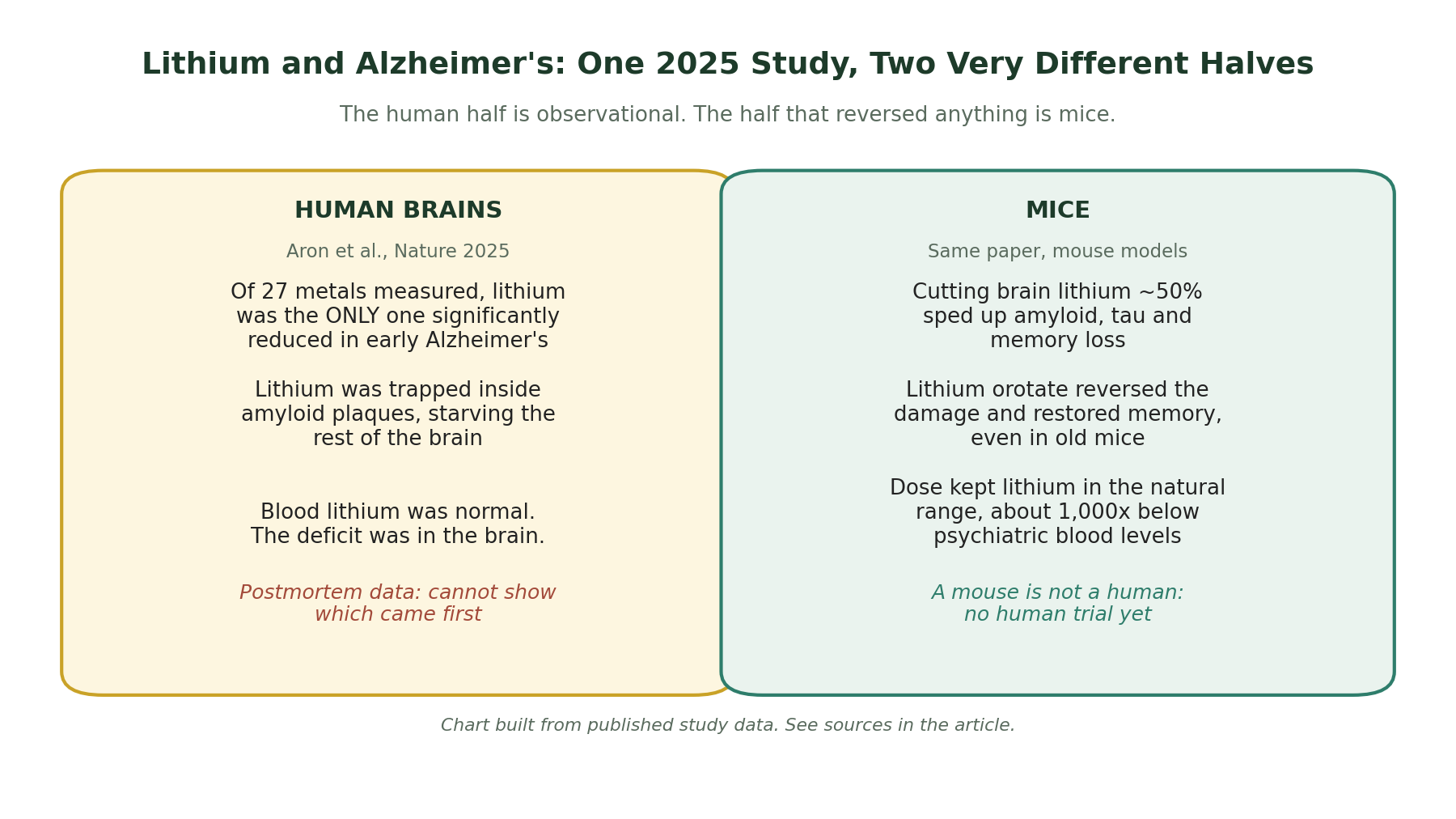
It has 2 halves. In the first, the team measured 27 metals in the prefrontal cortex and blood of older adults who had died with no cognitive impairment (133 people), mild cognitive impairment, the stage before Alzheimer's (58 people), or Alzheimer's disease (94 people). They confirmed the result in a second, independent group of 22 people without impairment and 21 with Alzheimer's.
In the second half, they ran experiments in mice. They fed mice a diet with 92% of the lithium removed, which cut blood lithium by 89% and brain lithium by about half. Then they tested whether putting lithium back, in the form of lithium orotate, could undo the damage, in 2 mouse models of Alzheimer's and in normally aging mice.
What it found
5 findings matter, and each one needs its own context.
1. Lithium was the only metal that was low in early Alzheimer's brains. Of the 27 metals measured, lithium was the only one significantly reduced in the prefrontal cortex of people with mild cognitive impairment. The same was true in Alzheimer's. Other metals changed too, sodium and zinc were higher, copper was lower, but lithium was the only change that showed up this early and this clearly.
2. The lithium was trapped inside amyloid plaques. Using a technique that maps metals in tissue, the team found lithium concentrated inside amyloid plaques, the sticky protein clumps that define Alzheimer's. In mouse brains, plaques held 3 to 4 times as much lithium as the tissue around them. In human tissue, the amount of lithium trapped in plaques rose from mild impairment to Alzheimer's. The picture is a brain that still has lithium, but locked away where it cannot be used.
3. Blood lithium was normal. This is the detail most coverage skipped. Blood lithium levels in people with mild impairment and Alzheimer's were not significantly different from healthy controls. The deficit was in the brain, not the blood. A blood test cannot tell you whether your brain lithium is low, and there is no established test that can.
4. Cutting brain lithium in mice sped up the disease. Mice on the lithium-poor diet developed more amyloid plaques within 5 weeks, more of the toxic amyloid-beta 42 protein in the cortex and hippocampus, more phosphorylated tau, more inflammation from the brain's immune cells, and loss of synapses, axons and myelin. Their memory declined faster. Gene activity in every major brain cell type shifted toward the pattern seen in human Alzheimer's.
5. Lithium orotate reversed it, in mice. The team tested 16 lithium salts and picked lithium orotate because it binds weakly to amyloid, so it should escape being trapped in plaques. Given in the drinking water from 9 to 18 months of age, it prevented and reversed amyloid and tau pathology in Alzheimer's mice, and it worked better than the same dose of lithium carbonate, the prescription form. In normally aging mice given orotate from 12 to 24 months, it prevented the loss of dendritic spines, calmed brain inflammation, and largely reversed the decline in maze learning and object recognition memory. Long-term treatment did not change kidney or thyroid blood markers in the mice.
The mechanism the paper proposes is a vicious cycle. Amyloid traps lithium. Low available lithium activates an enzyme called GSK3 beta, which drives more amyloid production and tau phosphorylation. Low lithium also weakens the brain's immune cells, so they clear amyloid less well, which means more amyloid, which traps more lithium. Restoring lithium breaks the cycle, at least in mice.
What came before: the evidence was already mixed
The 2025 paper did not come out of nowhere, and the earlier evidence is messier than the headlines suggest.
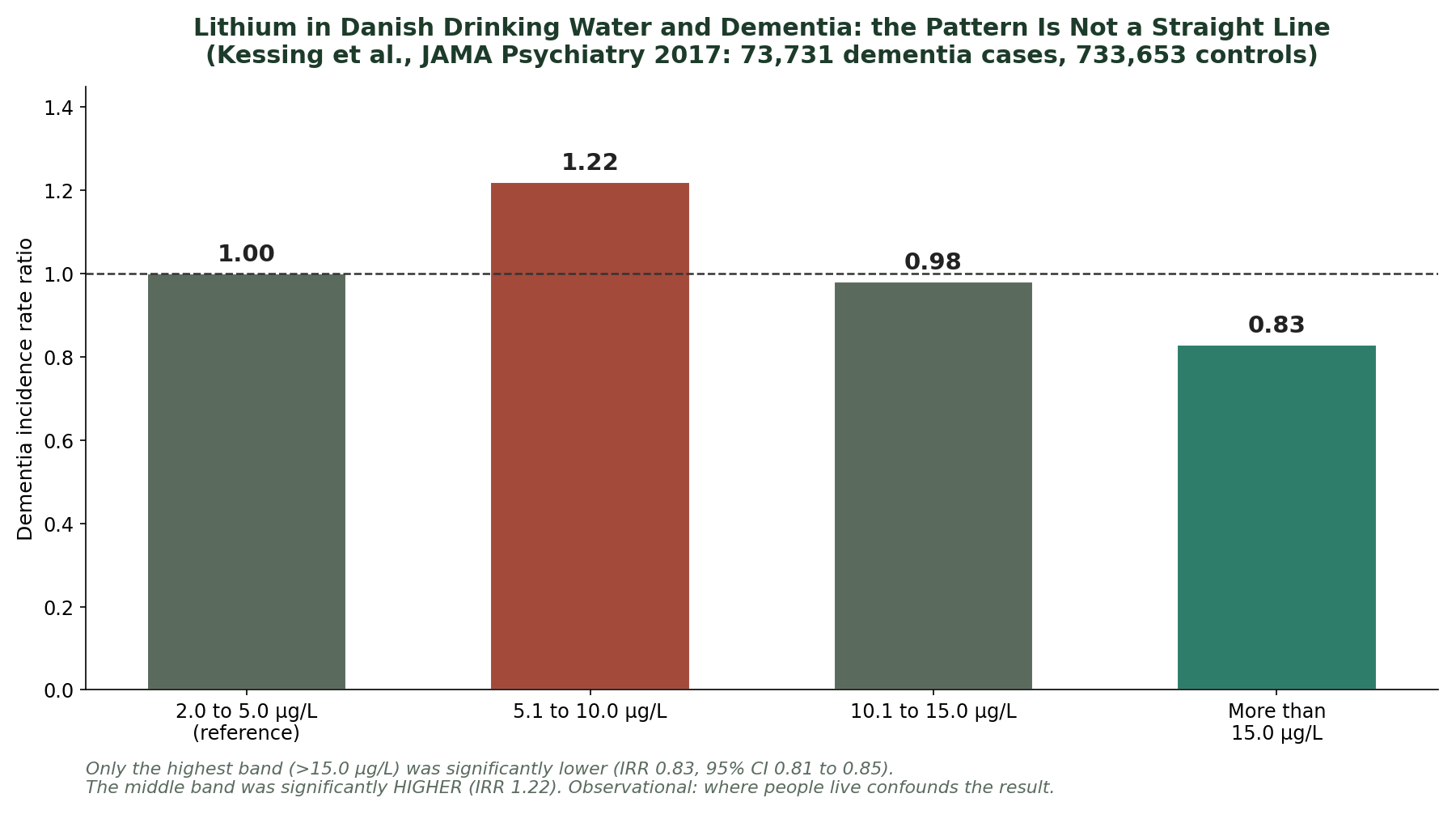
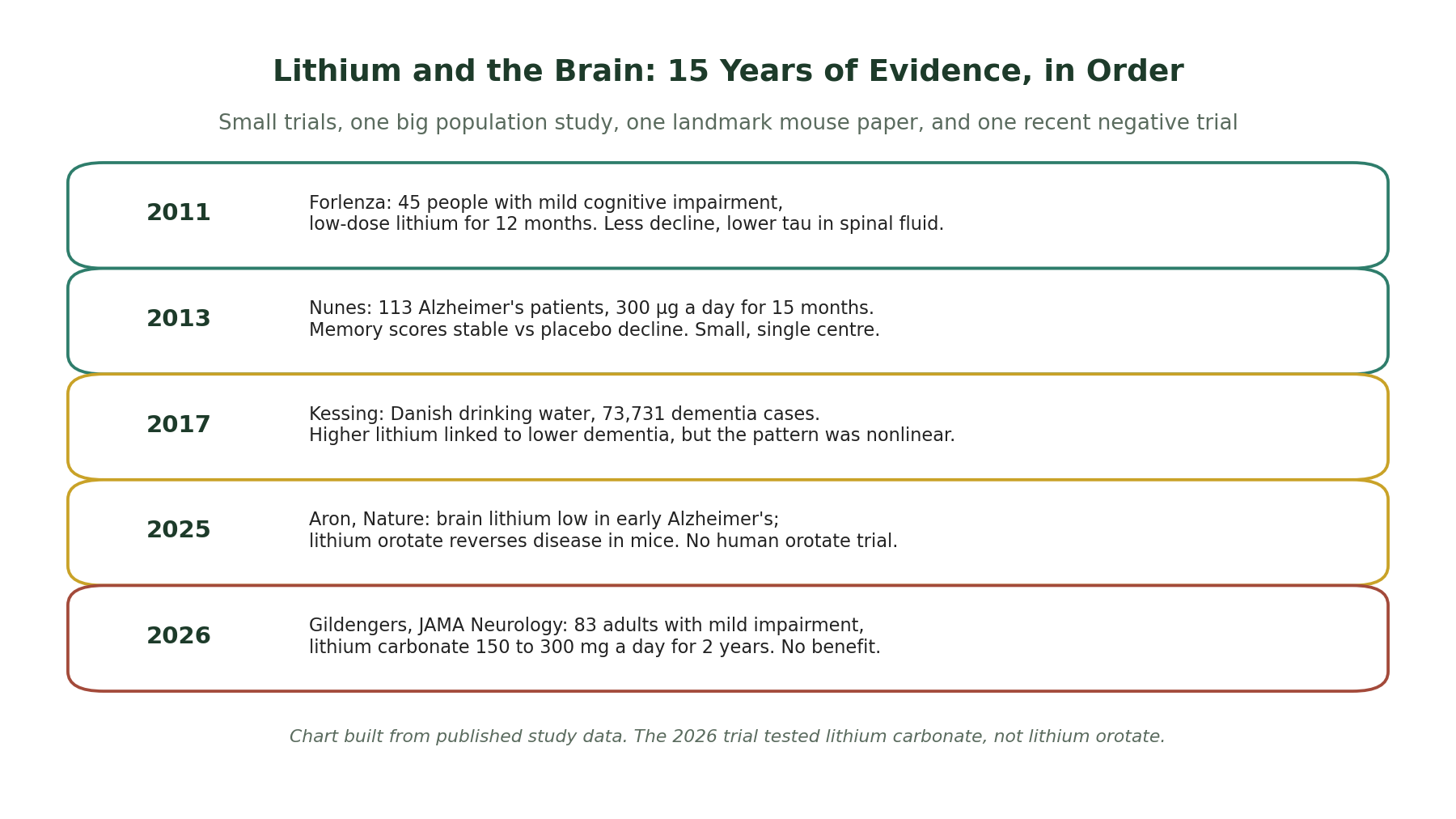
In 2017, a Danish study of 73,731 people with dementia and 733,653 controls found that higher lithium in drinking water was associated with lower dementia rates, but only at the highest levels, above 15 micrograms per litre, where the rate was 17% lower. The middle band, 5.1 to 10.0 micrograms per litre, was associated with a 22% higher rate. The authors called the pattern nonlinear and warned that where people live could explain it. A map of water lithium is also a map of geography, income, and access to health care.
In 2013, a small Brazilian trial gave 113 Alzheimer's patients a lithium microdose of 300 micrograms a day for 15 months. The treated group held steady on a memory test while the placebo group declined. It was a real randomized trial, but it was small, from a single centre, and its methods were thinly reported. It has never been replicated at that dose.
In 2011, a trial of 45 people with mild cognitive impairment used lithium at 150 to 600 mg a day for 12 months and found less decline and lower tau in spinal fluid. Two earlier trials at higher doses found nothing.
And in March 2026, a new trial in JAMA Neurology reported the opposite result. Gildengers and colleagues gave 83 adults with mild cognitive impairment lithium carbonate at 150 or 300 mg a day for 2 years. It did not improve cognition, brain shrinkage, or a growth factor called BDNF. That trial did not test lithium orotate, and only about a quarter of participants had amyloid in their brains, so it does not settle the orotate question. But it is a reminder that lithium has failed in humans before, and that a mouse result is not a human result.
What the study does not prove
The study's senior author said it plainly when the paper came out: a mouse is not a human, nobody should take anything based just on mouse studies, and the right dose in humans still needs to be found in a controlled trial. He is right, and here is why.
The human half cannot show cause and effect. The brain tissue came from people who had already died. Low brain lithium in Alzheimer's could be a cause of the disease, or it could be a result of it, since the paper itself shows plaques trap lithium. Both can be true at once, and this study cannot separate them.
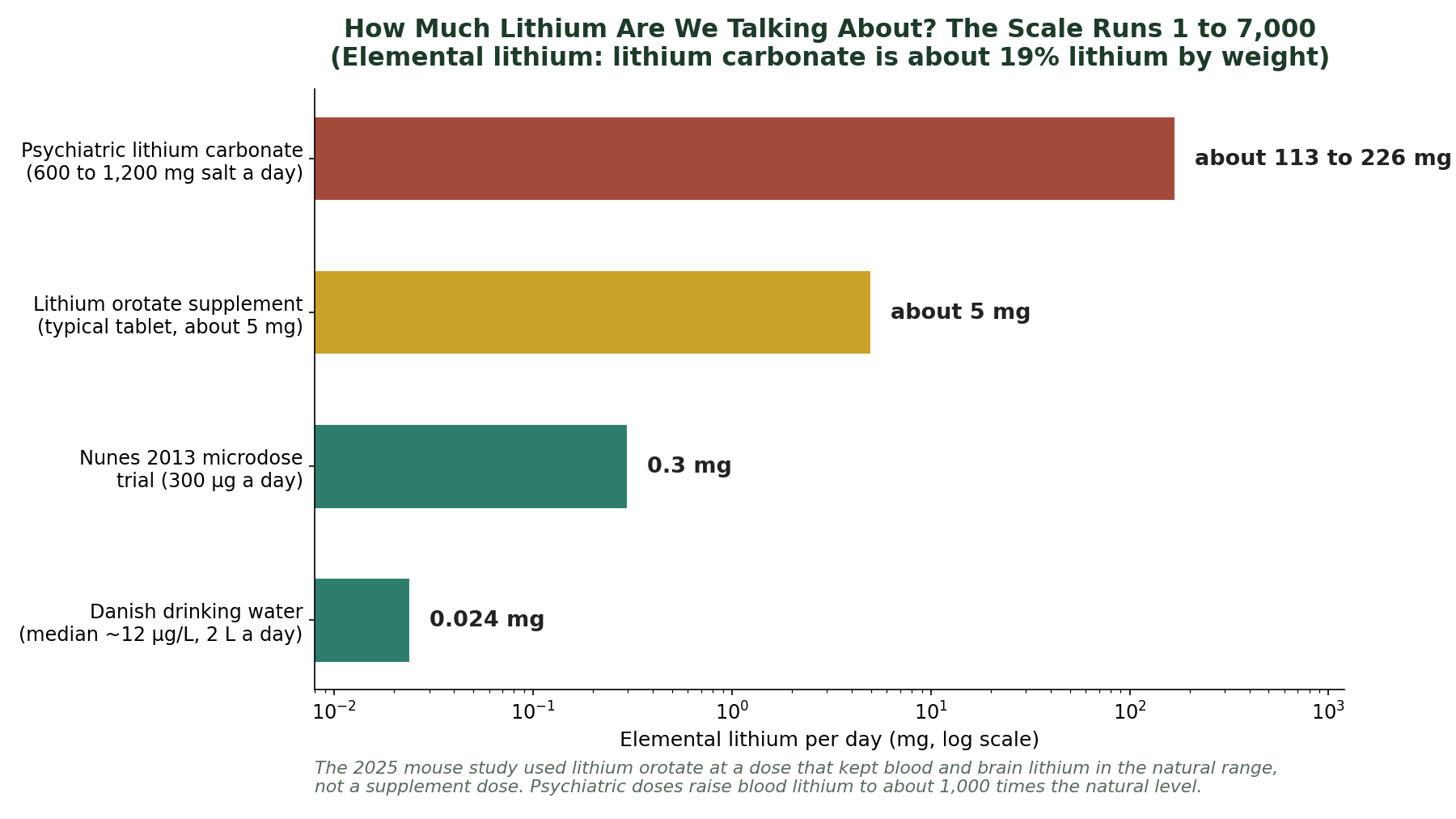
The mouse dose does not translate to a supplement dose. The mice received lithium orotate in their drinking water at a dose that kept their blood and brain lithium in the natural range. The paper stresses that psychiatric lithium doses raise blood lithium to about 1,000 times the natural level. There is no human dose for this purpose, no trial testing one, and no way to know from this paper what a person should take, or whether a store-bought tablet does anything at all in a human brain.
There is no such thing as a lithium deficiency test. There is no established recommended daily intake for lithium, no agreed definition of lithium deficiency in people, and no standard blood test with a reference range that tells you whether your brain lithium is low. So when a seller says 90 to 95% of people are lithium deficient, that number has no basis. Nobody has defined the word yet.
The orotate form has never been tested in people for this. Everything that makes lithium orotate interesting, it escapes amyloid trapping, it works at natural levels, it did not harm mouse kidneys or thyroids, was shown in mice. Human trials are, in the authors' words, on the horizon. They have not happened.
The supplement hype, and what buyers should know
Lithium orotate is sold as a supplement, usually in tablets of 120 mg of the salt, which is about 5 mg of elemental lithium. That is far below a psychiatric dose, which is 600 to 1,200 mg of lithium carbonate a day, or about 113 to 226 mg of elemental lithium. Low does not mean safe, and it does not mean effective.
The mouse study used a dose that kept lithium in the natural range. A 5 mg tablet is roughly 200 times the lithium in a litre of Danish tap water and about 17 times the 300 microgram dose used in the 2013 microdose trial. It is also an unregulated product: nobody has verified that the lithium in a given bottle reaches the brain, avoids amyloid trapping in a human, or does anything measurable. The study tested one specific salt, at one specific dose, in mice, under lab conditions. A bottle on a shelf is not that study.
Safety: lithium is not a vitamin
Prescription lithium has one of the narrowest safety margins in medicine. Its therapeutic blood range for bipolar disorder is about 0.6 to 1.2 mmol per litre, and toxicity can start not far above that. The risks include kidney damage, thyroid dysfunction, tremor, confusion, and at high levels, coma. It interacts with common medicines: NSAIDs like ibuprofen, diuretics, and ACE inhibitors can all push lithium levels up. It needs regular blood monitoring, and it is not safe in pregnancy without specialist input.
Lithium orotate at supplement doses has not been put through the same safety testing, which is not the same as being proven safe. There are no long-term human studies of daily orotate use, no established safe dose for brain health, and no data on what happens when someone with kidney disease, thyroid disease, or low sodium takes it, or combines it with the medicines above.
3 rules follow from that. If you take prescription lithium for bipolar disorder, do not change your dose because of this study, and talk to your psychiatrist before changing anything. If you have kidney disease, thyroid disease, are pregnant, or take a diuretic, an ACE inhibitor, or regular NSAIDs, do not self-experiment with lithium in any form. And if you are considering a supplement, that is a conversation for your doctor, not a checkout page.
What actually protects the brain today
While the lithium question is unanswered, the evidence for what does protect the brain is stronger than most people realise. The Lancet Commission on dementia prevention, updated in 2024, lists 14 modifiable risk factors, from high blood pressure and hearing loss to smoking, diabetes, depression, social isolation, and physical inactivity, and estimates that about 45% of dementia cases could be prevented or delayed by addressing them. None of that is as exciting as a new supplement, and all of it is better proven.
The basics are unglamorous and they work: regular aerobic exercise and strength training, consistent sleep, blood pressure control, treating hearing loss, staying socially connected, not smoking, and limiting alcohol. My earlier guides on strength training, VO2 max, and deep sleep cover the same ground, and they point to the same conclusion: the strongest brain intervention available today is not a pill, it is a routine.
Bottom line
The 2025 Nature study is one of the most interesting Alzheimer's papers of the last few years. It found that lithium is the only metal depleted in the brains of people with early Alzheimer's, that amyloid plaques trap it, and that restoring it with lithium orotate reversed the disease in mice, at natural levels, without detectable toxicity in those animals. It also leaves the human question entirely open. No human has been treated with lithium orotate for Alzheimer's in a trial, there is no established dose, no deficiency test, and the most recent human trial of lithium, using the carbonate form, found no benefit.
That is the honest position: a real discovery, a plausible mechanism, and a human answer that does not exist yet. If a seller tells you otherwise, they are selling you the headline, not the science.
Sources
- Aron L, Ngian ZK, Qiu C, et al. Lithium deficiency and the onset of Alzheimer's disease. Nature. 2025;645:711-720. doi:10.1038/s41586-025-09335-x
- Bush AI. Does lithium deficiency contribute to Alzheimer's disease? Nature. 2025. doi:10.1038/d41586-025-02255-w
- Kessing LV, Gerds TA, Knudsen NN, et al. Association of lithium in drinking water with the incidence of dementia. JAMA Psychiatry. 2017;74(10):1005-1010. doi:10.1001/jamapsychiatry.2017.2362
- Nunes MA, Viel TA, Buck HS. Microdose lithium treatment stabilized cognitive impairment in patients with Alzheimer's disease. Curr Alzheimer Res. 2013;10(1):104-107. PMID 22746245
- Forlenza OV, Diniz BS, Radanovic M, et al. Disease-modifying properties of long-term lithium treatment for amnestic mild cognitive impairment. Br J Psychiatry. 2011;198(5):351-356.
- Gildengers AG, et al. Low-dose lithium for mild cognitive impairment: a pilot randomized clinical trial. JAMA Neurol. 2026.
- Livingston G, et al. Dementia prevention, intervention, and care: 2024 report of the Lancet standing Commission. Lancet. 2024;404(10452):572-628.
- Harvard Medical School. Lithium loss ignites Alzheimer's, but lithium compound can reverse disease in mice. August 6, 2025.
Frequently asked questions
Does lithium prevent Alzheimer's disease?
No study has shown that lithium prevents Alzheimer's in people. A 2025 Nature study found low brain lithium in early Alzheimer's and reversed the disease in mice with lithium orotate, but mouse results often do not repeat in humans, and no human trial of lithium orotate has been done.
Is lithium orotate safe to take for brain health?
There is no established safe dose for brain health and no long-term human safety data for daily orotate use. Prescription lithium has a narrow safety margin and can damage kidneys and thyroid. Anyone with kidney or thyroid disease, anyone pregnant, and anyone taking diuretics, ACE inhibitors, or regular NSAIDs should not take lithium in any form without a doctor's input.
How much lithium do you need per day?
There is no established recommended daily intake for lithium. Typical dietary intake from food and water is in the range of tens of micrograms a day, and no health authority has set a requirement, because no deficiency syndrome has been defined in people.
What is the difference between lithium orotate and lithium carbonate?
Lithium carbonate is the prescription form used for bipolar disorder at doses of 600 to 1,200 mg a day, with blood monitoring. Lithium orotate is a different salt, sold as a supplement at about 5 mg of elemental lithium per tablet. In the 2025 mouse study, orotate worked better than carbonate at the same low dose, because it binds less to amyloid. That has not been tested in people.
Should I get my lithium levels tested?
A blood lithium test measures the drug in people taking prescription lithium. It does not measure brain lithium, and in the 2025 study blood lithium was normal in people whose brain lithium was low. There is no clinical test that tells you whether your brain lithium is low.
This article is for general information only and is not medical advice. It reports on published studies and does not recommend any supplement, dose, or treatment. If you take prescription lithium, do not change your dose without talking to your doctor.
Looking for tools that support healthy aging and recovery? Browse the current offers on our discount codes page. This article is for general information only and is not medical advice. It reports on a published study and does not recommend any supplement, dose, or treatment.