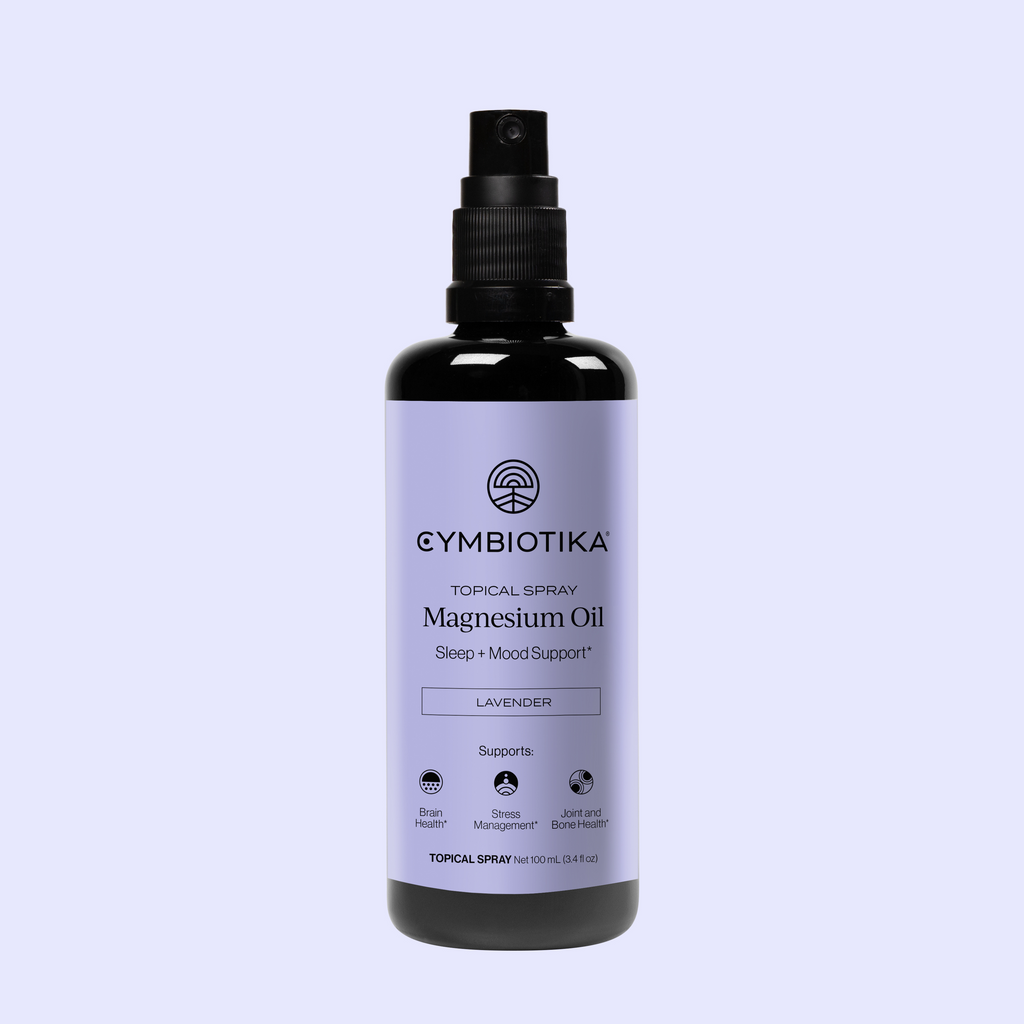
Cymbiotika's Topical Magnesium Oil Spray makes a bold promise. Spray it on your skin and it absorbs "into the bloodstream within minutes," bypassing digestion entirely. If that were true, it would solve the main problem with oral magnesium, which is that a large share of it never gets absorbed and the rest can upset your stomach. The question is whether skin works that way. A study published in 2026 tested exactly that, and the answer was not what the marketing suggests.
Disclosure: I'm affiliated with Cymbiotika, but I only recommend things I can actually stand behind so here's my honest breakdown.
The short answer
Cymbiotika's spray is a 100 mL lavender magnesium chloride spray that costs $27 for a one-time purchase, down from a $36 list price. It contains magnesium chloride plus a botanical blend, and its most interesting ingredient is pharmaceutical-grade DMSO, a known skin penetration enhancer. That DMSO is the one thing that could make this spray different from a plain magnesium chloride spray, because plain sprays have almost no evidence behind them.
The problem is that no published study has tested this product, or any DMSO plus magnesium formula, on human skin. The best direct test we have, a 2026 study from the University of Copenhagen, put a saturated magnesium solution on intact pig skin for 24 hours and found the amount that crossed was statistically indistinguishable from an untreated control. A 2025 randomised trial of a commercial magnesium gel found it did no better than a placebo gel for muscle soreness after hard exercise. The one placebo-controlled human trial of a magnesium cream found no significant overall rise in blood or urine magnesium after 2 weeks.
So the honest verdict is this. As a relaxing bedtime ritual with a pleasant lavender scent, it is a well-made product. As a way to raise your magnesium levels, it is unproven, and the current evidence points the other way. If you are low on magnesium, an oral supplement is still the evidence-based route. My review of Cymbiotika's own oral option is here: /blog/cymbiotika-liposomal-magnesium-complex-review.
The research gap this product actually fills
Transdermal magnesium is one of the most repeated claims in the wellness world, and one of the least tested. Search for it and you will find hundreds of products and almost no human data. The gap is not a lack of interest. It is that the obvious experiment, apply magnesium to skin and measure blood levels, has barely been run, and the runs that exist are small, short, or uncontrolled.
That makes this product worth reviewing honestly, because it is the 9th product in my Cymbiotika series and the first one that is not swallowed. Everything that was true for the liposomal packets, that the delivery claim is the whole pitch, is even more true here. The spray does not contain a novel form of magnesium. It contains magnesium chloride, the same salt in every cheap magnesium oil. The entire case for the $27 price rests on whether it gets through skin, and on what the DMSO and botanicals add.
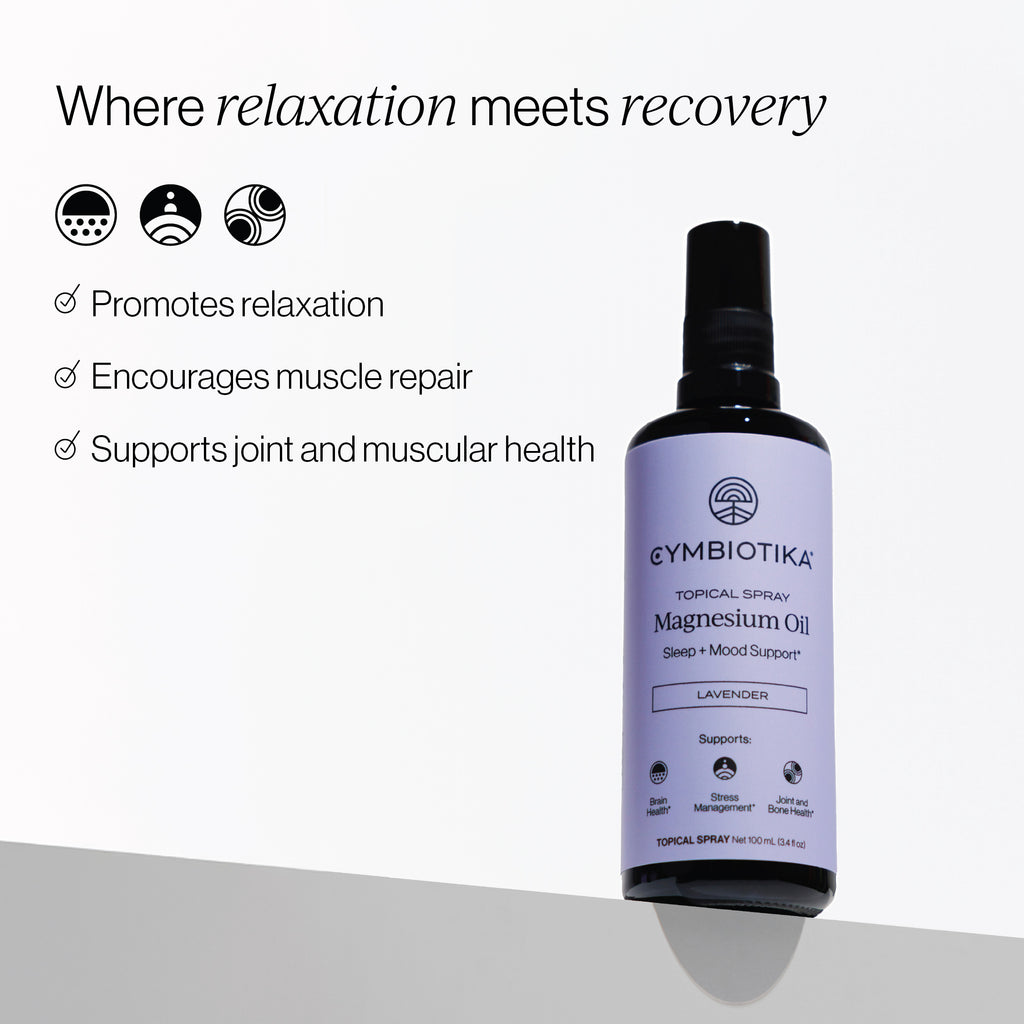
What is in the bottle
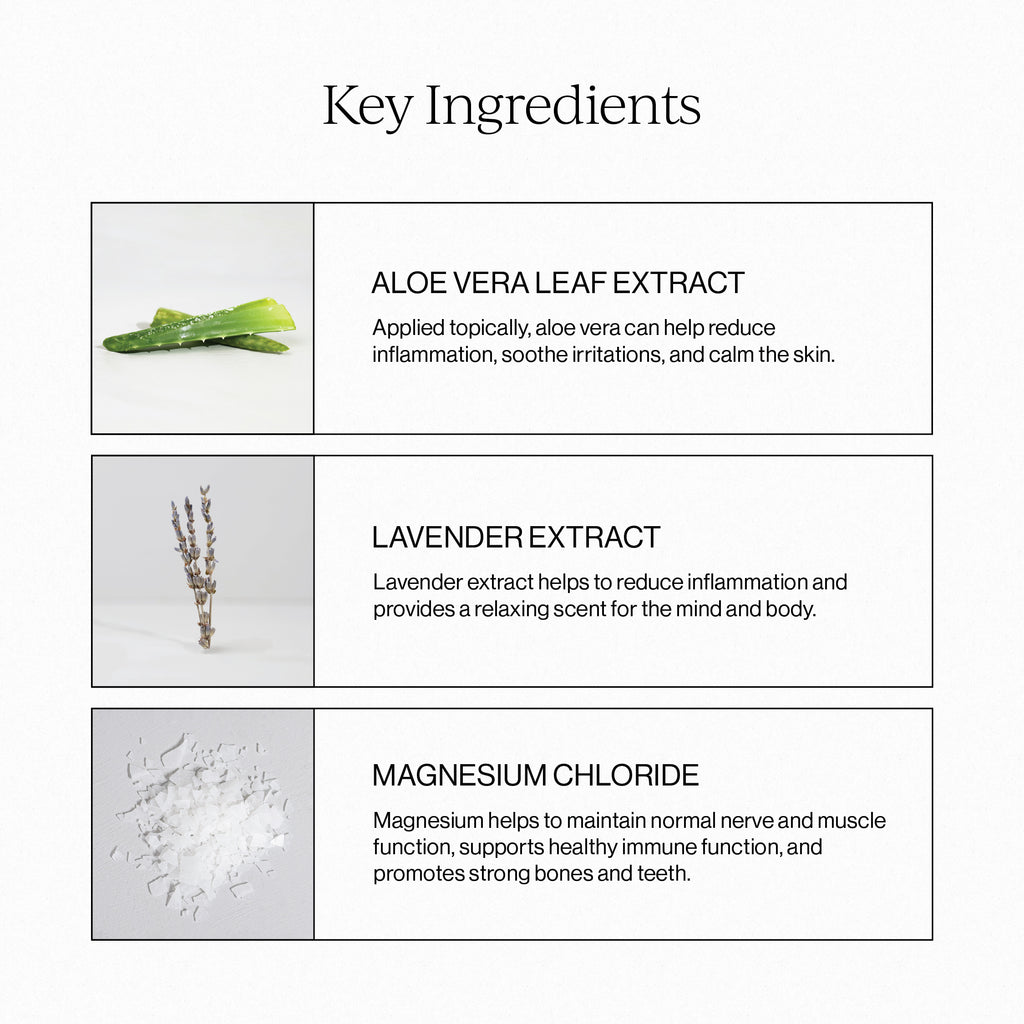
The product page lists 15 ingredients: distilled water, magnesium chloride, ashwagandha extract, dragons blood extract (Croton lechleri extract), Japanese honeysuckle extract, copper extract, reishi mushroom extract, shiitake mushroom extract, lavender extract, aloe vera leaf juice, dimethyl sulfoxide (DMSO), organic blue agave ferment, niacinamide, olive extract, and arnica extract.
Two things stand out. First, the page does not say how much elemental magnesium each spray delivers. Without that number, there is no way to calculate a cost per milligram or compare the dose with an oral supplement. That is a real omission for a product sold on absorption.
Second, the page does not name a source for its magnesium chloride. Older company material described it as sourced from the Dead Sea, and a newer Cymbiotika blog post described it as sourced from the Zechstein Seabed, but the current product page names neither. I am not repeating either claim here because the page you would buy from does not make it.
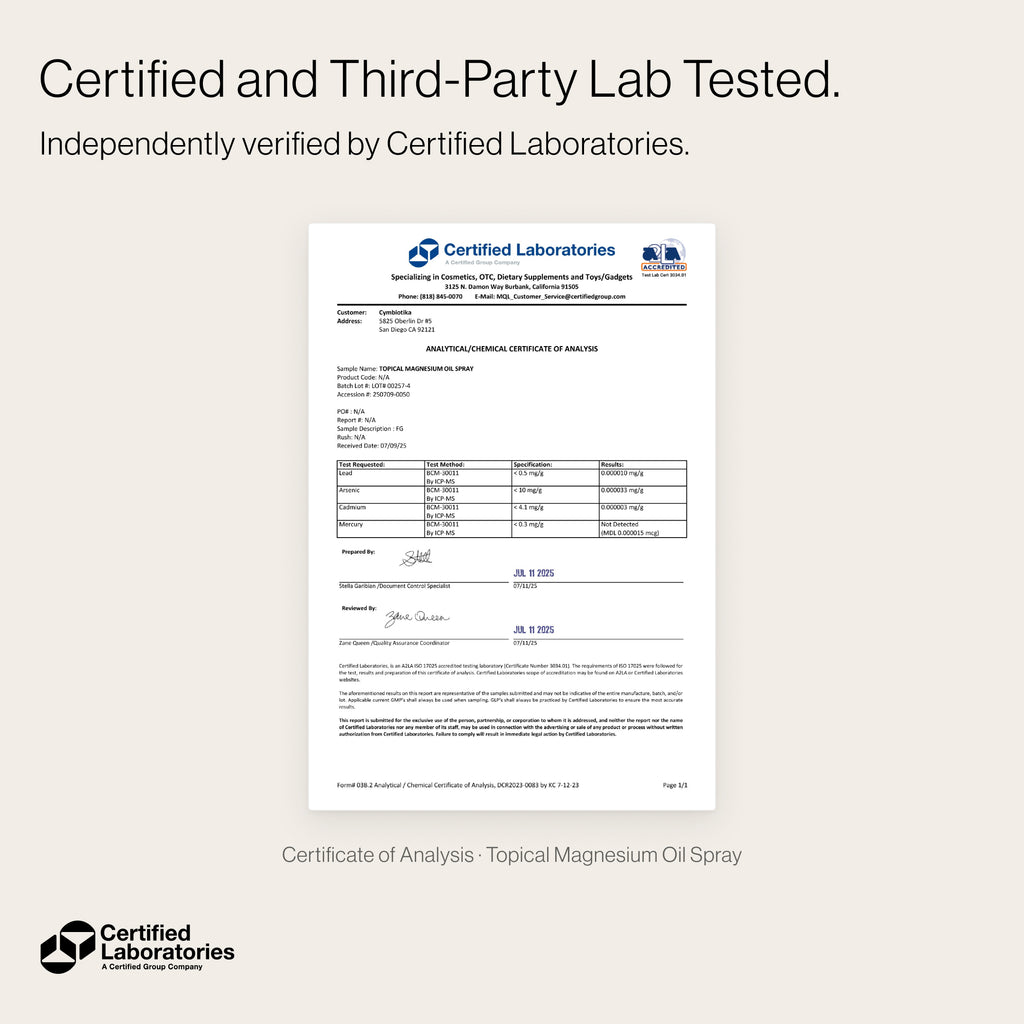
The formula also carries a third-party tested claim. Cymbiotika says each batch is screened by accredited third-party laboratories for microbial contaminants, heavy metals, and other specified contaminants, and the product page shows a certificate of analysis for heavy metals. That is a genuine quality plus, and it is one of the few things in this category that can be verified.
[Supporting image: images/magoil-ingredients.jpg]
Price and value
A one-time purchase costs $27, listed as 25% off the $36 list price. Subscribe and Save is the default option: $24.30 per box for delivery every 30 days, or $21.60 per box for delivery every 90 days, with 3 boxes per delivery. Shipping is free on every order, and there is a 60-day money-back guarantee. The page shows a 4.9 out of 5 rating from 1,372 reviews. You can shop through my affiliate link here: https://shop.cymbiotika.com/SFVM9DY9.
At $27, this is a premium price for a magnesium spray. Plain magnesium chloride sprays sell for much less. What the extra money buys is the botanical blend, the DMSO, the lavender scent, the third-party testing, and the brand. Whether that is worth it depends on what you expect the spray to do. If you want a pleasant, well-scented topical product for a bedtime wind-down routine, the price is defensible. If you want a proven way to fix low magnesium, no spray at any price has shown it can do that, so the money is better spent on an oral form.
What the studies actually show
The 2026 skin permeation study
Camili, Stürup and Heinz, at the University of Copenhagen's centre for cutaneous drug delivery, published the most direct test of this question in 2026 in the European Journal of Pharmaceutics and Biopharmaceutics. They applied a saturated magnesium sulfate solution to pig skin, the standard stand-in for human skin, in a Franz diffusion cell, and measured what crossed over 24 hours with mass spectrometry.
Through intact skin, 8.3 micrograms per square centimetre crossed, against 3.9 micrograms for the untreated control. The difference was not statistically significant. After a full day of contact, the researchers could not distinguish treated skin from untreated skin. When they stripped away the outer skin layer with adhesive tape, permeation jumped to about 13 milligrams per square centimetre, more than 1,000 times as much. Their conclusion was plain: magnesium delivery through the skin from a simple water-based solution is unlikely under normal physiological conditions.
Two caveats matter. The study used magnesium sulfate, not the magnesium chloride in Cymbiotika's spray, and it tested a simple solution with no penetration enhancer. That means it does not directly test this product. It does set the baseline that any transdermal claim has to beat: intact skin is a strong barrier to magnesium ions, and a simple salt solution does not get through in meaningful amounts.
The 2025 exercise recovery trial
Coates and colleagues ran the most recent placebo-controlled trial of a topical magnesium product, published in 2025 in the International Journal of Sport Nutrition and Exercise Metabolism. In 35 healthy active adults, a commercial magnesium gel or a placebo gel was applied to the thighs 10 minutes before and immediately after 40 minutes of downhill treadmill running. There were no differences between the groups on any outcome: not muscle soreness, not strength loss, not creatine kinase, and not IL-6, a marker of inflammation. The authors noted the dose or application protocol may have been too low, but the result stands: a real magnesium gel did no better than a placebo gel.
The 2017 review
Witkowski and colleagues reviewed the whole transdermal magnesium literature in Nutrients in 2017 and concluded that the promotion of transdermal magnesium was "scientifically unsupported." The studies manufacturers cited were small, poorly controlled, or measured the wrong endpoints. No larger review has overturned that conclusion since.
The one placebo-controlled human absorption trial
Kass and colleagues ran the only randomised, placebo-controlled trial that measured whether a magnesium cream raises magnesium levels in people, published in 2017 in PLOS ONE. In 25 adults, a cream providing 56 mg of elemental magnesium a day or a placebo cream was used for 2 weeks. Blood magnesium rose from 0.82 to 0.89 mmol per litre in the magnesium group, but the change was not statistically significant overall, and reached significance only in a post-hoc subgroup of non-athletes. Urinary magnesium, a more reliable marker of total body magnesium status, rose by 9.1% in the magnesium group, which was also not statistically significant. The authors called their own study a pilot and called for larger, longer, higher-dose trials. Those trials have not materialised.
The open-label symptom studies
Two small studies report symptom improvements without a placebo group, so they cannot prove the spray caused the change. Engen and colleagues, in 2015, had 40 women with fibromyalgia apply a magnesium chloride spray to their limbs twice daily for 4 weeks. Fibromyalgia impact scores improved significantly, but 16 of the 40 did not finish, and there was no placebo arm. A 2023 pilot in 20 people with advanced kidney disease and peripheral neuropathy used a magnesium chloride spray for 12 weeks. Neuropathy symptom scores fell from 6.92 to 4.26, but blood magnesium did not change at all during the study. That last detail is telling: in the study where symptoms moved, the measurement that would have shown absorption did not move.
The DMSO question
DMSO is the ingredient that makes this spray genuinely different from a plain magnesium oil, and it is also the ingredient that deserves the most careful reading. DMSO is a well-established skin penetration enhancer in pharmaceutical science. It disrupts the skin barrier and can carry dissolved substances through it. That is a real mechanism, and it is the reason this formula cannot simply be dismissed with the 2026 study, which tested a simple solution with no enhancer.
But there is no published study of DMSO plus magnesium chloride on human skin, and no study of this product at all. DMSO enhancing penetration in general does not prove that this formula delivers magnesium into the bloodstream in a meaningful amount. It is a plausible mechanism waiting for evidence, not evidence itself.
DMSO also carries its own cautions. It can irritate skin, it can cause a garlic-like taste or breath odour, and because it enhances penetration, it can carry other substances on the skin through with it. That is why the product page itself warns to avoid contact with clothing or other lotions until the spray is absorbed. In the United States, DMSO is approved as a drug only as a bladder instillation for interstitial cystitis, not as a topical magnesium carrier. None of this makes the spray unsafe at cosmetic concentrations, but it does mean the DMSO is doing real pharmacology on your skin, and it should be treated as an active ingredient, not a filler.
How to use it
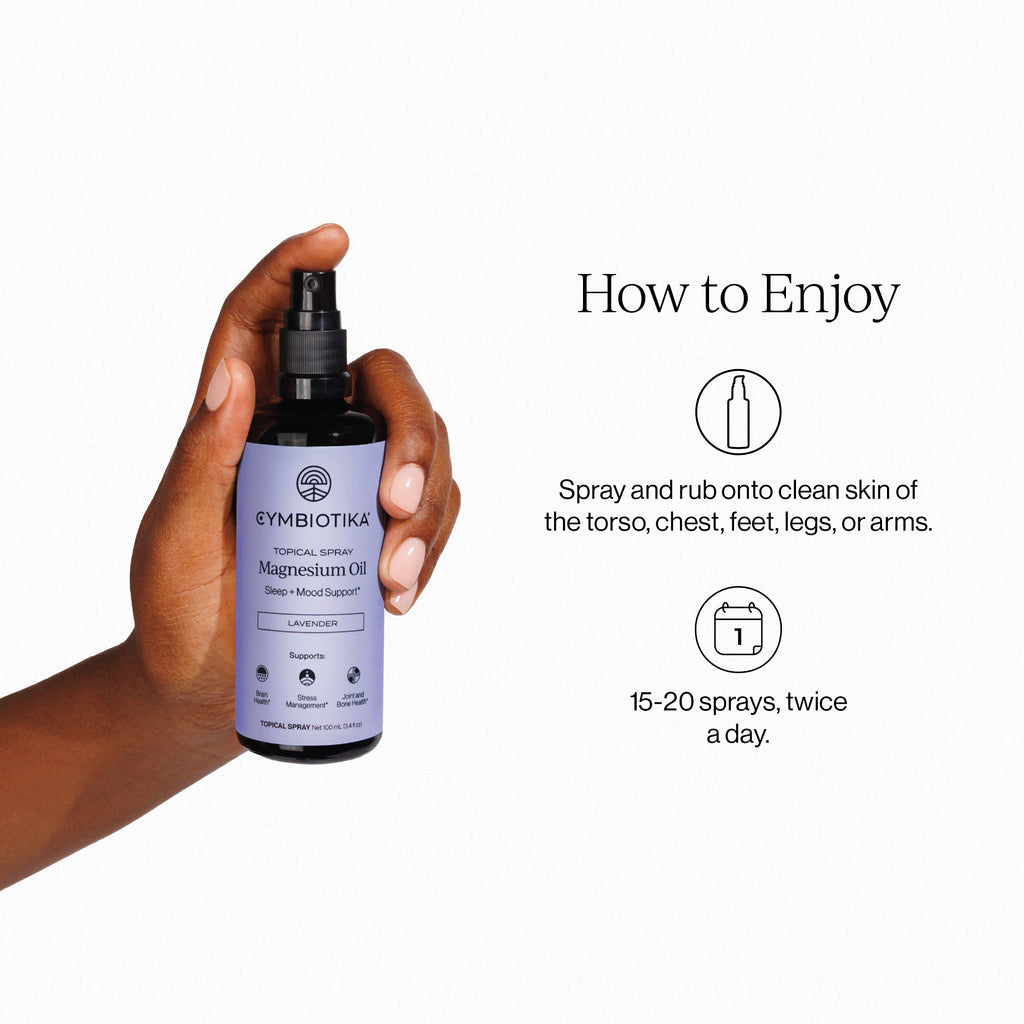
The product page says to spray and rub onto clean skin of the torso, chest, feet, legs, or arms, at 15 to 20 sprays twice a day, daily or as needed. Avoid sensitive areas, and avoid contact with clothing or other lotions until it is absorbed. A light tingle is normal at first, particularly on freshly shaven or sensitive skin, and the page suggests starting on a smaller area.
[Supporting image: images/magoil-how-to.jpg]
Safety and limitations
Magnesium sprays are generally low risk, but there are real limits. The tingle is common and usually fades, but stop if you get a rash or persistent irritation, and do not apply to broken skin, open wounds, or near the eyes. If you have kidney disease, be cautious with any magnesium product, because impaired kidneys clear magnesium poorly, and talk to your clinician first. The same applies if you are pregnant or breastfeeding. Do not use this spray, or any topical magnesium, as a replacement for oral magnesium if a blood test has shown you are deficient. And remember the page's own warning: do not layer other lotions or products over it until it has absorbed, because the DMSO can carry them through the skin too.
How it compares with oral magnesium
Oral magnesium is the route with established evidence. Dietary magnesium is absorbed at roughly 30 to 40%, and oral supplements have been shown to raise blood magnesium and correct deficiency. Cymbiotika's own Liposomal Magnesium Complex, which I reviewed here on the blog, provides 90 mg of elemental magnesium per packet in three forms, and its sleep evidence comes from oral trials. Topical magnesium has no equivalent evidence. The spray's honest role is different: it is a local, sensory product for a wind-down routine, not a systemic magnesium supplement in spray form.
Verdict
Cymbiotika's Topical Magnesium Oil Spray is a well-made, pleasant product with a real quality story: third-party batch testing, a certificate of analysis, a botanical blend, and a 60-day guarantee. Its DMSO formula is the one feature that could plausibly set it apart from a plain magnesium chloride spray, and it is also the feature with the least evidence behind it.
Buy it if you want a lavender-scented bedtime ritual and you like the idea of a topical product for sore muscles, and you understand that the relaxation you feel is most likely coming from the ritual, the massage, and the scent, not from magnesium entering your bloodstream. Skip it if your goal is to correct low magnesium, improve sleep through higher magnesium status, or replace an oral supplement. For those goals, the evidence still points to the oral route, and to the foods and supplements that have actually been shown to raise magnesium levels.
Sources
- Camili V, Stürup S, Heinz A. Does magnesium permeate the skin? An ex vivo investigation of magnesium ion delivery through intact and barrier-disrupted skin. European Journal of Pharmaceutics and Biopharmaceutics. 2026;226:115173. doi:10.1016/j.ejpb.2026.115173. PMID 42372834.
- Coates AM, Patel DV, Binet ER, Gibala MJ. No effect of topical application of a commercial magnesium gel on exercise recovery in active individuals. International Journal of Sport Nutrition and Exercise Metabolism. 2025;35(5):416-423. doi:10.1123/ijsnem.2025-0034. PMID 40537122.
- Witkowski M, Hubert J, Mazur A. Myth or reality, transdermal magnesium? Nutrients. 2017;9(10):1130.
- Kass L, Rosanoff A, Tanner S, Sullivan K, McAuley W, Plesset M. Effect of transdermal magnesium cream on serum and urinary magnesium levels in humans: a pilot study. PLOS ONE. 2017;12(4):e0174817.
- Engen DJ, McAllister SJ, Whipple MO, Cha SS, Dion LJ, Vincent A, Bauer BA, Wahner-Roedler DL. Effects of transdermal magnesium chloride on quality of life for patients with fibromyalgia: a clinical pilot study. Journal of Integrative Medicine. 2015;13(5):306-313.
- Cymbiotika. Topical Magnesium Oil Spray for Sleep and Muscle Relaxation. Product page, accessed Nov 16, 2026. https://cymbiotika.com/en-us/products/magnesium-oil
- Cymbiotika. Magnesium spray vs. supplement: which is better for you? https://cymbiotika.com/en-us/blogs/brain-health/is-magnesium-spray-or-supplement-better-exploring-the-best-ways-to-get-your-magnesium
FAQ
Does magnesium oil spray absorb through the skin?
Almost none, according to the best direct test. A 2026 University of Copenhagen study found that a magnesium solution on intact pig skin let through 8.3 micrograms per square centimetre over 24 hours, against 3.9 for an untreated control, a difference that was not statistically significant. The study tested a simple solution with no penetration enhancer, so it does not directly test Cymbiotika's DMSO formula, but no study has shown that formula absorbing either.
Does topical magnesium help you sleep?
There is no placebo-controlled trial showing a magnesium spray or cream improves sleep. The one placebo-controlled absorption trial found no significant rise in blood magnesium after 2 weeks. Any sleep benefit is more likely from the bedtime routine, the lavender scent, and the massage of rubbing it in, all of which are real relaxation cues, than from magnesium entering the bloodstream.
Is Cymbiotika magnesium oil spray worth $27?
It depends on what you want it for. As a premium, well-tested topical product with a botanical blend and DMSO, $27 is defensible, and the 60-day guarantee lowers the risk. As a way to raise magnesium levels, no spray has proven it works, so the money is better spent on an oral magnesium supplement with established absorption.
How many sprays should I use?
The product page says 15 to 20 sprays twice a day, sprayed and rubbed onto clean skin of the torso, chest, feet, legs, or arms. Start on a smaller area first, because a light tingle is normal, especially on freshly shaven or sensitive skin.
What is DMSO, and is it safe on skin?
DMSO, dimethyl sulfoxide, is a solvent and a well-known skin penetration enhancer. It can help substances cross the skin barrier, which is why it is in this formula. It can also irritate skin and cause a garlic-like taste or breath odour. In the United States it is approved as a drug only as a bladder instillation for interstitial cystitis. Avoid applying other lotions over it until it is absorbed, and do not use it on broken skin.
Does this spray have a discount code?
No. There is no discount code for Cymbiotika. I am affiliated with the brand, and you can shop through my affiliate link here: https://shop.cymbiotika.com/SFVM9DY9. For codes on other brands, browse the current offers on our discount codes page.
This article is for general information only and is not medical advice. Talk to your clinician before starting a new supplement, especially if you have kidney disease, are pregnant or breastfeeding, or take medication.
Looking for tools that support healthy aging and recovery? Browse the current offers on our discount codes page. This article is for general information only and is not medical advice. It reports on a published study and does not recommend any supplement, dose, or treatment.