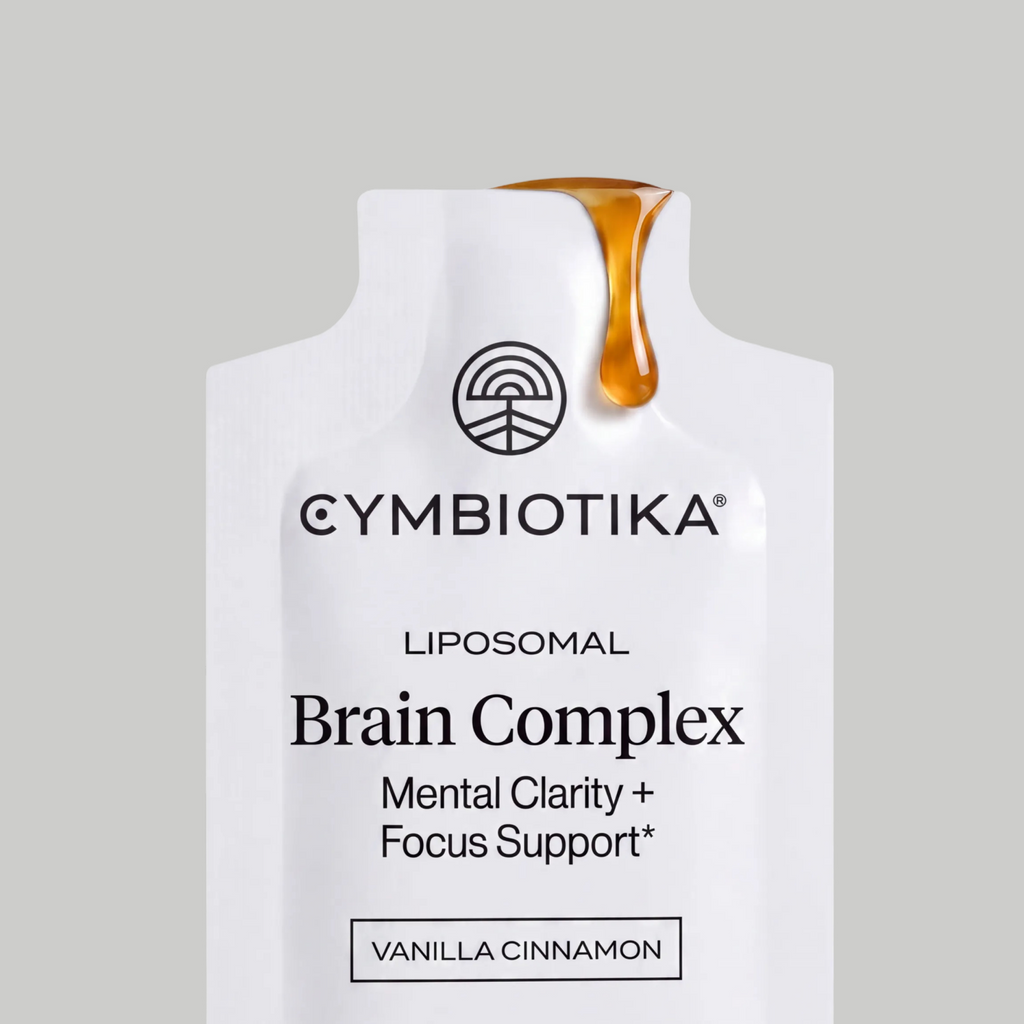
Brain supplements are the noisiest corner of the supplement aisle. Every bottle promises focus, memory, clarity, and calm, usually with a blend of herbs at doses nobody checks. This one is different: Cymbiotika prints every dose on the label, so each ingredient can be checked against the dose the trials actually used. When you do that, the formula splits in two. One ingredient is dosed exactly as studied. The other four are not. That split is the whole story of this product.
Disclosure: I'm affiliated with Cymbiotika, but I only recommend things I can actually stand behind so here's my honest breakdown.
The short answer
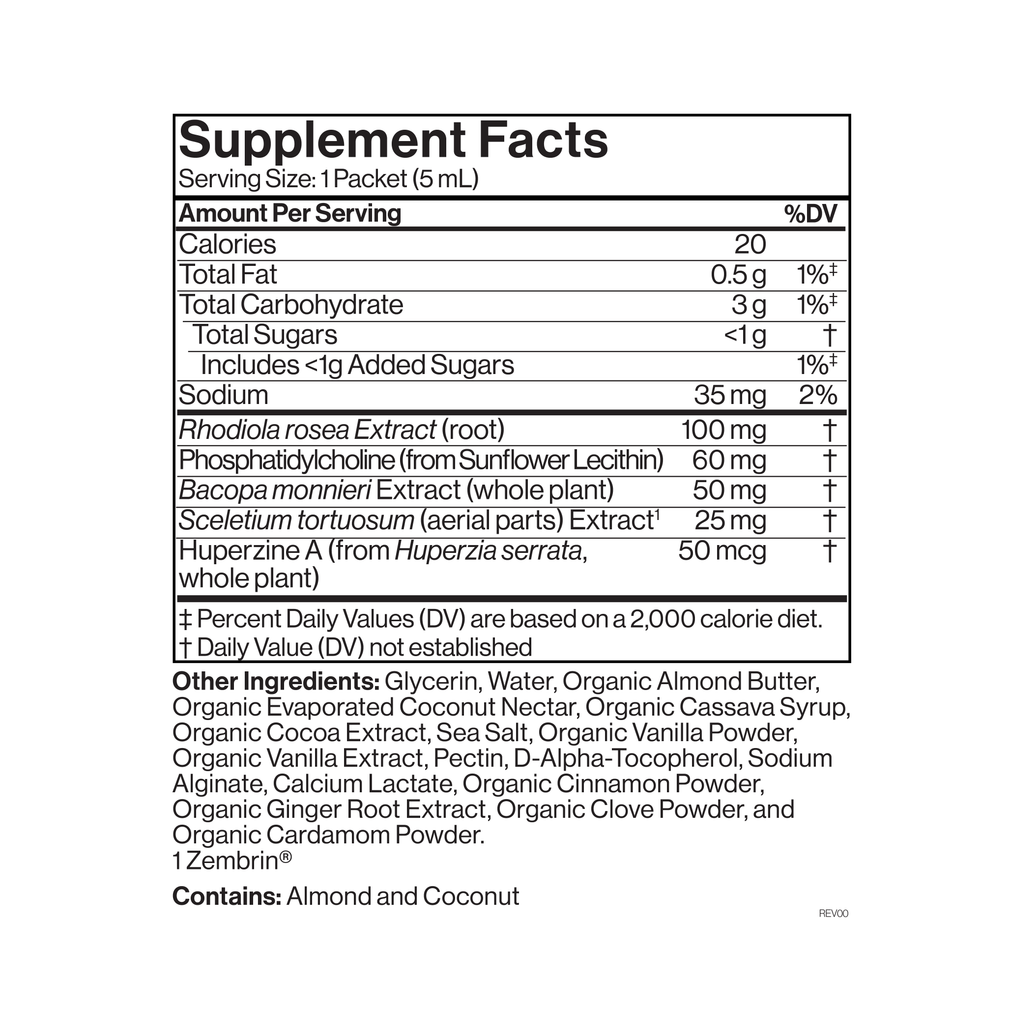
One 5 mL packet a day, Vanilla Cinnamon flavour, costs about $1.65 a packet on a one-time purchase and about $1.49 a packet for the first subscription box. Inside it: 25 mg of Zembrin, a standardised kanna extract, plus 100 mg of rhodiola, 50 mg of bacopa, 50 mcg of huperzine A, and 60 mg of phosphatidylcholine.
Zembrin at 25 mg is the exact dose used in the human trials, and it is the strongest thing about this product. The only randomised trial of Zembrin for cognition had 21 healthy adults, ran 3 weeks, and found better scores on cognitive flexibility and executive function. Two brain-wave studies in 60 people each found changes in EEG patterns during mental tasks, and a 3-month safety trial in 37 adults found it well tolerated.
The other four ingredients are all below their studied doses. Bacopa trials use 300 to 450 mg a day for 12 weeks; this has 50 mg. Rhodiola trials use 200 to 600 mg a day; this has 100 mg. Huperzine A trials use 200 to 400 mcg a day; this has 50 mcg. Phosphatidylcholine at 60 mg is a trace amount, mostly the liposome material itself. No trial has tested this combination or whether liposomal delivery improves absorption of these botanicals. The page claims 25% enhanced focus and 25% stress reduction, but cites no study and gives no source for either number.
The research gap this product actually fills
Most brain formulas hide behind proprietary blends, so you cannot check the doses at all. This one prints them, which lets us ask the question the category usually dodges: is each ingredient present at the dose the evidence used? One ingredient passes. Four do not.
There is a second gap. Brain supplements are almost never tested as finished products. The evidence is borrowed from single-ingredient trials, then stacked into a formula that has never been tested itself. Even if every ingredient were dosed correctly, the combination would still be unproven.
Zembrin: the one ingredient at the right dose
Zembrin is a standardised extract of Sceletium tortuosum, a South African succulent known as kanna. It blocks the PDE4 enzyme, which raises cAMP signalling involved in memory, and it inhibits serotonin reuptake, the same broad mechanism as SSRI antidepressants. That second mechanism is why the safety section below matters.
The cognition trial is Chiu and colleagues, 2014. It was a randomised, double-blind, placebo-controlled crossover study in 21 cognitively healthy adults aged 45 to 61. Each person took 25 mg of Zembrin or a placebo daily for 3 weeks, then switched. After 3 weeks on Zembrin, scores improved on cognitive flexibility and executive function, with moderate effect sizes, and processing speed improved strongly. Mood and sleep also improved. The authors acknowledged the limits: small sample, short duration, single dose. One of the authors works for the company that makes Zembrin, which is worth knowing.
The brain-scan study is Terburg and colleagues, 2013. Sixteen healthy people took a single 25 mg dose, and functional MRI showed reduced reactivity in the amygdala, the brain's threat-detection hub, and weaker connections between the amygdala and the hypothalamus. That is a real acute effect on the brain's stress circuitry, measured within hours, not a questionnaire result.
Then there are the two brain-wave studies, both by Dimpfel and colleagues, both in 60 healthy people using 25 or 50 mg of Zembrin against placebo. The 2016 study combined quantitative EEG with eye-tracking during mental tasks and found increased delta, theta and alpha power in the frontal brain, patterns the authors linked to attention and memory. The 2017 study ran 6 weeks in adults aged 50 to 80 and found similar EEG changes plus a drop in anxiety scores. These studies are real, randomised and placebo-controlled, and they are also the weakest link: they were published in low-tier journals, one author is connected to the company behind the extract, and EEG changes are not the same as better thinking. They are a signal, not a proof.
The safety trial is Nell and colleagues, 2013. Thirty-seven healthy adults took 25 mg a day for 3 months, and Zembrin was well tolerated. That is the longest human data on this extract.
Northumbria University registered an 8-week randomised, double-blind, placebo-controlled trial of 25 mg of Zembrin in 120 healthy adults aged 30 to 50, measuring cognition, mood, stress responses and sleep. As of writing, no results have been posted. That trial is far larger than any Zembrin cognition study so far. Until it reports, the honest summary is that Zembrin has a small but real human evidence base at exactly the dose in this packet.
Bacopa: a sixth of the studied dose
Bacopa monnieri is the best-known memory herb in this formula, and it is also the most underdosed. The human trials use 300 to 450 mg a day of a standardised extract for 12 weeks. The consistent finding, across a 2012 review of 6 trials and a 2014 meta-analysis of 9 trials with 518 people, is a small improvement in free-recall memory after about 12 weeks. It is not an instant nootropic, and nothing in the trials supports same-day focus.
This packet has 50 mg. That is one-sixth of the lowest trial dose, and one-twelfth of the dose a 2026 network meta-analysis of 29 trials with 2,107 people found worked best for working memory, 600 mg a day or more. Worse, the newest trial at the full dose did not replicate the benefit at all: Lopresti and Smith, 2025, randomised 101 adults to 300 mg a day or placebo for 12 weeks and found no difference in verbal learning, attention or working memory. So bacopa's evidence is already mixed at 300 mg, and this product contains a sixth of that. At 50 mg, bacopa here is a label ingredient, not a dose. If memory is your goal, bacopa on its own at 300 mg for 12 weeks is the evidence-based option.
Rhodiola: below the lowest trial dose
Rhodiola rosea is an adaptogen with its best evidence in stress-related fatigue, not in general brainpower. The landmark trials used a standardised extract called SHR-5, roughly 3% rosavins and 1% salidroside, at 200 to 600 mg a day. Darbinyan and colleagues, 2000, gave 170 mg a day to 56 physicians on night duty and found better mental performance and less fatigue. Olsson and colleagues, 2009, gave 576 mg a day to 60 adults with stress-related fatigue for 28 days and found less fatigue and better attention.
This packet has 100 mg of rhodiola root extract. That is below the lowest dose in any positive trial, 170 mg, and the label does not state the rosavins or salidroside content, so there is no way to check whether it matches the SHR-5 profile the trials used. No trial supports a 100 mg dose. Like bacopa, it is present at a dose the evidence does not cover.
Huperzine A: a quarter of the trial dose, and the ingredient to respect most
Huperzine A is the most potent ingredient in this formula by weight, and the one that deserves the most caution. It blocks acetylcholinesterase, the enzyme that breaks down acetylcholine, the same target as the prescription Alzheimer's drugs donepezil, rivastigmine and galantamine. That is a real mechanism, and it is why the safety warnings here are not boilerplate.
The Alzheimer's trials used 200 to 400 mcg a day. A 2013 meta-analysis of 20 trials with 1,823 people found cognitive benefits, but judged most trials at high risk of bias. The best-designed trial, a US phase 2 study by Rafii and colleagues in 2011 with 210 people with mild to moderate Alzheimer's, found no benefit on its main measure at 200 mcg twice a day. In healthy people, one small trial in 68 students found a memory benefit, and a single 200 mcg dose in 15 adults found none.
This packet has 50 mcg, a quarter of the lowest trial dose and the bottom of the usual supplement range of 50 to 200 mcg. At that dose it may do very little, and that is arguably a good thing, because huperzine A has a half-life of 24 to 36 hours. Taken daily, it accumulates. There is no long-term safety data in healthy people, and no trial has tested daily use beyond a few months. Never combine it with donepezil, rivastigmine or galantamine, and talk to a clinician first if you take beta-blockers, have a slow heart rate, asthma, a stomach ulcer or epilepsy, or have surgery planned.
Phosphatidylcholine and the liposomal question
Phosphatidylcholine is listed at 60 mg, from sunflower lecithin. As a nutrient, that is a trace amount: a normal diet provides grams a day, and brain-health trials use hundreds of milligrams. Its job here is structural: it is the material the liposomes are made of, the same 60 mg in the other Cymbiotika packets in this series. Does liposomal delivery improve absorption of these ingredients? For vitamin C and glutathione, human trials show higher blood levels from liposomal forms. For rhodiola, bacopa, kanna and huperzine A, there are none. A delivery system that helps one molecule does not automatically help another, and no study has measured blood levels of any of these four botanicals from this product.
The 25% claims, and what the page does not show
The product page makes two specific claims: 25% enhanced focus and 25% stress reduction, both attributed to Zembrin. It also says the formula is "backed by brain-wave science" and that a clinical study found Zembrin increases brain activity markers tied to memory and learning. The brain-wave studies above are the likely source of that last claim. But the page cites no study by name, no author, no journal, no year, and no link, and it gives no source at all for the two 25% figures. I searched for the origin of those numbers and could not find a published study behind them. A percentage with no source is a marketing number, not a finding.
Safety and limitations
Zembrin affects serotonin reuptake, so anyone taking an SSRI, SNRI or other serotonergic drug should talk to their clinician first. There is no safety data in pregnancy or breastfeeding, so avoid it there. The longest human safety data is 3 months.
Huperzine A is the bigger safety story. Never combine it with prescription cholinesterase inhibitors, and use caution with beta-blockers, asthma, ulcers, epilepsy, or planned surgery. It accumulates with daily use because of its long half-life, and there is no long-term safety data in healthy people.
Rhodiola can cause insomnia or vivid dreams if taken late in the day, which is why the brand says to take this in the morning. People with bipolar disorder should talk to a clinician first, because stimulating adaptogens have been reported to trigger mania in case reports. Bacopa's most common side effects are stomach upset and drowsiness.
The packet contains almond and coconut, so anyone with a tree nut allergy should not use it. No trial has tested this finished product or this combination in people, and four of the five ingredients are below their studied doses, so even the borrowed evidence is thinner than the label suggests.
Price and value
One box lists at $62. A one-time purchase is $49.60 with the sitewide 20% off banner running at the time of writing. The first subscription box is $44.64, renewing at $55.80 a box. The 90-day plan is $39.68 a box. The brand page never prints how many packets are in a box, but the 30-day subscription delivers one box every 30 days at one packet a day, which points to 30 packets, and that is the figure the math below uses.
On the inferred 30-packet box, one-time purchase is about $1.65 a packet, the first subscription box is about $1.49 a packet, the renewal is about $1.86 a packet, and the 90-day plan is about $1.32 a packet. Prices change, so check the current price on the product page. The page shows a rating of 4.9 out of 5 from 1,568 reviews, with 99% saying they would recommend it. Reviews on a brand's own page are self-selected, so treat that number as a satisfaction signal, not evidence.
It sits in the same price band as the other Cymbiotika packets, about $1.32 to $2.07 a packet depending on the plan. The difference is what the money buys. In the vitamin C and D3 reviews, the dose matched the trials. Here, only one ingredient out of five does. Worth it if you want Zembrin at its studied dose in a convenient morning packet, and you understand you are paying mostly for one ingredient. Not worth it if you want bacopa, rhodiola or huperzine A at studied doses, because those are all available on their own at full doses for far less per day. There is no discount code for Cymbiotika. If you want to look at it, here is my affiliate link: https://shop.cymbiotika.com/SFVM9DY9. The link is the way to find the product.
The verdict
Of the five Cymbiotika products covered in this series so far, this one has the most honest core and the weakest supporting cast. Zembrin at 25 mg is the exact dose from the human trials, and the trial record, while small, is real: better executive function in 21 people, calmer amygdala activity in 16, EEG changes in 60, and 3 months of safety data in 37. The Northumbria trial in 120 people could strengthen that story when it reports. Everything else in the packet is below its studied dose, some of it far below. Bacopa at 50 mg is a sixth of the trial dose. Rhodiola at 100 mg is below the lowest trial dose. Huperzine A at 50 mcg is a quarter of the lowest trial dose. And the two 25% claims on the page have no source behind them. Buy this for Zembrin, in a packet, at the right dose. Do not buy it for the other four ingredients, because at these doses the evidence does not follow them.
Sources
- Chiu S, Gericke N, Farina-Woodbury M, et al. Proof-of-concept randomized controlled study of cognition effects of the proprietary extract Sceletium tortuosum (Zembrin) targeting phosphodiesterase-4 in cognitively healthy subjects. Evidence-Based Complementary and Alternative Medicine. 2014;2014:682014. 21 healthy adults, 25 mg daily for 3 weeks, crossover.
- Terburg D, et al. Acute effects of Sceletium tortuosum (Zembrin), a dual 5-HT reuptake and PDE4 inhibitor, in the human amygdala and its connection to the hypothalamus. Neuropsychopharmacology. 2013. 16 healthy people, single 25 mg dose, fMRI.
- Nell H, et al. A randomized, double-blind, placebo-controlled trial of the safety and tolerability of Sceletium tortuosum (Zembrin). 2013. 37 healthy adults, 25 mg daily for 3 months.
- Dimpfel W, Gericke N, Suliman S, Dipah GNC. Psychophysiological effects of Zembrin using quantitative EEG source density in combination with eye-tracking in 60 healthy subjects. Neuroscience and Medicine. 2016;7:114-132.
- Dimpfel W, Gericke N, Suliman S, Dipah GNC. Effect of Zembrin on brain electrical activity in 60 older subjects after 6 weeks of daily intake. World Journal of Neuroscience. 2017;7:140-171.
- Psychological effects of 8 weeks supplementation with Sceletium tortuosum extract (Zembrin): a randomised, double-blind, placebo-controlled, parallel-groups trial. Northumbria University. ClinicalTrials.gov NCT05471804. 120 healthy adults aged 30 to 50. No results posted as of Nov 15, 2026.
- Pase MP, et al. The cognitive-enhancing effects of Bacopa monnieri: a systematic review of randomized, controlled human clinical trials. Journal of Alternative and Complementary Medicine. 2012. 6 trials, 300 to 450 mg a day for 12 weeks.
- Kongkeaw C, et al. Meta-analysis of randomized controlled trials on cognitive effects of Bacopa monnieri extract. Journal of Ethnopharmacology. 2014. 9 trials, 518 people.
- Lopresti AL, Smith SJ. The effects of a Bacopa monnieri extract (Bacumen) on cognition, stress, and fatigue in healthy adults: a randomized, double-blind, placebo-controlled trial. 2025. 101 adults, 300 mg a day for 12 weeks, no cognitive effect.
- Comparative effects of Bacopa monnieri and Ginkgo biloba on cognitive functions: a systematic review and network meta-analysis. Phytomedicine. 2026;153:157915. 29 trials, 2,107 people. High-dose bacopa beat lower doses for working memory.
- Darbinyan V, et al. Rhodiola rosea in stress induced fatigue: a double blind cross-over study of a standardized extract SHR-5. Phytomedicine. 2000. 56 physicians on night duty, 170 mg a day.
- Olsson EM, et al. A randomised, double-blind, placebo-controlled, parallel-group study of the standardised extract SHR-5 of the roots of Rhodiola rosea in the treatment of subjects with stress-related fatigue. Planta Medica. 2009. 60 adults, 576 mg a day for 28 days.
- Yang G, et al. Huperzine A for Alzheimer's disease: a systematic review and meta-analysis of randomized clinical trials. 2013. 20 trials, 1,823 people. Most trials at high risk of bias.
- Rafii MS, et al. A phase II trial of huperzine A in mild to moderate Alzheimer disease. Neurology. 2011. 210 people. No benefit on the main measure at 200 mcg twice a day.
- Cymbiotika. Liposomal Brain Complex product page. https://cymbiotika.com/en-us/products/brain-complex (accessed Nov 15, 2026, for product facts, price, rating, and Supplement Facts).
FAQ
Is 25 mg of Zembrin the right dose?
Yes. It is the exact dose used in the human trials: 25 mg a day for 3 weeks in the cognition study, a single 25 mg dose in the brain-scan study, and 25 or 50 mg a day in the brain-wave studies. It is the only ingredient in this packet dosed exactly as studied.
Does Cymbiotika Brain Complex improve memory?
There is no direct evidence it does. No trial has tested this product. Zembrin improved executive function in one small 21-person study and changed brain-wave patterns in two 60-person studies. Bacopa and huperzine A, the two ingredients most associated with memory, are both far below their trial doses here.
How fast does it work?
Zembrin's brain-scan effects appeared within 2 hours of a single dose. Bacopa needs about 12 weeks at 300 mg or more to show anything, and this packet has 50 mg. Do not judge this product on day one.
Can I take it with antidepressants?
Talk to your clinician first. Zembrin inhibits serotonin reuptake, the same broad mechanism as SSRI antidepressants, so combining them needs medical guidance. Huperzine A must never be combined with prescription Alzheimer's drugs such as donepezil, rivastigmine or galantamine.
What do the 25% focus and 25% stress claims mean?
The product page gives no source for either number and cites no specific study. The brain-wave studies are the likely basis for the "brain-wave science" claim, but they did not report 25% improvements. Treat both figures as unverified marketing numbers.
Is it safe to take every day?
Zembrin has 3 months of safety data in healthy adults at 25 mg. Huperzine A has a half-life of 24 to 36 hours, so it accumulates with daily use, and there is no long-term safety data in healthy people. There is no safety data in pregnancy or breastfeeding, and the packet contains almond and coconut.
Is there a discount code for Cymbiotika Brain Complex?
No. There is no discount code for Cymbiotika. If you want to look at the product, my affiliate link is https://shop.cymbiotika.com/SFVM9DY9.
How does it compare with the other Cymbiotika products I reviewed?
It is the fifth in the series. Vitamin C, magnesium and D3 had data at matching doses, NAD+ had almost none. Brain Complex sits in the middle. Vitamin C review: https://thrivetools.co/blog/cymbiotika-liposomal-vitamin-c-review NAD+ review: https://thrivetools.co/blog/cymbiotika-liposomal-nad-review
This article is for general information only and is not medical advice. It reports on published studies and does not recommend any supplement, dose, or treatment. Talk to your clinician before starting a new supplement, especially if you take prescription medication or are pregnant or breastfeeding.