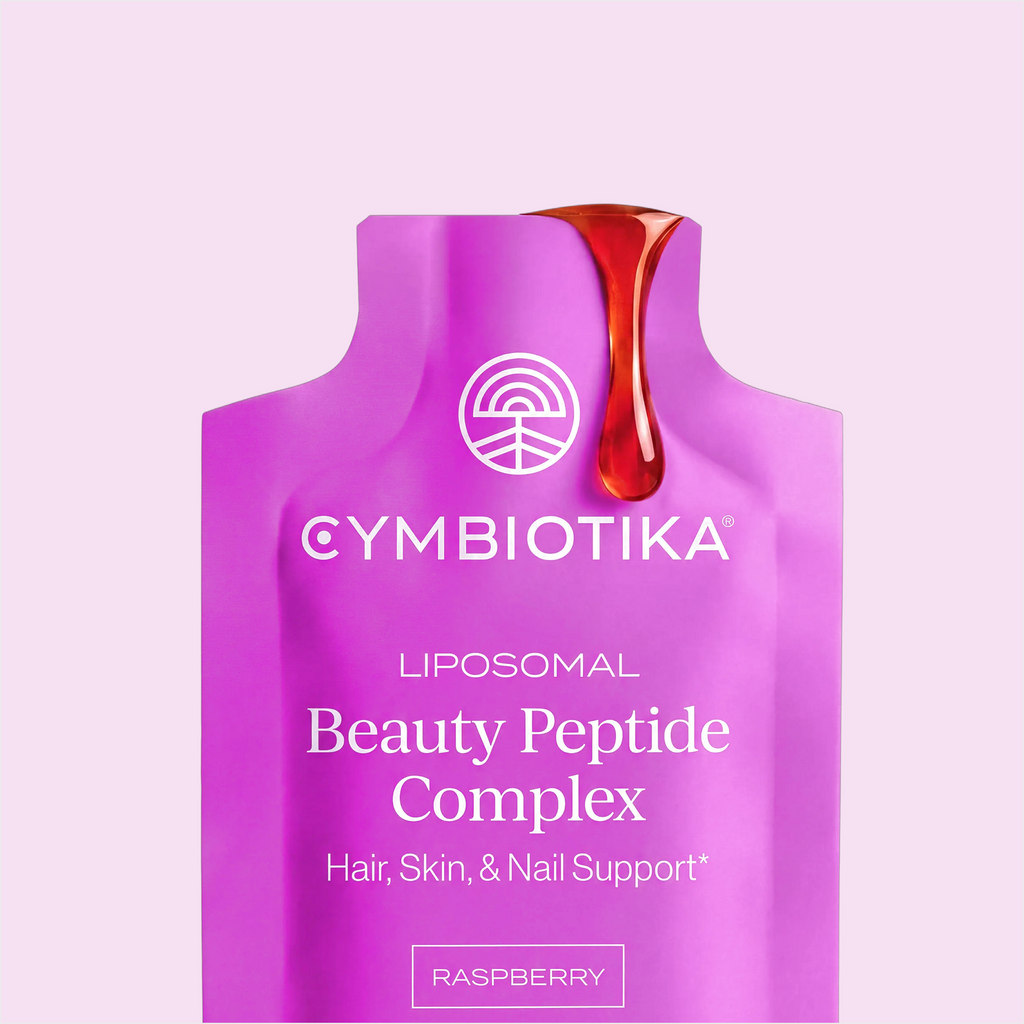
Collagen is the most sold beauty supplement in the world, and also one of the most oversold. Cymbiotika's Liposomal Beauty Peptide Complex, launched on Sept 14, 2026, is a more interesting case than most, because its headline ingredient is dosed exactly the way the trials dosed it. The numbers on the page can be checked line by line against the trials, and I did that. Two of the brand's numbers do not match the papers they rest on, one ingredient is dosed at half the studied amount, and the liposomal absorption claim has no study behind it at all.
Disclosure: I'm affiliated with Cymbiotika, but I only recommend things I can actually stand behind so here's my honest breakdown.
The short answer
VERISOL is dosed at 2.5 g per packet, exactly the dose used in the 2 best known skin trials, and Ceramosides is dosed at 70 mg, exactly the oil form dose used in its clinical study. The problems start with the marketing numbers. The page claims 32% less eye wrinkle volume in 8 weeks vs placebo, but the published VERISOL trial reported 20%. The page promises stronger nails in 12 weeks, but the published nail trial ran 24 weeks. The hyaluronic acid dose is 60 mg, half the 120 mg used in most skin trials. And the "up to 3X higher absorption" claim has no cited study, and no trial has tested liposomal collagen against standard collagen peptides at all. At $74 for a box of 26 packets, about $2.85 a packet at list price, you are paying a premium for a small 2.5 g dose of collagen plus small doses of ceramides and hyaluronic acid. If you want the studied VERISOL dose in a ready to drink packet, this is a fair option.
The research gap this product actually sits in
Collagen peptides have real human trial data, but almost all of it is for 1 specific peptide preparation, VERISOL, at 1 specific dose, 2.5 g a day, in small industry funded trials of mostly middle aged women. The rest of the category borrows that evidence for products that use different peptides, different doses, or no stated dose at all. This packet is different: it uses the actual studied ingredient at the actual studied dose. That makes it the right product to ask the harder question with. Does the finished packet work the way the ingredient trials worked? Nobody knows, because no trial has tested this finished product, or any liposomal collagen formula, in people. The trials tested VERISOL powder dissolved in water, not a liposomal liquid with ceramides, hyaluronic acid, zinc, copper, and silica added.
What is in the packet
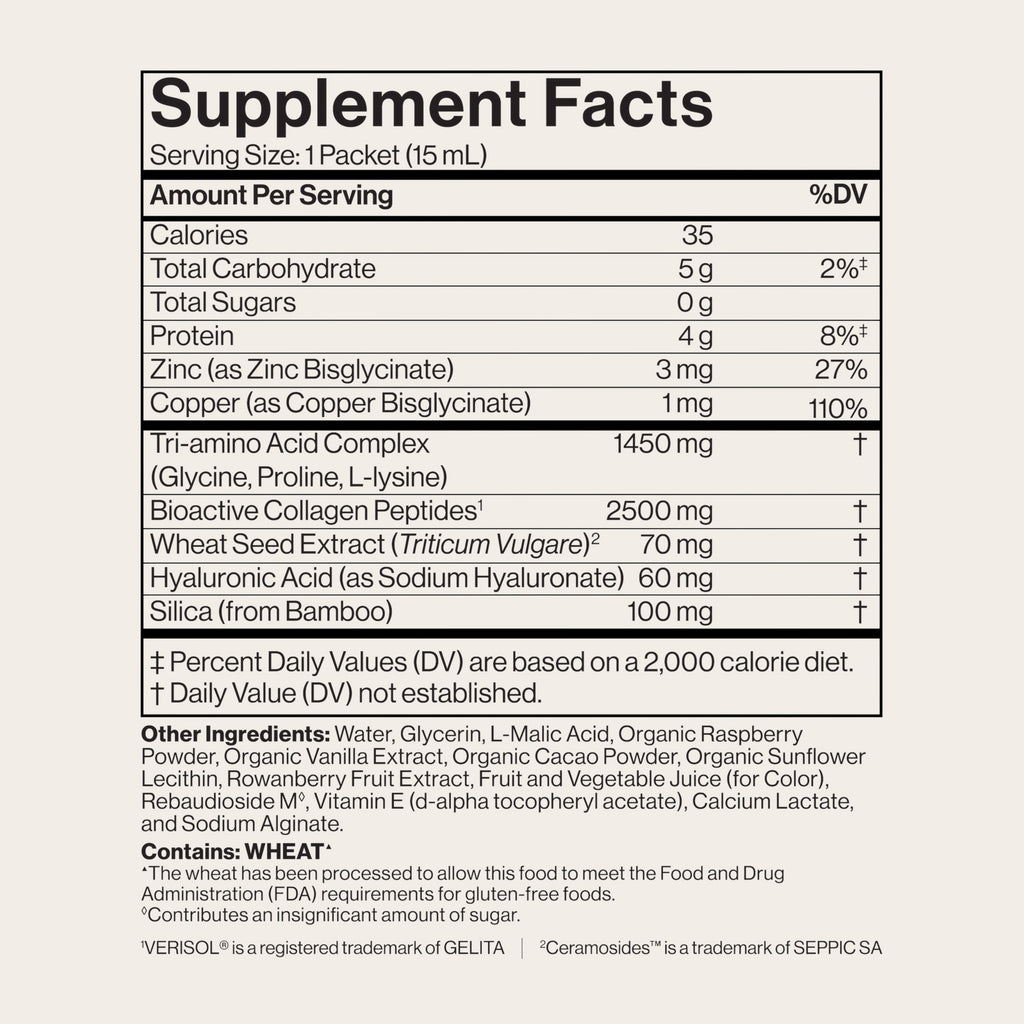
I verified every number against the Supplement Facts panel on cymbiotika.com on Nov 15, 2026. One packet is 15 mL, Raspberry flavour, taken daily. Rip it open, sip it, or drizzle it over food. Per packet: 35 calories, 5 g of carbohydrate, 0 g of sugars, 4 g of protein, zinc 3 mg (27% of daily value), copper 1 mg (110%), a tri-amino acid complex of glycine, proline, and L-lysine at 1450 mg, bioactive collagen peptides (VERISOL) at 2500 mg, wheat seed extract (Ceramosides) at 70 mg, hyaluronic acid as sodium hyaluronate at 60 mg, and silica from bamboo at 100 mg. Other ingredients include water, glycerin, organic raspberry powder, organic sunflower lecithin, and Rebaudioside M. The full list is on the product page. The label says "Contains: WHEAT", with a note that the wheat has been processed to meet FDA requirements for gluten free foods.
VERISOL: the one ingredient dosed exactly like the trials
VERISOL is a specific bioactive collagen peptide preparation made by GELITA from porcine type I collagen, with a defined peptide profile and an average molecular weight around 2 kDa. That specificity matters, because collagen peptides are not all the same, and the trial evidence belongs to this preparation, not to collagen in general. Cymbiotika uses 2.5 g per packet, the dose in the 2 landmark trials, and that is the strongest point in this product's favour.
The wrinkle trial, Proksch and colleagues, 2014, enrolled 114 women aged 45 to 65. Half took 2.5 g of VERISOL a day, half took placebo, for 8 weeks. Eye wrinkle volume was significantly lower in the VERISOL group after 4 and 8 weeks. In a biopsy subgroup, procollagen type I was 65% higher and elastin 18% higher than placebo after 8 weeks, and the effect was still there 4 weeks after the women stopped taking it. The elasticity trial, from the same group in 2014, enrolled 69 women aged 35 to 55. Both 2.5 g and 5 g a day significantly improved skin elasticity vs placebo over 8 weeks. A 2015 trial in 105 women found a cellulite benefit at 2.5 g a day for 6 months.
The wider evidence is consistent but modest. A 2021 meta-analysis of 19 trials with 1125 people and a 2023 meta-analysis of 26 trials with 1721 people both found benefits for wrinkles, hydration, and elasticity vs placebo. A 2026 systematic review of 25 trials still found wrinkle measures improved in 9 of 10 trials that reported them, but rated most of the included trials at high risk of bias. Nearly all were funded by or run with the company that makes the peptide. The effects are cosmetic and modest, but on the narrow question of whether 2.5 g of VERISOL does something measurable to skin in 8 weeks, the answer is yes, in small trials of middle aged women.
The 32% wrinkle claim, checked against the published trial
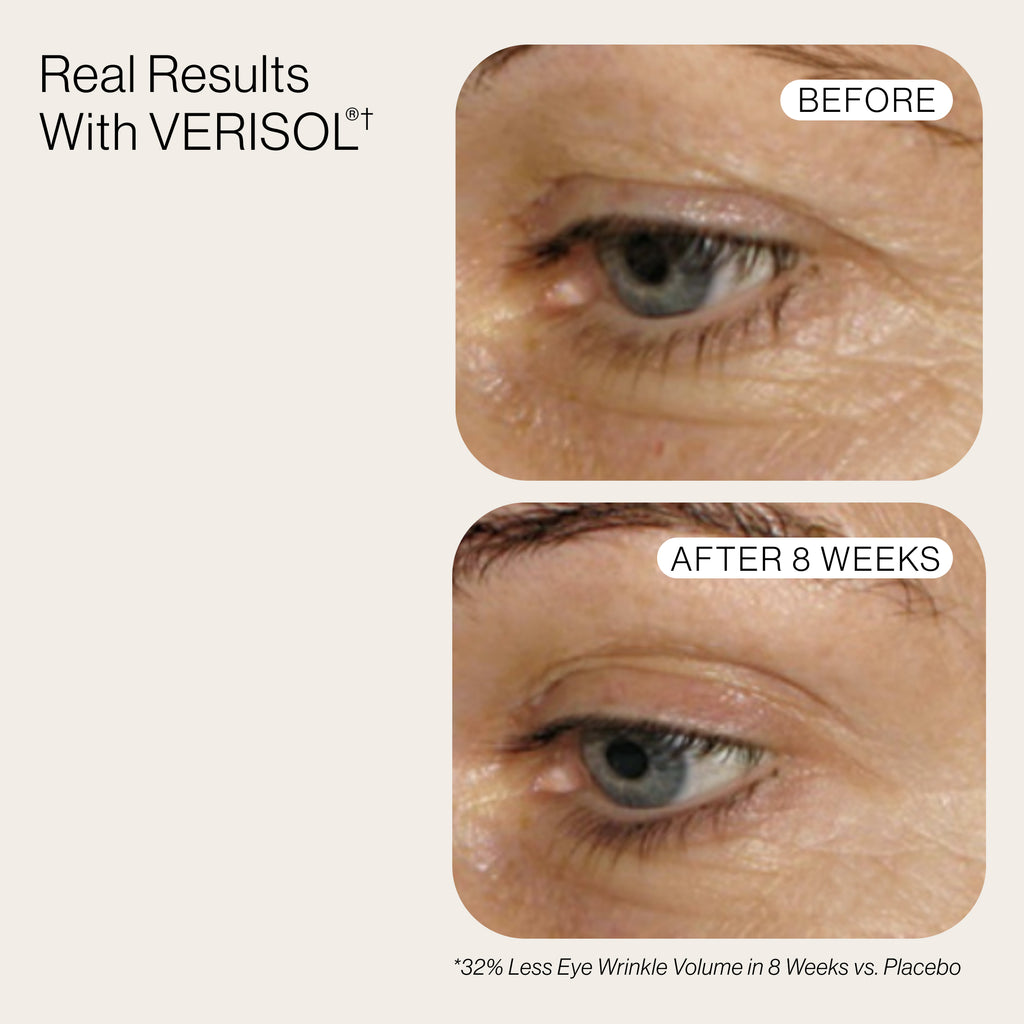
This is where the page and the paper part ways. The product page shows before and after eye photos and says "32% Less Eye Wrinkle Volume in 8 Weeks vs. Placebo", with a footnote saying the photos reflect the efficacy of VERISOL. The published 2014 wrinkle trial reported a 20% reduction in eye wrinkle volume vs placebo at 8 weeks, not 32%. I could not find the 32% figure anywhere in the published trial. It may come from a different analysis or from unpublished company data, but the page does not say that. The honest version is 20% less eye wrinkle volume vs placebo in 8 weeks, in 114 women aged 45 to 65. It just is not 32%.
Ceramosides: the 70 mg dose matches, the timeline mostly does
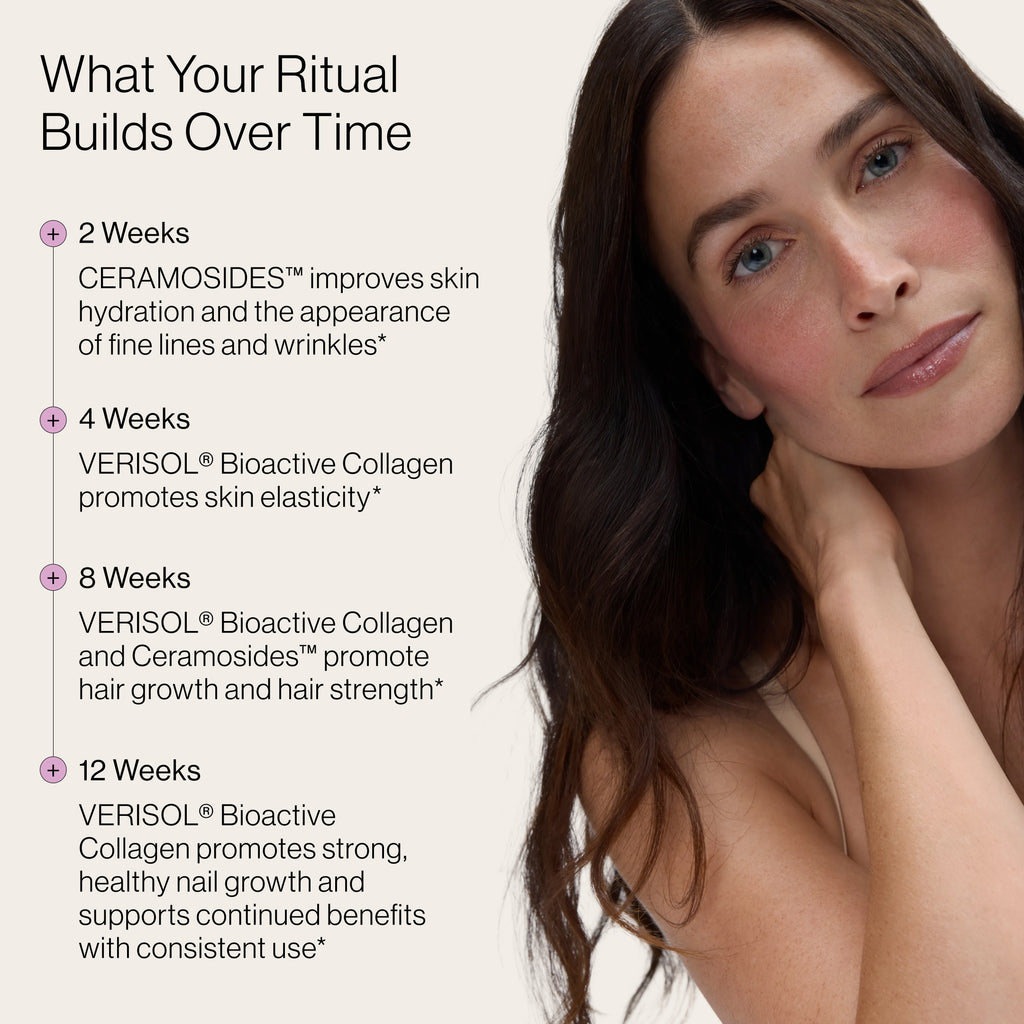
Ceramosides is a wheat derived phytoceramide ingredient from Seppic, and the 70 mg in this packet matches the oil form dose used in its clinical study. That is the second exact dose match in this formula, and it is worth crediting, because most ceramide supplements do not disclose a studied dose at all. The key study is Bizot and colleagues, 2017. Sixty volunteers with dry and wrinkled skin took a wheat polar lipid complex for 60 days, either as a 30 mg powder or a 70 mg oil, or placebo. Both forms significantly improved skin hydration, elasticity, and smoothness, and reduced water loss, roughness, and wrinkledness vs placebo, all at p less than 0.001, with improvements building over the 60 days. Seppic lists 2 more skin studies and 2 hair studies, including a randomized trial in healthy women that found less hair loss and better hair growth, and a trial in acute telogen effluvium, the shedding that follows illness or stress. A pooled analysis of 7 small phytoceramide trials with 426 people found a small to moderate hydration effect and lower water loss vs placebo. Every one of these trials is manufacturer linked, the samples are small, and no independent replication exists. The hydration effect is the best supported part. The wrinkle effect rests on 1 sixty person study and has never been pooled or replicated. The page promises Ceramosides results by week 2, but the Bizot trial found improvements building over 60 days. The honest timeline is measurable hydration changes in 2 to 4 weeks, with the fuller picture at 8 weeks.
Hyaluronic acid: half the studied dose
Hyaluronic acid is the one ingredient in this packet dosed below the trials. The packet has 60 mg. Most skin trials used 120 mg a day. Oe and colleagues, 2017, gave 120 mg a day for 12 weeks to 60 adults and found lower wrinkle volume than placebo at week 8, though the difference was no longer significant at week 12. Hsu and colleagues, 2021, gave 120 mg a day for 12 weeks to 40 adults and found fewer wrinkles, more skin moisture, less water loss, and better elasticity than placebo. Gollner and colleagues, 2017, gave 120 mg a day for 12 weeks to 45 women aged 45 to 60 and found hydration up 28% and wrinkle depth down 10% vs placebo. A 2025 meta-analysis of 7 trials found significant improvements in hydration, elasticity, and wrinkle depth, but not in firmness, wrinkle volume, or water loss.
There is a partial defence for the 60 mg dose. Doleckova and colleagues, in a 150 person trial published in Scientific Reports in 2026, tested both 60 mg and 120 mg a day for 12 weeks. The 120 mg dose improved hydration, elasticity, and wrinkle depth vs placebo, and the 60 mg dose had similar but smaller effects. So 60 mg is not a useless dose, but it is the weaker dose, tested in 1 trial. Against that, a 2025 meta-analysis of 40 supplement trials for sun aged skin found no significant benefit from hyaluronic acid at all, while collagen and flavanols did help. In short: oral hyaluronic acid probably helps skin hydration a little, the wrinkle evidence is mixed, and this packet gives you half the dose most trials used. The other supporting ingredients have thinner evidence still. The tri-amino acid complex, 1450 mg of glycine, proline, and lysine, supplies the building blocks of collagen, but no trial shows that adding these amino acids to collagen peptides adds anything beyond the peptides themselves. Silica from bamboo, 100 mg, has no strong human trial evidence for hair or nail benefits at this dose. Zinc at 3 mg and copper at 1 mg are sensible, and the pairing is thoughtful, since high dose zinc can deplete copper.
Hair and nails: the weakest links in the timeline
The page's timeline promises hair growth and strength by week 8 and strong, healthy nails by week 12. Both claims stretch the trials they rest on. For nails, the published VERISOL trial is Hexsel and colleagues, 2017. Twenty five women with brittle nails took 2.5 g a day for 24 weeks. Nail growth rate rose 12%, and broken nails fell 42%. That is a real result, but it took 24 weeks, twice the 12 weeks on the page. The page's nail graphic shows growth from 0.22 cm to 1.16 cm in 12 weeks, figures that do not appear in the published nail trial, and no source is given for them. For hair, the evidence is 2 small Seppic linked studies of the wheat lipid complex: a randomized trial in healthy women that found less hair loss and better growth, and a trial in people recovering from telogen effluvium. Both ran 2 to 3 months, and neither was large or independently replicated. Hair grows about 1 cm a month, so an 8 week claim for visible hair growth is optimistic. The honest version is that the hair evidence is early and small.
The 3X absorption claim
The product page carries a liposomal delivery diagram headed "Up To 3X Higher Absorption", saying liposomes reach the bloodstream while powders and capsules do not. No study is cited for this claim anywhere on the page, and I could not find a published trial testing liposomal collagen peptides against standard collagen peptides for absorption or for any skin outcome. This matters, because collagen peptides are already absorbed well: human studies show that specific dipeptides and tripeptides from collagen, such as proline-hydroxyproline, survive digestion and reach the blood intact. The VERISOL trials used plain powder dissolved in water, not a liposomal liquid. If liposomes improved absorption, the benefit would have to show up on top of an ingredient that already works in powder form, and no trial has tested that. Until Cymbiotika publishes or cites a study on its liposomal collagen, treat "3X higher absorption" as marketing copy, not evidence.
Safety and limitations
The ingredients in this packet have a good short term safety record in trials lasting up to 6 months, with no serious adverse effects reported at these doses. A few honest limits apply. The label says "Contains: WHEAT". The wheat has been processed to meet FDA requirements for gluten free foods, but if you have celiac disease or a wheat allergy, check with your doctor before taking a product that lists wheat as an allergen. The collagen is bovine sourced, so this product is not vegetarian or vegan. There are no trials of this formula in pregnancy or breastfeeding, and no long term data beyond 6 months, or any data at all for the finished packet, which launched 2 months ago and has 64 reviews. Sunscreen, not smoking, and sleep do more for wrinkles than any supplement. The 60 day money back guarantee is the practical safety net here: if you try it, 8 weeks is the minimum fair test.
Price and value
A box holds 26 packets and lists at $74. That is $2.85 a packet at list price. With the sitewide 20% off offer live at the time of writing, a one time purchase is $59.20 a box, or $2.28 a packet. A 30 day subscription is $53.28 a box, or $2.05 a packet. A 90 day subscription is $47.36 a box, or $1.82 a packet, with 3 boxes per delivery at $142.08 today and renewals of $177.60 every 90 days. Because a box holds 26 packets and you take 1 a day, a box lasts 26 days, not a month. A 30 day month costs about $85.38 at list, about $61.50 on the monthly plan, and about $54.60 on the 90 day plan. You can buy it through my affiliate link here: https://shop.cymbiotika.com/SFVM9DY9
The price math is the real objection to this product. You are paying $2.85 a day at list price for 2.5 g of collagen peptides, about $1.14 per gram of VERISOL, plus small doses of ceramides and hyaluronic acid. A plain collagen powder scoop typically delivers 10 g or more of collagen peptides per serving for a fraction of that cost per gram, though it will not be VERISOL specifically, and it will not include the ceramides or hyaluronic acid. What you are paying for here is the studied VERISOL dose in a ready to drink packet, the Ceramosides dose at the trial amount, and the convenience of tearing open a packet instead of mixing a powder. That is a real trade, and for some people it is worth it. But be clear about what the premium buys: convenience and the exact studied ingredient, not proven extra absorption. No Cymbiotika discount code exists, so do not expect a code at checkout.
The verdict
This is the best dosed Cymbiotika product I have reviewed in this series. VERISOL at 2.5 g and Ceramosides at 70 mg are both exactly the doses the trials used, which is rare in beauty supplements. The hyaluronic acid is half the studied dose, the 32% wrinkle claim is 12 points higher than the published trial reported, the nail timeline is half the trial length, and the 3X absorption claim has no study behind it. None of that makes the product bad. It makes the marketing louder than the evidence. If you buy it, buy it for the 2.5 g of VERISOL, take it daily for at least 8 weeks, judge it on hydration and elasticity rather than on a visible transformation, and use the 90 day subscription to bring the price down. If the price puts you off, a plain VERISOL powder at the same 2.5 g dose is the honest cheaper alternative, and the trials support that dose in powder form, not in liposomal form. Keep your expectations at the level the trials support: modest, measurable, and slow.
Sources
- Proksch E, et al. Oral intake of specific bioactive collagen peptides reduces skin wrinkles and increases dermal matrix synthesis. Skin Pharmacol Physiol. 2014;27(3):113-119. PMID 24401291. Wrinkle trial, 114 women, 2.5 g, 8 weeks.
- Proksch E, et al. Oral supplementation of specific collagen peptides has beneficial effects on human skin physiology. Skin Pharmacol Physiol. 2014;27(1):47-55. PMID 23949208. Elasticity trial, 69 women, 2.5 g or 5 g, 8 weeks.
- Hexsel D, et al. Oral supplementation with specific bioactive collagen peptides improves nail growth and reduces symptoms of brittle nails. J Cosmet Dermatol. 2017. Nail trial, 25 women, 2.5 g, 24 weeks.
- Schunck M, et al. Dietary supplementation with specific collagen peptides and cellulite morphology. J Med Food. 2015. PMID 26561784. 105 women, 2.5 g, 6 months.
- Pu SY, et al. Oral collagen for skin anti-aging: systematic review and meta-analysis. Nutrients. 2023. PMID 37432180. 26 trials, 1721 people.
- de Miranda RB, et al. Hydrolyzed collagen supplementation and skin aging: systematic review and meta-analysis. Int J Dermatol. 2021. PMID 33742704. 19 trials, 1125 people.
- Systematic review of oral collagen peptide trials, 2026. PMID 42342959. 25 trials.
- Bizot V, et al. Improving skin hydration and age-related symptoms by oral administration of wheat glucosylceramides and digalactosyl diglycerides. Cosmetics. 2017;4(4). 60 volunteers, 60 days.
- Dudonne S, et al. Wheat polar lipid complex, hair loss, and hair growth in healthy women. Int J Cosmet Sci.
- Nobile V, et al. Polar lipid-rich wheat extracts and acute telogen effluvium.
- Oe M, et al. Oral hyaluronan relieves wrinkles. Clin Cosmet Investig Dermatol. 2017;10:267-273. 60 adults, 120 mg, 12 weeks.
- Hsu TF, et al. Oral hyaluronic acid and skin health. 2021. 40 adults, 120 mg, 12 weeks.
- Gollner I, et al. Oral hyaluronic acid and skin hydration. 2017. 45 women, 120 mg, 12 weeks.
- Doleckova I, et al. Oral sodium hyaluronate improves skin hydration, barrier function and signs of aging. Sci Rep. 2026. 150 adults, 60 or 120 mg, 12 weeks.
- Amin P, et al. Oral hyaluronic acid supplement: efficacy in skin hydration, elasticity, and wrinkle depth reduction. J Drugs Dermatol. 2025;24(9):910. Meta-analysis of 7 trials.
- Yang Q, et al. Supplements for photoaging: a systematic review and meta-analysis. Front Med. 2025. 40 trials.
- Systematic review and meta-analysis of oral phytoceramide trials, 7 trials, 426 participants, summarized in DeAging Europe, Ceramides review, Oct 2026. https://www.deage.eu/ceramides
- Cymbiotika product page, Liposomal Beauty Peptide Complex, accessed Nov 15, 2026. https://cymbiotika.com/en-us/products/liposomal-beauty-peptide-complex
- Cymbiotika launches Liposomal Beauty Peptide Complex, PR Newswire, Sept 14, 2026.
FAQ
Does Cymbiotika Beauty Peptide Complex actually work for wrinkles?
The ingredient evidence says modestly yes. In the best trial, 114 women aged 45 to 65 took 2.5 g of VERISOL a day for 8 weeks, and eye wrinkle volume was 20% lower than placebo. This packet has that same 2.5 g dose. But no trial has tested this finished packet, the product page's 32% figure does not match the published trial, and the effect is a measured reduction in wrinkle volume.
How long does it take to see results?
Judge it at 8 weeks, not 2. The wrinkle and elasticity trials ran 8 weeks, the ceramide trial ran 60 days, and the nail trial ran 24 weeks. Hydration may shift in 2 to 4 weeks. Elasticity and wrinkles need 8 weeks. Nails need 6 months. The 60 day guarantee covers about 8 weeks, the minimum fair test.
Is it safe if I have celiac disease or a wheat allergy?
Be cautious. The label says "Contains: WHEAT", and the wheat has been processed to meet FDA requirements for gluten free foods. But the allergen warning is on the label for a reason, and there is no published safety data for this product in people with celiac disease. Talk to your doctor first.
Does it help hair growth and nails?
The evidence is thin. For nails, 1 trial of 25 women found 12% faster nail growth and 42% fewer broken nails after 24 weeks at 2.5 g a day, twice the 12 weeks on the page. For hair, 2 small manufacturer linked studies found less hair loss and better growth over 2 to 3 months. Neither result has been independently replicated, and hair grows about 1 cm a month, so 8 weeks is too soon to judge visible growth.
Where can I buy it, and is there a discount code?
You can buy it through my affiliate link here: https://shop.cymbiotika.com/SFVM9DY9. There is no Cymbiotika discount code. The cheapest way to buy it is the 90 day subscription at $47.36 a box, or $1.82 a packet, against $74 a box, or $2.85 a packet, at list price. A box holds 26 packets, so it lasts 26 days, not a full month.
This article is for general information only and is not medical advice. It reports on published studies and a product label and does not recommend any supplement, dose, or treatment. Talk to your doctor before starting a new supplement, especially if you are pregnant, breastfeeding, have celiac disease or a wheat allergy, or take medication.
Looking for tools that support healthy aging and recovery? Browse the current offers on our discount codes page. This article is for general information only and is not medical advice. It reports on a published study and does not recommend any supplement, dose, or treatment.