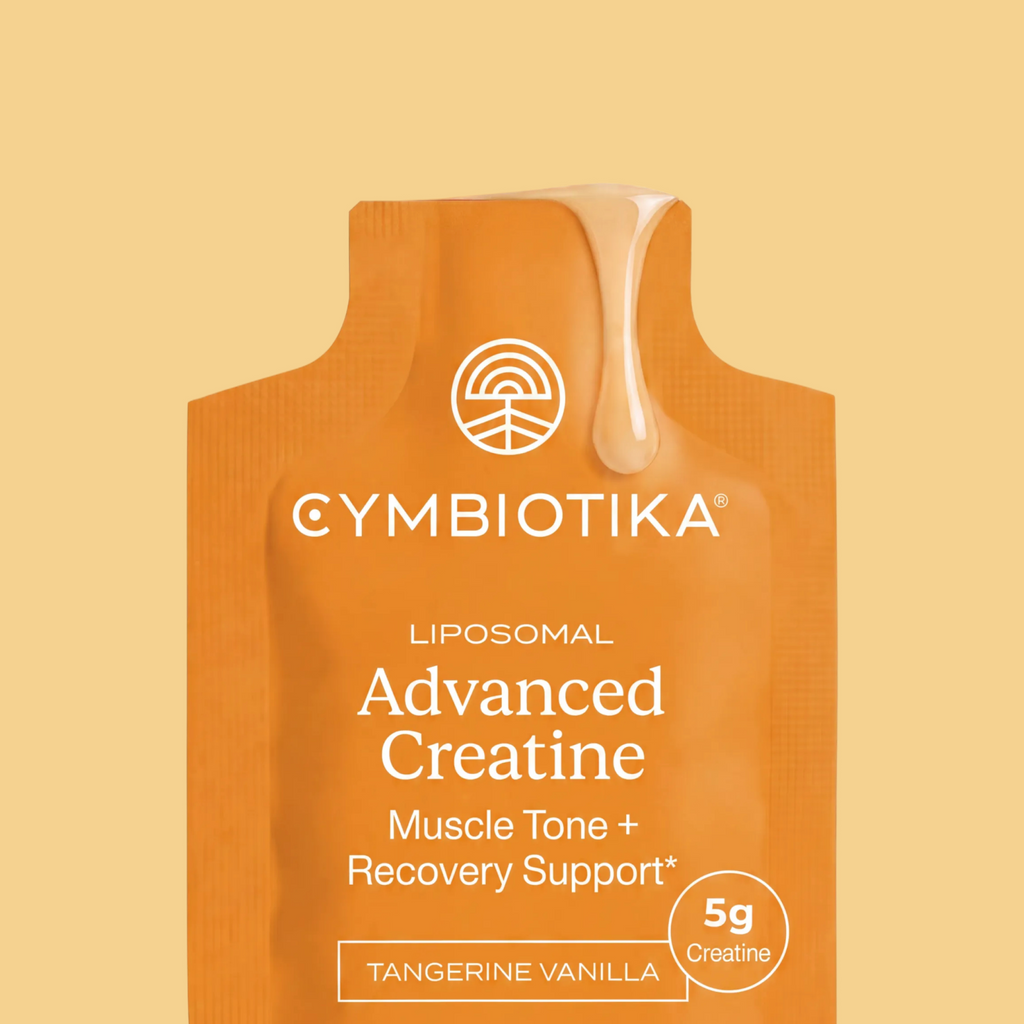
Creatine is the most studied supplement in sports nutrition. More than 500 human trials cover it, and the verdict on plain creatine monohydrate is settled: 3 to 5 g a day, taken alongside training, raises muscle creatine, adds strength and lean mass, and carries one of the best safety records of any supplement on the market. So the interesting question about Cymbiotika's Liposomal Advanced Creatine is not whether creatine works. It is whether a $2.71 liquid packet does anything a scoop of plain powder does not. The brand says yes, and puts numbers on it: 21% more creatine delivered, 15% better absorption, and a 9.8% greater cognitive improvement than standard creatine. I traced each number back to its source. The gap between what those numbers sound like and what they actually measure is the whole story of this product.
Disclosure: I'm affiliated with Cymbiotika, but I only recommend things I can actually stand behind so here's my honest breakdown.
The short answer
5 g of creatine monohydrate per packet is the right dose for muscle, and that part of this product is solid. The 21% and 15% figures come from 1 small study that measured creatine in blood after a single dose, using powdered test products rather than this liquid packet, and the differences were not statistically significant against plain monohydrate. The brain claims run into a dose problem: the trials that showed clearer thinking during sleep loss used 20 to 25 g in a single dose, 4 to 5 times what is in this packet. At 5 g a day, the brain evidence is thin, and in 2024 Europe's food safety authority concluded that a cause-and-effect link between creatine and better thinking has not been established. At $65 for a box of 24 packets, you are paying about 9 times the price of plain powder, mostly for convenience, taste, and a format you do not have to mix. If that matters to you, it is a fair trade. If you want the cheapest proven dose, it is not.
The research gap this product actually sits in
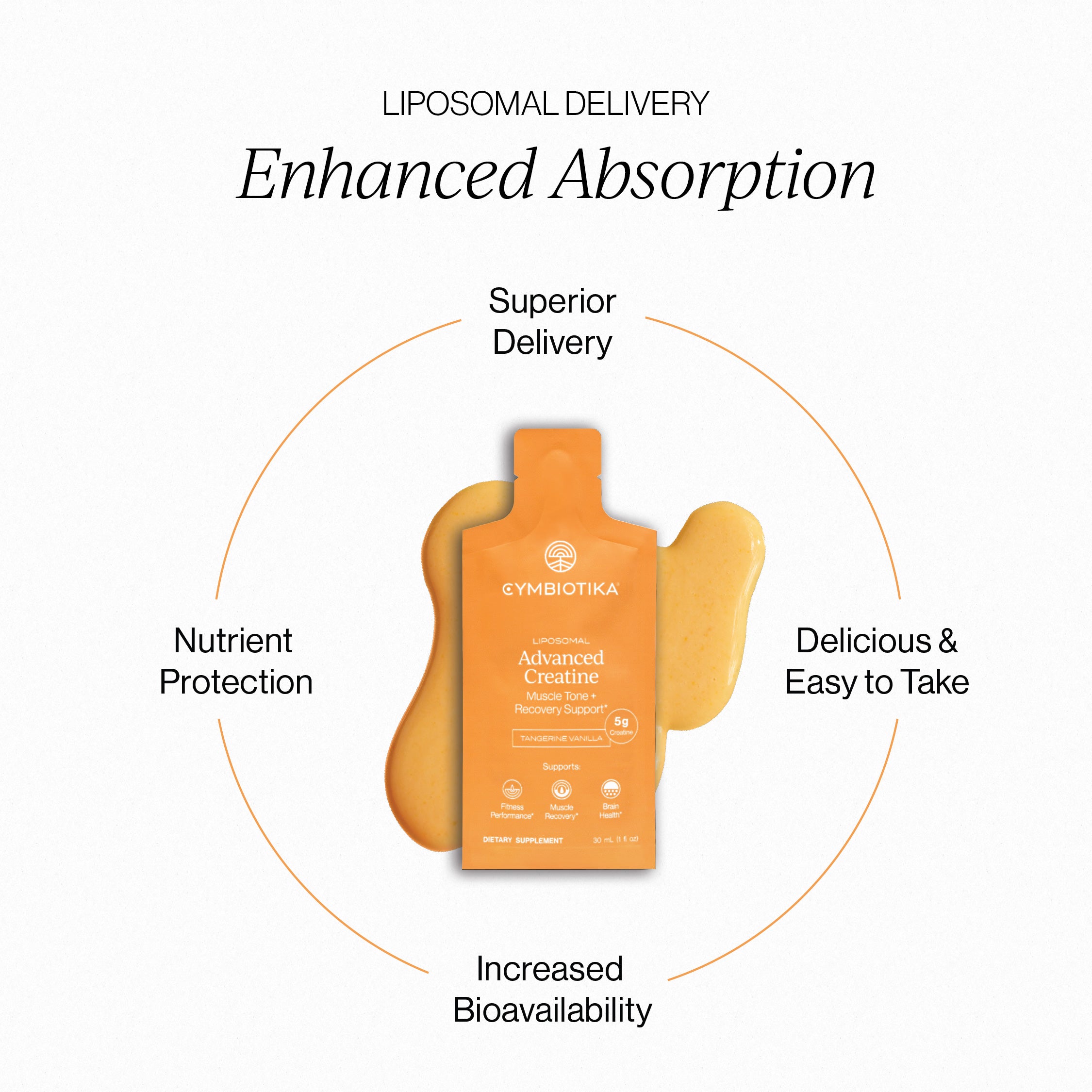
Here is the gap nobody in the creatine conversation talks about. Creatine itself is settled science. Delivery is not. No published trial has tested this liposomal liquid packet, or any liposomal creatine, against plain monohydrate for the outcomes that matter: muscle creatine levels, strength, lean mass, or thinking. The brand's absorption numbers come from blood levels after 1 dose, which is a long way from proving better results in the gym or in your head. Meanwhile the brain story is real but dose mismatched: the most exciting brain trials used single doses 4 to 5 times larger than this packet. So this review has 2 separate questions to answer, and they have different answers. Is 5 g the right dose for muscle? Yes. Does the liposomal format add anything proven? No, not yet.
What is in the packet
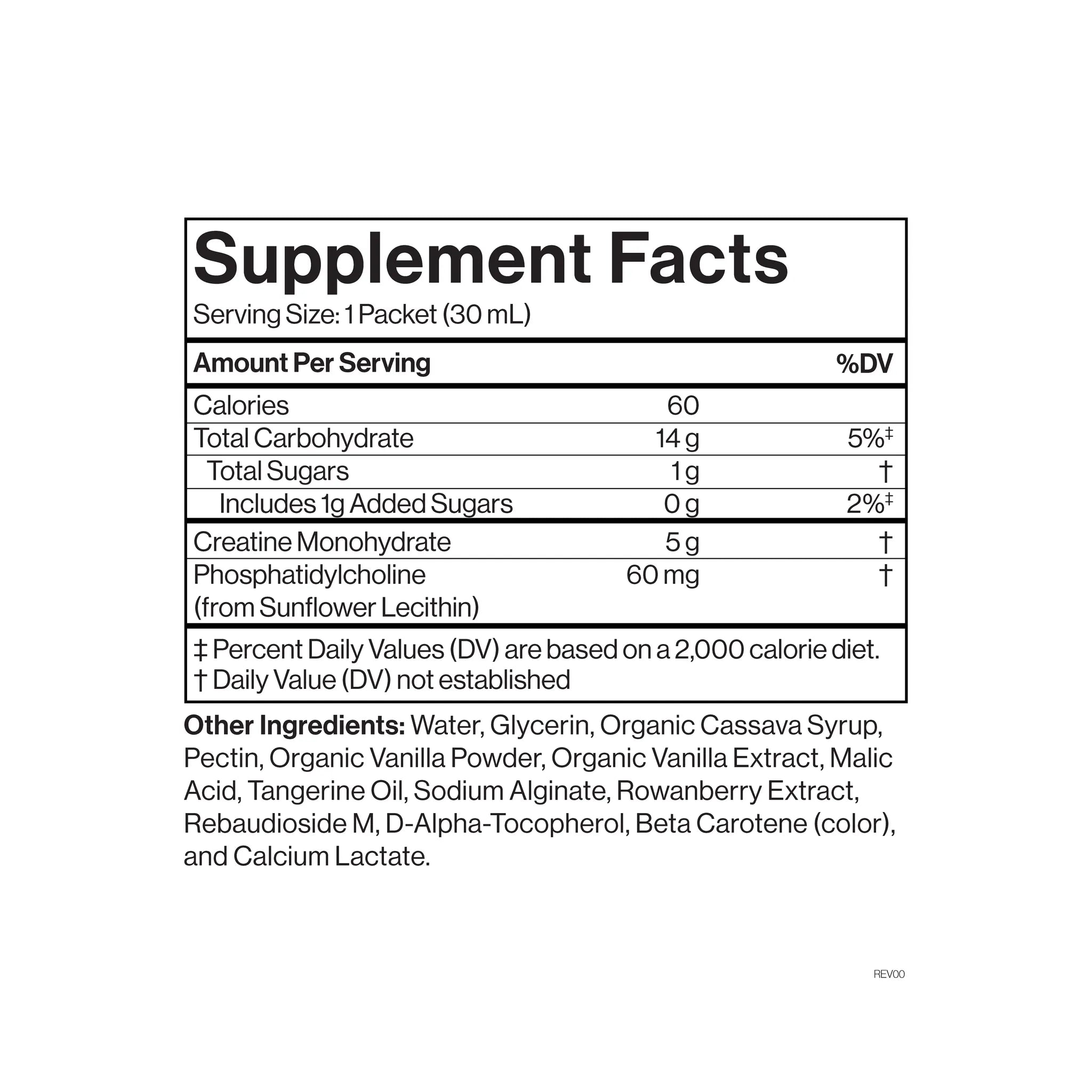
The label is refreshingly simple, and I verified every number against the Supplement Facts panel on cymbiotika.com on Nov 15, 2026. 1 packet is 30 mL, Tangerine Vanilla flavour, and contains 5 g of creatine monohydrate (as CreaBev) and 60 mg of phosphatidylcholine from sunflower lecithin. That is the whole active formula. It also has 60 calories, 14 g of carbohydrate, and 1 g of total sugars, with 0 g of added sugars. Other ingredients are water, glycerin, organic cassava syrup, pectin, organic vanilla powder, organic vanilla extract, malic acid, tangerine oil, sodium alginate, rowanberry extract, Rebaudioside M, D-Alpha-Tocopherol, beta carotene for colour, and calcium lactate. The brand says to squeeze the packet straight into your mouth or stir it into a drink, take it before exercise, and cycle 6 days on and 1 day off. No loading phase is needed. A box holds 24 packets, which the brand calls a 1 month supply, although on the 6 days on, 1 day off cycle, 24 packets last 28 days.
The 21% and 15% claims, traced to their source
The product page says each packet provides "21% more creatine and 15% better absorption compared to standard creatine." Those 2 numbers come from 1 study, and it is worth reading closely. Antonio and colleagues published it in Cureus in 2022. They enrolled 37 exercise-trained men, and 32 finished. Each man swallowed a single 5 g bolus of 1 of 3 things: plain creatine monohydrate, or 1 of 2 powdered investigational products called CreaBev 1 and CreaBev 2. The researchers then measured creatine in the blood over several hours. CreaBev 2 reached the highest peak blood level, 15.45 against 12.77 for plain monohydrate, which is about 21% higher. Its total exposure over time, the area under the curve, was 33.92 against 29.58, about 15% higher. Those are the 2 numbers on the product page.
What the page does not say is that the same paper reports no significant difference between CreaBev 2 and plain monohydrate on either measure. The only significant differences were between the 2 CreaBev formulas. With about 11 men per group, the study was too small to say whether a 21% gap in peak blood level was real or chance. And the other CreaBev formula, CreaBev 1, actually scored lower than plain monohydrate on both measures. Blood levels after 1 dose are also not the same as muscle creatine after weeks of use, and they say nothing about strength or performance, which the study did not measure. The test products were powders, not this liposomal liquid, so the study does not test the packet you would buy. It is also worth knowing that plain monohydrate is already absorbed almost completely, with about 99% of a dose taken up or excreted, according to a 2011 review of creatine forms. When absorption is already near total, there is very little room for a delivery system to improve it.
The page also claims "9.8% Greater Cognitive Improvement vs. Standard Creatine" and says CreaBev "demonstrated an 11.5% improvement in cognitive performance, about 10% greater than standard creatine." No study is cited for either number anywhere on the page, and I could not find a published CreaBev cognition trial. Until the brand shows its source, treat those 2 numbers as marketing copy, not evidence.
What 5 g does for muscle
This is the part of the product that needs no defending. The International Society of Sports Nutrition's 2017 position stand calls creatine monohydrate the most extensively studied and clinically effective form of creatine for muscle uptake and high-intensity exercise capacity. A 2024 meta-analysis of 12 randomized trials in adults under 50 found that creatine added to resistance training built 1.14 kg more lean mass than training alone, with 0.88 percentage points less body fat. The standard maintenance dose in the trials is 3 to 5 g a day, and this packet sits at the top of that range. If you train and you take 1 packet a day, you are getting a dose the evidence supports. The packet does not beat powder here. It matches it, at a higher price.
The brain story, and the dose gap
Creatine's brain story is the most interesting new chapter in this supplement, and it is also where this packet's dose stops matching the evidence. Your brain runs on the same phosphocreatine energy system as your muscles, but it takes up creatine slowly. Brain creatine rises only about 9 to 11%, against about 20% in muscle, and only at high doses. A 1999 imaging study found brain creatine up about 9% after 4 weeks at 20 g a day. A 2025 pilot in 20 Alzheimer's patients found an 11% rise after 8 weeks at 20 g a day, with better scores on several thinking tests, but it had no placebo group, so it proves very little on its own.
The strongest brain evidence comes from sleep loss. In a 2024 study in Scientific Reports, 15 volunteers stayed awake for 21 hours, then took a single dose of 0.35 g of creatine per kg of body weight, about 25 g for a 70 kg person. Creatine partly reversed the drop in memory and processing speed, with the effect peaking about 4 hours after the dose and lasting up to 9 hours. A 2026 follow-up from the same research group, in 29 people, used a smaller single dose of 0.20 g per kg, about 12 to 15 g, and still found up to 12% less deterioration in thinking speed. Both studies are small, and both used single doses far above 5 g. A 2024 meta-analysis of 16 randomized trials with 492 people found small improvements in memory and processing speed, with no significant effect on overall thinking or executive function, and the average trial enrolled only about 31 people. A 2023 meta-analysis found the memory benefit was large in adults aged 66 to 76 and essentially zero in people aged 11 to 31. In healthy young adults taking 10 or 20 g a day for 6 weeks, a 2023 trial of 30 people found no benefit at all. And in 2024, the European Food Safety Authority reviewed 23 human studies and concluded that a cause-and-effect relationship between creatine and improved cognitive function has not been established.
Put together, the pattern is clear. Creatine helps thinking most when the brain is under strain, from age or from lost sleep, and at doses far above a daily 5 g. A 5 g packet is a muscle dose, not a brain dose. The product page lists brain health, focus, concentration, and executive function among its benefits, but the trials behind those words used 4 to 5 times the creatine in this packet. I wrote more about the brain dose question in my earlier guide, Why 5g of Creatine Isn't Enough for Your Brain. For the women's angle, see Creatine for Women.
Safety and limitations
Creatine has the best safety record of any sports supplement, and the newest data is comprehensive. A 2025 analysis in the Journal of the International Society of Sports Nutrition reviewed 685 human trials with 12,839 people taking creatine and 13,452 taking placebo. Side effects were reported by 4.60% of the creatine group and 4.21% of the placebo group, a difference that was not statistically significant. Gut upset and muscle cramps were reported slightly more often in creatine groups, but not when counted per person. There was no signal for kidney or liver harm. That said, a few honest limits apply. Weight gain, mostly water, is real, averaging about 0.9 kg across 61 trials. Creatine raises blood creatinine, the marker labs use to estimate kidney filtration, by about 0.13 to 0.14 mg/dL, so the estimate reads lower even though filtration itself does not change. Tell your doctor you take creatine before kidney bloodwork. Large single doses can cause diarrhea: in 1 trial of soccer players, 55.6% of those taking 10 g at once reported it, against 28.6% taking two 5 g doses. Data are thin for pregnancy, breastfeeding, children, and people with kidney disease, and 4 cases of mania have been reported in people with bipolar disorder. Talk to your doctor first if any of those apply to you. Women are underrepresented in creatine trials, and the brand's claim that 5 g is the ideal dose for women through all life stages goes beyond what the trials prove. The brand's 6 days on, 1 day off cycle has no trial behind it: the studies used daily dosing. And creatine breaks down into creatinine in liquid over time, so a liquid packet depends on the brand's stability testing. Cymbiotika publishes a certificate of analysis for this product, which is good, but no independent published stability data for the packet appears on the page.
Price and value
Here is the honest math, from prices on cymbiotika.com on Nov 15, 2026. A box of 24 packets lists at $65, which is $2.71 a packet. A sitewide 20% off offer was live when I checked, bringing a 1-time purchase to $52, or $2.17 a packet. A first subscription box is $46.80, or $1.95 a packet, and renews at $58.50, or $2.44 a packet. A 90-day plan is $41.60 a box, or $1.73 a packet. The page shows a 4.8 out of 5 rating from 1,111 reviews, with free shipping and a 60-day money-back guarantee. A box lasts 28 days on the brand's cycling schedule, so a month costs about $70 at list price, or about $56 with the 20% offer. Compare that with plain creatine monohydrate powder, which typically costs roughly $0.30 per 5 g serving from a standard tub. At list price, the packet costs about 9 times as much per dose. What the extra money buys is real but narrow: no scooping, no shaker, no grit, a pleasant tangerine vanilla taste, and a packet you can carry anywhere. It does not buy proven extra absorption or better results. If you travel a lot, hate mixing powder, or struggle with the taste of plain creatine, the convenience may be worth it to you. If you mostly take creatine at home, powder gives you the same 5 g for a fraction of the price. There is no discount code for Cymbiotika. If you want to look at it, here is my affiliate link: https://shop.cymbiotika.com/SFVM9DY9.
The verdict
Cymbiotika Liposomal Advanced Creatine is a well-made convenience product with an honest dose and overstretched claims. The 5 g of CreaBev creatine monohydrate is exactly the dose the muscle evidence supports, the label is transparent, and the safety record of creatine at this dose is excellent. But the 21% and 15% absorption numbers come from 1 small blood-level study of powdered test products, where the gap against plain monohydrate was not statistically significant, and the brain benefits on the page rest on trials that used 4 to 5 times the dose in this packet. No trial has tested this liposomal packet against plain powder for muscle creatine, strength, or thinking. Buy it if you will genuinely use it more because it tastes good and needs no prep. Buy plain powder if you want the same 5 g for about a tenth of the price. Either way, pair it with training, because creatine amplifies what training does, it does not replace it. If you want to see the current offers on the tools I use, including Cymbiotika, browse the discount codes page.
FAQ
Is liposomal creatine better absorbed than regular creatine monohydrate?
Not proven. The only CreaBev study measured blood levels after 1 dose, found a 21% higher peak and 15% higher total exposure, but neither gap was statistically significant against plain monohydrate, and it used powdered test products, not the liquid packet. Plain monohydrate is already absorbed almost completely.
Is 5 g of creatine a day enough?
Yes, for muscle. 3 to 5 g a day is the standard maintenance dose in the trials, and 5 g sits at the top of that range. You do not need a loading phase.
Does creatine help focus and memory?
Possibly, but mostly when the brain is stressed by age or sleep loss, and the trials that showed it used 20 to 25 g in a single dose, far above the 5 g in this packet. Europe's food safety authority said in 2024 that the link is not established.
Do I need to cycle creatine 6 days on, 1 day off?
No trial tested that schedule. The studies used daily dosing. Cycling is the brand's suggestion, not an evidence-based requirement. A box lasts 28 days on that cycle, not 30.
Is creatine safe for my kidneys?
In healthy people, the largest safety review, 685 trials, found no kidney signal. Creatine does raise blood creatinine, so kidney lab estimates read lower. Talk to your doctor first if you have kidney disease.
Will creatine make me gain weight or bloat?
Weight gain, mostly water in the muscles, is common, averaging about 0.9 kg across trials. True bloating is less common at a 5 g dose. Gut upset is mostly a problem with large single doses of 10 g or more.
Is there a discount code for Cymbiotika Advanced Creatine?
No. There is no discount code for Cymbiotika. If you want to look at the product, my affiliate link is https://shop.cymbiotika.com/SFVM9DY9.
Sources
- Antonio J, Evans C, Jiannine L, et al. Pharmacokinetic evaluation of a single 5-gram bolus of creatine monohydrate versus two other creatine-containing investigational products. Cureus. 2022;14(4):e24395. doi:10.7759/cureus.24395
- Kreider RB, Kalman DS, Antonio J, et al. International Society of Sports Nutrition position stand: safety and efficacy of creatine supplementation in exercise, sport, and medicine. J Int Soc Sports Nutr. 2017;14:18.
- Jager R, Purpura M, Shao A, Inoue T, Kreider RB. Analysis of the efficacy, safety, and regulatory status of novel forms of creatine. Amino Acids. 2011;40:1369-1383.
- Xu C, Bi S, Zhang W, Luo L. The effects of creatine supplementation on cognitive function in adults: a systematic review and meta-analysis. Front Nutr. 2024.
- Prokopidis K, et al. Effects of creatine supplementation on memory in healthy individuals: a systematic review and meta-analysis of randomized controlled trials. Nutr Rev. 2023.
- Gordji-Nejad A, et al. Single dose creatine improves cognitive performance and induces changes in cerebral high energy phosphates during sleep deprivation. Sci Rep. 2024.
- Follow-up sleep deprivation trial from the same research group, 2026, 29 participants, single 0.20 g per kg dose, up to 12% less deterioration in thinking speed (reported in 2026 coverage).
- Creatine to Augment Bioenergetics in Alzheimer's (CABA) pilot trial, University of Kansas Medical Center, 2025. 20 patients, 20 g per day, 8 weeks, 11% rise in brain creatine, no placebo group.
- EFSA Panel on Nutrition, Novel Foods and Food Allergens (NDA). Creatine and improvement in cognitive function: evaluation of a health claim. EFSA J. 2024;22(11):e9100.
- Moriarty T, et al. The effects of creatine supplementation on cognitive performance in healthy young adults. Brain Sci. 2023. 30 participants, 10 or 20 g per day for 6 weeks, no benefit.
- Kreider RB, Gonzalez DE, Hines K, et al. Safety of creatine supplementation: analysis of the prevalence of reported side effects in clinical trials and adverse event reports. J Int Soc Sports Nutr. 2025;22(sup1):2488937. PMID 40198156.
- Dechent P, et al. Increase of total creatine in human brain after oral supplementation of creatine-monohydrate. Am J Physiol. 1999.
- 2024 meta-analysis of 12 randomized trials in adults under 50: creatine plus resistance training added 1.14 kg of lean mass versus training alone.
- Cymbiotika. Liposomal Advanced Creatine product page. Accessed Nov 15, 2026. https://cymbiotika.com/en-us/products/creatine
This article is for general information only and is not medical advice. Talk to your doctor before starting any supplement, especially if you have kidney disease, are pregnant or breastfeeding, take medication, or are under 18.