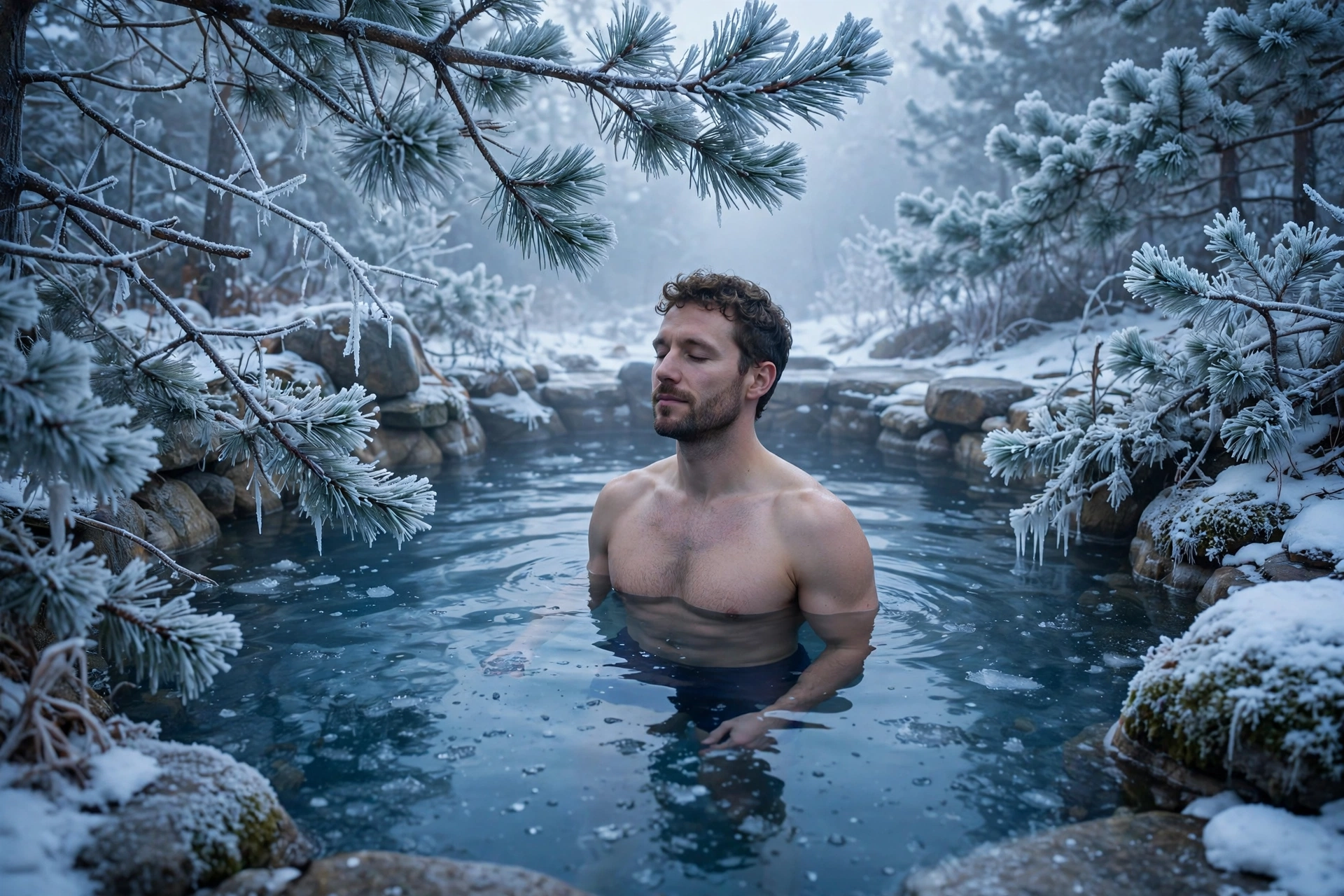
Cold exposure has been a biohacking staple for years: cold showers, ice baths, and cold plunges, usually justified with talk of resilience, recovery, and longevity. Until recently, though, a basic question was left unanswered — how would cold actually slow aging inside the body, rather than just making you feel tougher for a few minutes?
A new study published in Nature and reported by ScienceAlert on October 30, 2026, offers one concrete piece of that puzzle. Researchers at the University of Cologne, led by molecular biologist David Vilchez, traced a cold-triggered signalling pathway in roundworms that starts in muscle, travels through the body, and helps keep proteins in good shape as the animals age. It is an elegant finding — and it is also, for now, a worm and lab-cell finding, not a human prescription.
What the Researchers Actually Did
The team worked with Caenorhabditis elegans, a tiny roundworm widely used in aging research because its biology is well mapped and its lifespan is short enough to study in full. Scientists have known for more than a century that lower temperatures extend lifespan in animals including worms, flies, fish, and rodents. What they did not fully understand was the mechanism.
The older, simpler explanation was passive: cold slows everything down, so the animal ages more slowly, like food lasting longer in a fridge. Newer research has pushed against that idea, suggesting cold-induced longevity is actively regulated — the body switches on specific pathways in response to cold. This study set out to find one of those pathways, by looking at metabolites: small molecules produced by metabolic processes that can act as signals between tissues.
In experiments with C. elegans, exposure to moderately cold temperatures — 15 °C, or 59 °F, a temperature known to extend lifespan in these worms — increased production of an enzyme called CAT-4, largely in the worms' muscles. That enzyme, in turn, stimulated production of a metabolite called dihydrobiopterin, or BH2.
That is where the story gets interesting, because BH2 does not stay put. According to the researchers, BH2 is synthesized, stored, and then released by muscle tissue, travelling to other parts of the body. There it is converted into a bioactive molecule called tetrahydrobiopterin (BH4), which enables an enzyme called PAH-1 to produce the amino acid tyrosine.
In other words, muscle acts as a sender, and the rest of the body listens. Disrupting this pathway reduced the lifespan benefits seen in cold-exposed worms, which is the key evidence that the pathway is not just correlated with cold — it helps drive the effect, at least in worms.
Why Protein Clumping Matters
The pathway does more than nudge lifespan numbers. It also supports proteostasis — the healthy balance of making, folding, and clearing proteins inside cells. When that balance fails, damaged proteins clump together, and those clumps are a hallmark of several neurodegenerative diseases.
In a worm model of Huntington's disease, the cold-triggered pathway suppressed the aggregation of harmful proteins. And in separate experiments with human cells, the findings moved one step closer to human relevance, without crossing into human proof: cells engineered to develop proteins associated with Huntington's disease and amyotrophic lateral sclerosis (ALS) accumulated fewer abnormal proteins when supplemented with BH2. In another experiment, BH2 and tyrosine supplementation reduced signs of programmed cell death in human motor neurons carrying an ALS-associated mutation.
That combination — a whole-animal lifespan effect in worms, plus a protective effect in human cells in the lab — is why the study has drawn attention. It connects a whole-body practice (cold exposure) to a specific molecular chain (CAT-4 → BH2 → BH4 → tyrosine) to a cellular outcome that matters in aging and neurodegeneration (cleaner protein handling).
The Most Surprising Twist: Cold Might Not Be Required
Perhaps the most talked-about part of the study is what happened when the researchers bypassed cold altogether. By genetically boosting CAT-4 levels in the worms' muscles, they were able to extend the worms' lifespan even at normal or warmer temperatures.
Vilchez put it this way: "We were genuinely surprised to find the supplementation significantly extended lifespan, even at standard and warmer temperatures." The team added that further experiments on human cells encourage them to look for treatments that mimic the beneficial effects of cold without requiring changes in body temperature.
That is the seed of a future "cold-mimicking" therapy — but it is only a seed. A genetically boosted worm is not a pill, and a human cell in a dish is not a human body. The researchers themselves are clear that much more work is needed before anything like this could be safely transferred to people.
What This Does Not Prove
It is worth being precise here, because this is exactly the kind of study that gets flattened into a headline like "cold makes you live longer" or "scientists find a longevity molecule."
Here is what the study does not show:
- It does not show that cold plunges extend human lifespan. No humans were put in cold water in this study. The lifespan data come from worms, and the human data come from cells in a lab.
- It does not show that taking BH2 works. BH2 is not a supplement you should go looking for. The human-cell experiments used controlled laboratory conditions, and the safety of manipulating this pathway in a living person is unknown.
- It does not show that more cold is better. The worms were kept at a moderately cold temperature, not frozen. In humans, extreme or prolonged cold carries real risks, including hypothermia and cardiac strain, especially for people with heart conditions.
- It does not prove that this pathway is the whole story of cold and aging. The researchers describe a mechanism that contributes to cold's effect. Aging is driven by many overlapping processes, and cold almost certainly acts through more than one.
In short: the study identifies a real, testable pathway. It does not rewrite cold-exposure advice, and it does not license a new supplement.
What It Means for Your Cold Practice
If you already use cold exposure, this study does not change the sensible version of the practice — but it does sharpen how to think about it:
1. Think "moderate and consistent," not "extreme"
The worm finding came from moderately cold conditions, sustained over time, not from a single punishing shock. That fits with how most sensible cold protocols already work: brief, regular, controlled exposure that you can repeat, rather than the coldest, longest session you can endure.
2. Muscle may matter more than we thought
Because the pathway starts in muscle, it raises an interesting question for future research: does muscle mass or muscle activity change how the body responds to cold? The study does not answer that, and it would be wrong to claim that building muscle "activates BH2" in humans. But it is a reason to watch this line of research, and a reminder that cold, exercise, and muscle health are not separate systems — they talk to each other.
3. Keep the basics in view
Cold exposure is an acute stressor, and stress only helps when recovery follows. That is the same logic behind tracking recovery signals like heart rate variability: push on one day, recover on the next, and watch the trend rather than chasing a single session. If you are new to cold water, start gently — our cold plunge at home guide covers how to begin safely — and skip intense protocols when you are ill, exhausted, or already run down.
4. Do not try to shortcut it with a molecule
There is no verified BH2 supplement, no dose, and no human safety data behind taking one. Anyone selling a "cold-mimicking" or "BH2-boosting" product on the back of this study is getting ahead of the science by years. The honest version of this story is that researchers have found a pathway worth studying, not a product worth buying.
Why This Study Matters Anyway
Even with those limits, this is a genuinely useful study for the longevity field, for three reasons.
First, it moves cold research from vague "cold is good for you" claims toward a specific, falsifiable mechanism. A pathway with named molecules — CAT-4, BH2, BH4, tyrosine — can be tested, blocked, boosted, and eventually, if the evidence holds up in mammals, explored as a drug target.
Second, it reinforces the idea that aging is not just wear and tear. If a single tissue (muscle) can send a signal that protects the whole organism, then targeted, tissue-specific therapies become more plausible — you may not need to change the whole body to protect it.
Third, it connects two worlds that are often kept apart: lifestyle practices (cold exposure, exercise) and molecular medicine (protein quality control, neurodegeneration). The same pathway that responds to temperature also shows up in models of Huntington's and ALS. That overlap is where the next round of research is likely to go.
Frequently Asked Questions
Does this study prove cold plunges make you live longer?
No. It shows that moderately cold temperatures extend lifespan in roundworms through a specific BH2 pathway, and that BH2 protects human cells in the lab. Human lifespan effects have not been shown.
What is BH2?
BH2 (dihydrobiopterin) is a metabolite — a small molecule produced during metabolism. In this study, cold increased its production in worm muscle via the enzyme CAT-4. BH2 travels to other tissues, where it is converted into BH4, which helps produce the amino acid tyrosine.
Should I take a BH2 or tyrosine supplement because of this study?
No. There is no human evidence, dose, or safety data for BH2 supplementation from this study, and tyrosine was studied in worms and lab cells, not as a human longevity intervention. Do not buy a product marketed on this study.
Is cold exposure safe for everyone?
No. Cold water immersion can strain the heart and breathing, especially on sudden entry, and it is riskier for people with cardiovascular conditions, breathing problems, or other medical issues. Check with a healthcare professional before starting, enter gradually, never plunge alone, and get out if you feel dizzy, numb, or unwell.
How does this relate to HRV and recovery?
Cold exposure is a stressor, so it affects the nervous system and recovery in the short term. Tracking a recovery signal such as heart rate variability can help you judge whether you are adapting or overdoing it — see our guide on what HRV is and how to improve it.
The Bottom Line
A new Nature study has given cold exposure something it long lacked: a named molecular pathway. Moderately cold temperatures switch on CAT-4 in worm muscle, raising BH2, which travels through the body, becomes BH4, and supports tyrosine production and healthier protein handling. Boosting that pathway extended worm lifespan even without cold, and BH2 protected human lab cells from disease-related protein clumps.
That is a real advance — and a long way from a human treatment. The right response is curiosity, not a shopping list: keep cold practice moderate, consistent, and safe, watch this research as it moves (or does not move) into mammals and people, and be sceptical of anyone selling you the molecule before the science arrives.
Looking for tools that support recovery, cold exposure, and training? Browse the current offers on our discount codes page.
This article is for general information only and is not medical advice. Cold water immersion carries risks, and this study involved worms and laboratory cells, not human patients. If you have a medical condition or are considering a new cold-exposure routine, talk to a qualified healthcare professional first.