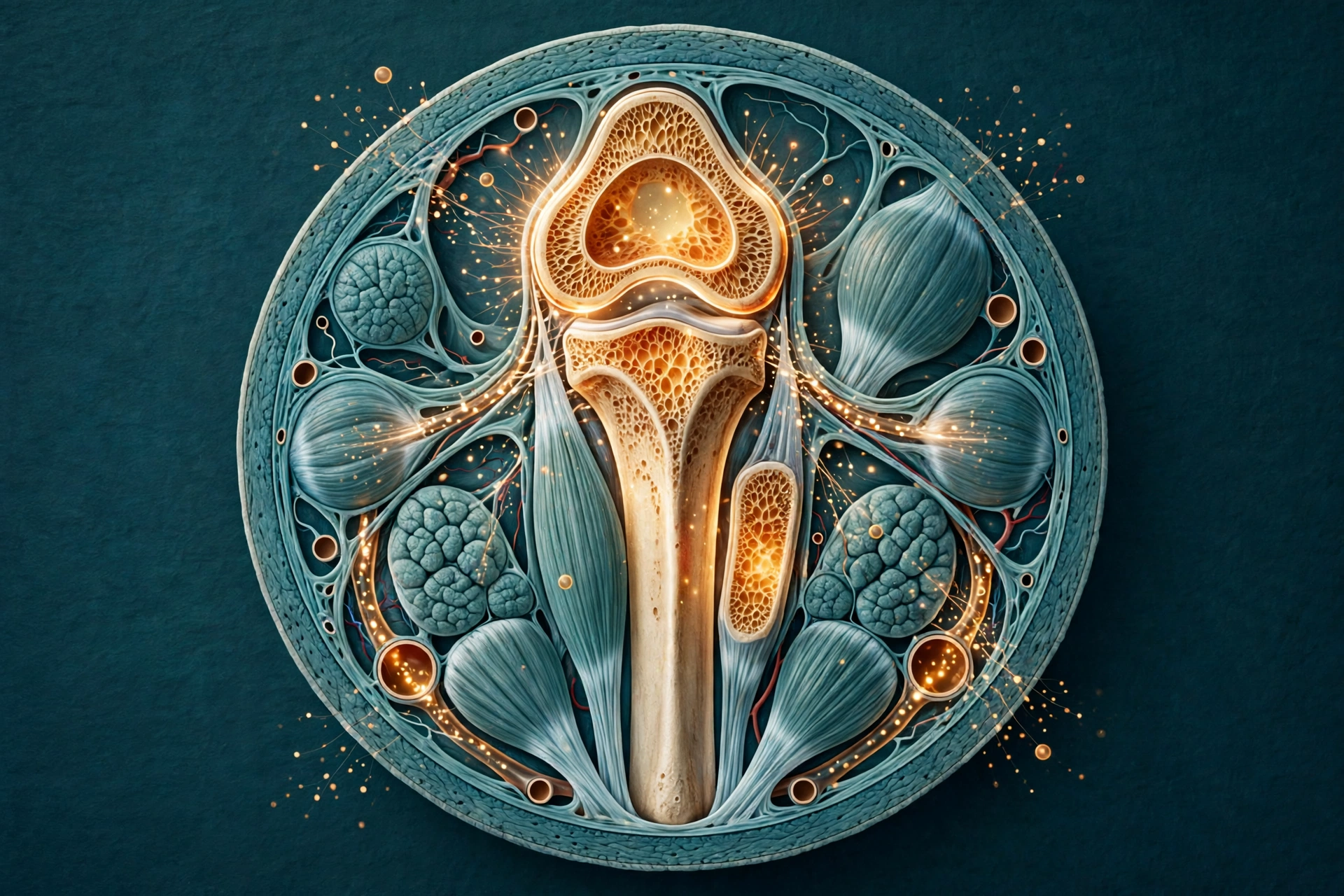
Your bones do far more than hold you up. They make new blood cells, store calcium, and — according to a study published this week in the journal Cell Metabolism — they may also act as a chemical factory that helps the rest of your body age more slowly when they are put under gentle mechanical load.
The research, led by scientists at Southern Medical University in Guangzhou, China, found that repeatedly applying a tiny, rhythmic load to the shinbones of elderly mice improved their strength, coordination, and memory, and extended their median lifespan by 9.4% — around 80 days. The work points to a pressure-sensing channel in bone cells, called PIEZO1, and a circulating protein, PEDF, as key players in a previously underappreciated link between mechanical loading and aging.
It is an animal study, and it is a long way from a human treatment. But it offers a fresh, testable explanation for something we already know: staying physically active as we age protects far more than our muscles.
What the Researchers Did
The study centers on osteocytes, a type of bone cell that senses mechanical forces. These cells use a pressure-sensitive channel called PIEZO1 to help bones adapt to physical exertion — the same kind of channel that lets cells detect touch and pressure elsewhere in the body.
The team first asked what happens when that sensing system breaks down. They found that PIEZO1 levels decline with age in both mouse and human bone. Then they chemically destroyed the channel in the osteocytes of adult mice. The result was striking: signs of aging accelerated far beyond the skeleton, affecting the brain, liver, and muscles. Median lifespan fell by roughly 11% in females and 13% in males.
That raised the opposite question: if losing the signal speeds aging up, could stimulating it slow aging down?
To test that, the researchers used a device to rhythmically apply a tiny load to the shinbones of anaesthetized mice, starting when the animals were a relatively old 20 months. The loading was gentle — the point was to activate the bone's mechanical sensors, not to stress the animals.
The Results
The treated mice did not just live longer. They aged better across the board:
- Longer life. Median lifespan rose by an average of 9.4%, or around 80 days, compared with untreated mice.
- Better movement and memory. Treated mice showed improved strength, coordination, and performance on memory tests.
- Better metabolic health. The treatment improved blood sugar regulation and bone structure.
- Less cellular aging. Markers of inflammation and senescence — the accumulation of worn-out cells that stop dividing but refuse to die — were reduced in several organs.
- A younger immune system. The treatment returned the aging immune system to a more youthful state, including changes to the bone marrow's blood-producing tissues.
Perhaps the most telling experiment came next. When the researchers transferred blood plasma from treated mice into other old mice, the recipients also showed benefits. That strongly suggested something circulating in the blood was carrying the effect from the loaded bones to the rest of the body.
The Mechanism: PIEZO1 and PEDF
The team identified a promising candidate messenger: pigment epithelium-derived factor, or PEDF, a protein with protective effects in multiple tissues. Bone loading boosted PEDF's circulating levels, and when the researchers injected the protein into older mice, it reduced several signs of aging and improved cognitive and physical performance.
The chain of logic is now reasonably clear, at least in mice. Mechanical load activates PIEZO1 in osteocytes. The bone cells respond by releasing signals — PEDF among them — into the bloodstream. Those signals then protect tissues well beyond the skeleton, from the brain to the liver to the immune system.
This fits with a growing theme in aging research: the systems that move us also maintain us. Muscles, for example, release their own chemical signals during exercise that benefit other organs. This study suggests bones belong in that same conversation — not just as structural scaffolding, but as an active endocrine-like tissue that talks to the rest of the body.
It also helps explain why the benefits of exercise are so broad. If loading the skeleton triggers protective signals throughout the body, then activities that put mechanical stress on bones — walking, running, resistance training, jumping — may be doing more than building muscle and bone density. They may be switching on a whole-body maintenance program.
What This Does Not Prove
A study this eye-catching needs its limits stated plainly:
- It was done in mice, not people. The lifespan extension, the memory improvements, and the immune changes were all measured in elderly mice. Nothing in this study tests whether bone loading extends human life, let alone by a comparable amount.
- PEDF is a candidate, not a proven cause. The researchers themselves acknowledge they have not established whether PEDF is essential to the loading treatment's effects. Other proteins, immune changes, and signalling pathways could also be responsible. PEDF injections helped older mice, but that is not the same as proving PEDF is the mechanism behind the loading benefit.
- Human PEDF data are limited. We do know that PEDF levels in human blood tend to drop significantly as we grow older, and that the protein appears to protect laboratory-grown human cartilage from experimentally induced damage. That is suggestive, not conclusive — a long way from evidence that raising PEDF keeps people younger.
- A shinbone squeeze is not exercise. The treatment was a controlled, rhythmic load applied to one bone in anaesthetized animals. It does not reproduce everything a walk, a swim, or a strength session does for a human body. The study does not show that a specific exercise, device, or routine delivers the same effect in people.
- There is no product here. No device, supplement, or treatment based on this research exists for humans. Any company claiming to sell "bone loading for longevity" on the back of this paper would be getting far ahead of the science.
In short: the study establishes a new, plausible mechanism in mice — mechanical loading of bone triggers protective signals that slow aging across multiple organs — and it identifies PEDF as a lead worth investigating. It does not establish a human intervention.
Practical Takeaways
The honest takeaway is not "go squeeze your shinbones." It is something the evidence already supports, now with a new mechanism behind it: weight-bearing movement matters, and it matters for more than your bones.
Walking, running, hiking, resistance training, and other activities that load the skeleton are already among the best-supported habits for healthy aging in humans. This study adds a reason why their benefits may run so deep — the skeleton itself may be broadcasting protective signals when it is worked. That is a useful frame for thinking about exercise, but it does not change the prescription: move regularly, load your bones through normal activity, and do not wait for a device or a drug based on this research, because neither exists yet.
For researchers, the next steps are clear: test whether the PIEZO1–PEDF pathway works the same way in people, find out whether PEDF is truly essential to the effect, and explore whether the pathway could eventually help people whose illness or limited mobility makes exercise difficult. Those are the people who would benefit most if a bone-loading signal could one day be delivered without the loading itself.
For more on how movement and recovery support healthy aging, see our guide to the best recovery tech of 2026.
FAQ
What did the new study find?
Researchers at Southern Medical University in Guangzhou found that repeatedly applying gentle, rhythmic pressure to the shinbones of 20-month-old mice extended median lifespan by 9.4% (around 80 days) and improved strength, coordination, memory, blood sugar regulation, and bone structure, while reducing markers of inflammation and cellular senescence in several organs.
What is PIEZO1?
PIEZO1 is a pressure-sensitive channel found in cells, including osteocytes — the bone cells that detect mechanical forces. It helps bones adapt to physical exertion. The study found PIEZO1 levels decline with age in both mouse and human bone, and destroying the channel in adult mouse osteocytes accelerated aging and shortened median lifespan by roughly 11% in females and 13% in males.
What is PEDF?
PEDF (pigment epithelium-derived factor) is a protein with protective effects in multiple tissues. Bone loading boosted its circulating levels in the mice, and injections of PEDF reduced several signs of aging and improved cognitive and physical performance in older mice. It is a leading candidate for the messenger that carries the benefit from loaded bones to the rest of the body — but the researchers have not proven it is essential to the effect.
Does this mean squeezing my bones will make me live longer?
No. The study was done in mice, using a controlled device on anaesthetized animals. It did not test whether bone loading extends human life, and there is no device or treatment based on this research available for people. The practical implication is the familiar one: weight-bearing exercise that loads the skeleton is good for healthy aging, now with a new mechanism that may help explain why.
How was the study published?
The research was published in the journal Cell Metabolism and reported by Science magazine and New Atlas on November 6, 2026.
Could this help people who cannot exercise?
That is one of the most interesting possibilities the researchers raise. If the protective signals triggered by bone loading could eventually be delivered without the loading itself, it might help people whose illness or limited mobility makes exercise difficult. That is a long-term research goal, not a current treatment.
The Bottom Line
A new Cell Metabolism study shows that gentle, repeated loading of the shinbones of elderly mice extended median lifespan by 9.4% and improved strength, memory, metabolism, and immune function — apparently by activating the PIEZO1 pressure sensor in bone cells and raising circulating levels of the protective protein PEDF. The mechanism is new and compelling, and it reframes the skeleton as an active participant in healthy aging rather than passive scaffolding. But it is mouse evidence, PEDF's role is not yet proven essential, and no human intervention exists. The takeaway for now is the one we already knew, strengthened: keep moving, and let your bones do some of the work.
Looking for tools that support healthy aging, recovery, and training? Browse the current offers on our discount codes page.
This article is for general information only and is not medical advice. It reports on a published study and does not recommend any exercise program, device, supplement, or treatment. If you have a medical condition, take medication, or are considering a new exercise routine, talk to a qualified healthcare professional first.