Muscle loss with age is usually talked about as a muscle problem: use it or lose it, eat enough protein, lift weights. A study published in Cell Metabolism suggests the picture is wider than that. Researchers found that a compound from aged garlic extract strengthened aging muscles in mice — not by acting on muscle at all, but by setting off a chain reaction that ran from fat tissue, through the brain, and back to muscle.
The compound is S-1-propenyl-L-cysteine, or S1PC, a sulfur-containing amino acid found in aged garlic extract. The study, led by researchers at Wakunaga Pharmaceutical and the Institute for Research on Productive Aging in Tokyo, with senior author Shin-Ichiro Imai of Washington University, was published online on May 7, 2026, and it reached mainstream wellness coverage this week when mindbodygreen reported on it on November 3, 2026. A small human study in the same paper found that a single dose of S1PC raised blood levels of a key NAD+-related protein in middle-aged adults — an early signal, not proof of stronger muscles in people.
It is a striking result, and a good example of how longevity science is shifting: away from single-organ fixes and toward the communication networks between organs.
Why NAD+ and Muscle Matter Here
NAD+ is a molecule every cell uses to produce energy and repair DNA. Its levels fall with age, and that decline is linked to muscle loss, metabolic slowdown, and frailty. That is why NAD+ boosters such as NMN and NR have become household names in the longevity world.
But the body does not make NAD+ in one place and ship it everywhere. It relies on an enzyme called NAMPT, and on its extracellular form, eNAMPT, which circulates in the blood and helps tissues maintain their NAD+ supply. Previous research from Imai's group has shown that eNAMPT levels fall with age, and that restoring them can improve aspects of health in old mice.
This study asked a different question: can a food-derived compound raise eNAMPT naturally — and if so, does that actually help aging muscle?
The Study: Fat to Brain to Muscle
The researchers worked through the mechanism step by step, in cell cultures and in aged mice, before testing S1PC in people.
First, they showed that S1PC activates an enzyme called LKB1 in white fat tissue, by helping it form a protein complex with two partners, STRAD and MO25. That activation switches on SIRT1, a well-known longevity-linked protein, which in turn triggers fat cells to release eNAMPT — packaged inside tiny extracellular vesicles — into the bloodstream.
Here is where the story takes its unexpected turn. The eNAMPT released from fat did not travel to muscle. It travelled to the hypothalamus, the small region deep in the brain that regulates metabolism, body temperature, and nervous-system activity. From there, the signal was relayed through the sympathetic nervous system — the branch that governs the body's "fight or flight" responses — and on to skeletal muscle.
The pathway, in short, looked like this: aged garlic compound → fat tissue → brain → muscle.
Stronger Muscles, Lower Frailty — in Mice
After eight months of S1PC treatment, aged mice showed measurable improvements compared with untreated mice of the same age:
- Stronger muscle force in electrical stimulation tests, and better grip strength.
- Lower frailty scores, a composite measure of age-related decline.
- Restored core body temperature, which tends to fall with age.
- Higher levels of proteins involved in energy production within muscle tissue.
One detail is especially telling: the mice's muscles did not get bigger. The benefit was in muscle quality and function, not muscle growth — the kind of improvement that matters most for staying mobile and independent in later life, where strength and coordination decline faster than muscle size alone would predict.
To confirm the mechanism, the researchers showed that the effect depended on the fat-to-brain relay. When the hypothalamic signalling step was disrupted, the muscle benefit disappeared — evidence that this was not a direct effect on muscle, but a genuine case of organs talking to each other.
What Happened in People
The human part of the study was small and short, and it should be read as a first signal rather than a result. In a randomized, placebo-controlled study in healthy adults aged 20 to 49, participants took a single 25 mg tablet of S1PC. Among participants aged 40 and older who maintained a healthy body weight and body-fat level, circulating eNAMPT levels rose significantly at 120 minutes after the dose, compared with placebo.
Two important details came out of that human test:
- It only worked in people with healthy fat mass. Participants who were significantly underweight did not show the same eNAMPT response — which makes sense, given that the pathway starts in fat tissue. The compound appears to need a minimum amount of healthy fat to act on.
- No muscle outcomes were measured in people. The human study tested a single acute dose and measured a blood marker. It did not test muscle strength, mobility, or frailty over time, so it cannot tell us whether the muscle benefits seen in mice translate to people.
In other words, the human data show that at least part of the fat-to-brain pathway responds to S1PC in people. They do not show that taking S1PC makes anyone stronger.
What This Does Not Prove
A study this interesting needs its limits stated plainly:
- The muscle benefits were shown in mice, not people. Eight months of treatment improved strength and frailty in aged mice. No long-term human trial has tested whether S1PC improves muscle function or healthspan.
- The human evidence is a single-dose biomarker signal. One 25 mg dose raised eNAMPT at two hours in middle-aged adults with healthy body fat. That is a long way from a proven functional benefit, and there is no established long-term dose for people.
- Aged garlic extract is not raw garlic. S1PC is concentrated in aged garlic extract, a specific preparation. This study says nothing about eating raw garlic, garlic powder, or ordinary garlic supplements, which contain different compounds in different amounts.
- There is an industry link worth knowing. Several authors work for Wakunaga Pharmaceutical, a company that makes aged garlic extract products. That does not invalidate the findings — the work was published in a peer-reviewed journal, and the mechanism was tested with control experiments — but it is relevant context when weighing the results.
- It is not a replacement for the fundamentals. Nothing in this study suggests a garlic compound can substitute for resistance training, adequate protein, sleep, and metabolic health — the interventions with proven effects on muscle aging in humans.
Why It Still Matters
Even with those caveats, the study is worth paying attention to for three reasons.
First, it identifies a new, food-derived way to influence the NAD+ system. Most NAD+ strategies today rely on direct precursors such as NMN or NR. S1PC works upstream, nudging the body's own eNAMPT production — a different lever on the same system, and one that may interact with the others in ways future research can explore.
Second, it strengthens the case that muscle aging is a whole-body problem. The idea that fat tissue talks to the brain, and the brain talks to muscle, reframes sarcopenia — age-related muscle loss — as a failure of communication between organs, not just a failure of muscle itself. That opens up new targets: if the signalling network can be supported, muscle may follow.
Third, it fits a pattern emerging across longevity research in 2026. The year's notable findings — a senolytic mineral compound, a directly druggable energy sensor, a DNA-repair protein that slowed aging in progeria mice, and now a food compound acting through inter-organ signalling — all point in the same direction: aging is increasingly understood as a set of measurable, targetable processes, and the interventions of the future may work through the body's own networks rather than on single tissues.
Practical Takeaways While the Science Catches Up
No one should start taking S1PC supplements on the basis of this study. There is no long-term human data, no established dose, and no evidence yet of a functional benefit in people. But the study reinforces several evidence-based strategies that support the same systems it highlights:
- Resistance training. The most proven way to preserve muscle strength and function with age. It also improves metabolic health and supports the NAD+ system through increased energy demand.
- Maintain a healthy body composition. The human study's clearest practical hint is that the S1PC pathway depends on having healthy fat tissue — neither too little nor, by extension, metabolically unhealthy excess. Body composition matters for how these signalling pathways work.
- Prioritize sleep and metabolic health. NAD+ levels, SIRT1 activity, and hypothalamic signalling are all sensitive to sleep quality, circadian rhythm, and blood-sugar control.
- Eat a varied, plant-rich diet. Aged garlic extract is one source of S1PC, but the broader lesson is that food-derived compounds can influence aging pathways in measurable ways — one more reason a diverse diet rich in plant compounds is a reasonable foundation.
The fundamentals remain the most reliable tools for muscle aging. This study adds a fascinating new thread to follow — and a reminder that the body's systems are more connected than the supplement aisle suggests.
FAQ
What did the new study find?
Researchers from Wakunaga Pharmaceutical and the Institute for Research on Productive Aging in Tokyo, with senior author Shin-Ichiro Imai of Washington University, found that S1PC, a compound in aged garlic extract, activates the LKB1–SIRT1 pathway in fat tissue, causing fat cells to release eNAMPT, a key NAD+-related enzyme. The eNAMPT travels to the hypothalamus, and the resulting brain-to-muscle signal improved muscle strength and lowered frailty in aged mice. The study was published in Cell Metabolism (2026;38(6):1218–1228.e10, DOI: 10.1016/j.cmet.2026.04.006).
What is S1PC, and is it the same as eating garlic?
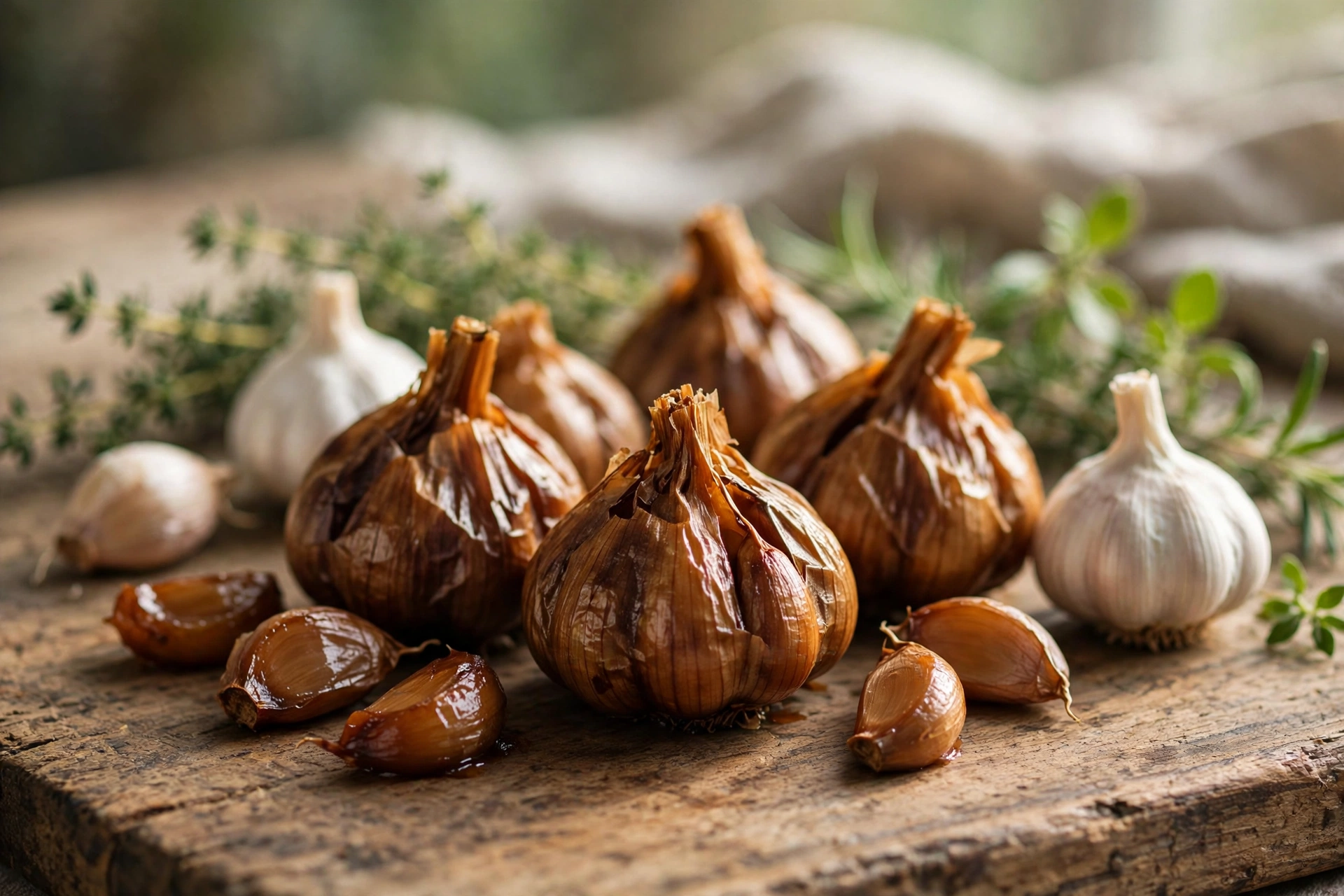
S1PC (S-1-propenyl-L-cysteine) is a sulfur-containing amino acid concentrated in aged garlic extract, a specific preparation in which garlic is aged over time. It is not the same as raw garlic or ordinary garlic powder, which contain different compounds in different amounts. The study tested S1PC itself, not dietary garlic.
How did a garlic compound help muscles without acting on muscle?
S1PC activated LKB1 in white fat tissue, triggering the release of eNAMPT in extracellular vesicles. The eNAMPT travelled through the blood to the hypothalamus in the brain, which then signalled to skeletal muscle through the sympathetic nervous system. When the researchers disrupted the hypothalamic step, the muscle benefit disappeared.
Did the study test S1PC in people?
Yes, in a small way. In a randomized, placebo-controlled study in healthy adults aged 20 to 49, a single 25 mg dose of S1PC raised circulating eNAMPT levels at 120 minutes in participants aged 40 and older with healthy body weight and body fat. The study did not measure muscle strength, mobility, or any long-term outcome in people.
Why did the human response depend on body fat?
The pathway starts in fat tissue: S1PC acts on white adipose tissue to trigger eNAMPT release. Participants who were significantly underweight did not show the same eNAMPT rise, suggesting the compound needs a minimum level of healthy fat tissue to work.
Should I take an aged garlic or S1PC supplement for muscle aging?
There is no evidence yet that S1PC improves muscle function in people, and no established long-term dose. Resistance training, adequate protein, sleep, and metabolic health remain the proven ways to support muscle aging. If you are considering any new supplement, talk to a qualified healthcare professional first — especially if you take medication, as garlic preparations can interact with blood-thinning drugs.
What is eNAMPT, and why does it matter for longevity?
eNAMPT (extracellular nicotinamide phosphoribosyltransferase) is an enzyme that helps tissues maintain NAD+, a molecule essential for energy production and DNA repair that declines with age. Restoring eNAMPT has improved aspects of health in old mice in prior research, making it a target of growing interest in aging science.
The Bottom Line
A Cell Metabolism study found that S1PC, a compound in aged garlic extract, set off a fat-to-brain-to-muscle relay that improved strength and lowered frailty in aged mice — without increasing muscle size — by raising eNAMPT, a key NAD+ enzyme. A small human test showed the same pathway responds to a single dose in middle-aged adults with healthy body fat, but it measured a blood marker, not muscle function. It is early, mouse-led evidence with an honest industry link to disclose, and it says nothing about eating raw garlic. What it does offer is a new way of thinking about muscle aging: not as a muscle-only problem, but as a conversation between fat, brain, and muscle — and one more reason the fundamentals of strength training, body composition, and metabolic health remain the best-supported strategy while the science catches up.
Looking for tools that support healthy aging and recovery? Browse the current offers on our discount codes page.
This article is for general information only and is not medical advice. It reports on a published study and does not recommend any supplement, dose, or treatment. S1PC has no established long-term dose in people, and garlic preparations can interact with blood-thinning medication. If you have a medical condition, take medication, or are considering any new supplement, talk to a qualified healthcare professional first.